
Aug
Part 1 — The Woman Who Vanished
The first time I met Cara, she was sitting in my seat.
It was the first week of college, and the sociology lecture hall was so crowded that students were standing along the walls. I arrived carrying a notebook, two pens, and the certainty that the seat I had used all week belonged to me.
Cara apparently disagreed.
When I stopped beside her, she glanced at my notebook and smiled.
“You can sit next to me,” she said, “but only if your notes are actually worth copying.”
I should have been annoyed.
Instead, I laughed and sat down.
By the time the lecture ended, I already wanted to know everything about her.
Cara was fearless in ways I wasn’t. She spoke to strangers as if she’d known them for years, challenged professors when she thought they were wrong, and could turn an ordinary trip to the grocery store into an adventure.
Within months, we were inseparable.
For three years, we became the kind of college couple everyone recognized. We studied at the same library table, ruined countless dinners while teaching ourselves how to cook, and spent Sunday mornings fighting over crossword puzzles.
She dreamed about someday owning an aging house with green shutters and a garden full of flowers.
I dreamed about seeing the world.
Graduate school.
Research.
Europe.
A career that might take me from one country to another.
Back then, neither of us thought those dreams competed with each other.
We believed love would somehow make room for everything.
Then came the conversation that changed our lives.
I had recently been accepted into graduate school. One evening, while we were cleaning up after dinner, Cara asked what I imagined happening after graduation.
I talked enthusiastically about research opportunities, travel, maybe another degree.
Cara stood near the sink, twisting a dish towel between her hands.
Then she asked something that seemed simple at the time.
“When do you think you’d want children?”
I gave an awkward laugh.
“Not anytime soon.”
Her expression changed.
I continued without noticing.
“Probably years from now. There’s still so much I want to do first.”
She looked down.
I thought she was disappointed.
I had no idea she was terrified.
Our conversation became an argument almost immediately.
I accused her of trying to create a schedule for our lives.
She told me I wasn’t listening.
I told her she was making too much out of one conversation.
She told me I didn’t understand.
She was right.
Neither of us apologized before going to sleep.
When I woke the next morning, half the closet was empty.
Cara was gone.
At first, I assumed she’d gone to stay with a friend and needed space.
Then I called her.
Her number had been disconnected.
By lunchtime, her social media accounts had disappeared.
I contacted her friends.
Her professors.
Her mother.
Everyone gave me some version of the same answer.
They didn’t know where she was.
Whether they truly didn’t know or had promised Cara not to tell me, I never discovered.
By nightfall, the woman I had spent three years loving had erased herself from my life.
And for the next ten years, I tried to understand why.
I searched less often as time passed, but I never completely stopped.
I moved to different cities.
Built a career.
Made new friends.
I even dated several wonderful women.
But some part of me remained trapped in that empty apartment, staring at Cara’s side of the closet.
Whenever I heard laughter that sounded like hers, I turned around.
Whenever I crossed a crowded station, I scanned faces.
Whenever an unfamiliar number appeared on my phone, my heart beat a little faster.
Friends eventually told me I wasn’t missing Cara anymore.
I was missing the person I remembered.
Maybe they were right.
Then, thirteen years after the day we first met, someone rang my doorbell on a rainy Thursday evening.
When I opened the door, I forgot how to breathe.
Cara was standing on my porch.
Part 2 — Her Last Request
For several seconds, neither of us spoke.
She looked different.
Her face was thinner.
Her clothes seemed too large for her.
One hand remained wrapped tightly around the porch railing, as if she needed it to stay upright.
But her eyes were exactly the same.
“Hi,” she whispered.
One word.
After ten years.
One word.
I stared at her.
Her lips trembled slightly.
“Can I come in?”
There were hundreds of questions I could have demanded answers to.
Where had she been?
Why had she disappeared?
Why hadn’t she called?
Did she understand what she’d done to me?
Instead, I stepped aside.
Cara entered slowly.
She paused in my living room, studying the photographs on the walls. I noticed the faintest smile when she realized there were no wedding pictures.
We sat facing one another.
She folded her hands carefully in her lap.
Then she said the words that made my anger disappear for several seconds.
“I’m very sick.”
I didn’t respond.
She swallowed.
“The doctors say it’s terminal.”
The room suddenly felt smaller.
“How long?”
“A few months at most.”
Behind me, a clock continued ticking.
I hated that clock.
“How long have you known?”
“Long enough.”
Then she looked directly at me.
“There is something I need to ask you.”
I waited.
She took a breath.
“Will you marry me?”
I actually laughed.
Not because it was funny.
Because my mind couldn’t process what I had heard.
“You disappear for ten years,” I said. “Then you come back, tell me you’re dying, and ask me to marry you?”
“I know how it sounds.”
“No, Cara. I don’t think you do.”
She reached across the space between us and touched my hand.
I nearly pulled away.
But I didn’t.
“Please,” she whispered.
I looked at the woman I had spent a decade trying to forget.
“Why me?”
Her eyes filled with something I couldn’t understand.
Regret.
Love.
Fear.
Maybe all three.
She squeezed my fingers.
But she didn’t answer.
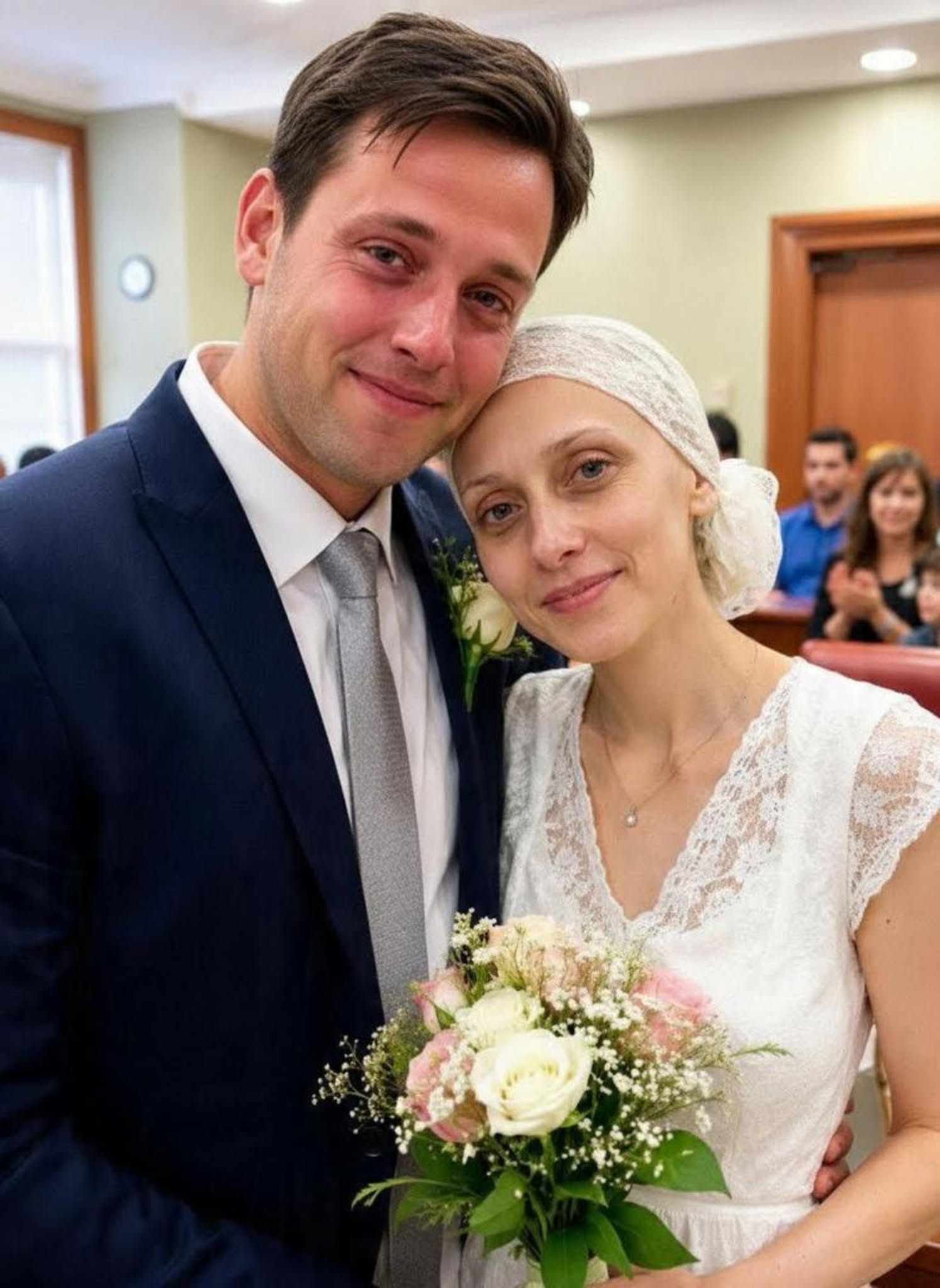
Two days later, we were married.
There were no flowers.
No guests.
No carefully planned ceremony.
Just a courthouse clerk and two employees who agreed to serve as witnesses.
Cara wore a simple blue dress.
She was so weak that I kept one arm around her during the vows.
When the clerk finally declared us married, Cara looked up at me.
For one brief moment, illness disappeared from her face.
She looked twenty again.
She looked like the woman sitting in my sociology seat.
Then she leaned closer.
“I’m sorry I waited so long to come home.”
I wanted to tell her that sorry wasn’t enough.
Instead, I kissed her forehead.
Because suddenly I understood something terrible.
We didn’t have enough time left for anger to be the only thing between us.

Part 3 — Five Days
Our marriage lasted five days.
Five ordinary, extraordinary days.
We ate toast in bed because Cara barely had the strength to sit at the kitchen table.
We watched movies we’d loved in college.
We laughed about professors we’d forgotten.
We remembered the terrible pasta we once served to friends and pretended was intentional.
Rain fell almost constantly.
Cara would lie against me beneath the blankets while water tapped softly against the windows.
Sometimes she slept with her head resting against my chest.
I would remain awake, listening to her breathe.
Part of me still desperately wanted answers.
One morning, I finally asked again.
“Why did you come back?”
She gave me a tired smile.
“Later.”
“You’ve already made me wait ten years.”
“I know.”
“Then tell me now.”
Her smile faded.
“Please. Just give me a little more time.”
I should have insisted.
But looking at her, I couldn’t.
So I waited.
And later never came.
On our fifth night as husband and wife, Cara fell asleep beside me wearing the wedding ring we’d bought two days earlier.
Before sunrise, I woke.
The room was completely still.
I knew what had happened before I even reached for her hand.
Cara was gone again.
This time, she hadn’t chosen to leave.
And somehow that hurt differently.
Part 4 — The Woman at the Funeral
The funeral took place beneath a gray sky.
Rain darkened the ground around Cara’s grave while a small group of mourners stood beneath umbrellas.
Most of them were strangers to me.
People from the ten years of Cara’s life I knew nothing about.
That realization made grief feel strangely incomplete.
I had married Cara.
I had loved Cara.
Yet there was an entire decade of her life that existed without me.
As the service ended and people began quietly walking away, a woman in black approached me.
I didn’t recognize her.
Without introducing herself, she placed an envelope in my hand.
“Cara couldn’t tell you why she returned,” she said softly. “She was still afraid. But she doesn’t have to be afraid anymore.”
I stared at her.
“What are you talking about?”
“Open it.”
Inside the envelope was a small brass key and a folded note.
The note contained only a few lines.
There were 127 letters.
I was supposed to read the oldest one first.
I looked up.
“Who are you?”
“My name is Mara.”
She paused.
“I lived with Cara.”
Mara drove me across town to a small apartment.
We barely spoke during the ride.
When we arrived, she led me into Cara’s bedroom and pointed toward the closet.
“She wrote to you for years,” Mara said.
“How often?”
“Sometimes once a year. Sometimes several times a month.”
“Then why didn’t I receive any of them?”
Mara’s expression hardened with sadness.
“Because every time she got close to contacting you, fear stopped her.”
I turned toward her.
“That isn’t romantic.”
“I didn’t say it was.”
“It’s cruel.”
“Yes.”
There was no defense in her answer.
Somehow, that made me trust her more.
Beneath several winter coats sat a dark wooden trunk.
Brass corners.
Old lock.
My hands trembled as I inserted the key.
The lid opened.
Inside were stacks of envelopes tied together by year.
Every envelope carried my name.
Every one was written in Cara’s handwriting.
I picked up the oldest.
It had been written three days after she disappeared.
I opened it.
And in the first sentence, Cara explained the secret that had shaped the next ten years of both our lives.
She had been pregnant.
Part 5 — 127 Letters
For several moments, I couldn’t continue reading.
My mind returned to that final argument.
Cara beside the sink.
Her hands gripping the dish towel.
Her question about children.
My careless answer.
Years from now.
Suddenly the entire conversation meant something different.
Cara explained that she had discovered the pregnancy only hours before asking me about our future.
She had planned to tell me.
Then she heard me describing graduate school, Europe, travel, and all the things I wanted to accomplish before becoming a father.
She panicked.
In Cara’s mind, there were only two possibilities.
Tell me about the pregnancy and watch me abandon my dreams.
Or leave before I had the chance.
So she went to her mother’s house.
She told herself she needed a few days.
She planned to calm down, find the right words, and return.
But before she could, the pregnancy ended because of medical complications.
Cara went through the loss alone.
Her next letter was harder to read than the first.
She described feeling as though she had lost not only the baby, but the person she had been before that night.
Afterward, grief became shame.
Shame became fear.
Fear became silence.
And silence became years.
The letters repeated the same painful pattern.
One began with her promising herself she would call me the next morning.
Another said she had purchased a ticket to come see me.
In another, she had found the number to my office and kept it beside her phone.
But every attempt ended the same way.
She convinced herself too much time had passed.
That I hated her.
That I had moved on.
That reopening the past would only hurt me.
Eventually, I threw the bundle onto the floor.
“She knew where I was.”
Mara nodded.
“Yes.”
“She knew I wasn’t married?”
“Yes.”
“Did she know I searched for her?”
“Eventually, yes.”
I stood so quickly the chair scraped across the floor.
“And you watched this happen?”
Mara didn’t react to my anger.
“I argued with her about it more times than I can count.”
“Then you should have told me yourself.”
“I thought about it.”
“Why didn’t you?”
“Because it wasn’t my secret.”
I stared at her.
“That excuse cost us ten years.”
“I know.”
I hated her answer.
But I also knew the person I was truly angry with wasn’t Mara.
It was Cara.
And being angry with someone who could never answer me felt unbearable.
Later letters revealed how closely Cara had followed my life from a distance.
She knew when I changed jobs.
She knew when I moved.
She even knew when certain relationships ended.
Mutual friends had passed along information without realizing what it meant to her.
Twice, Cara had traveled to cities where I lived.
Twice, she had come within blocks of seeing me.
And twice, she turned around.
I wanted to read everything immediately.
Mara stopped me.
“Cara left instructions.”
I gave her a bitter look.
“I don’t care what Cara instructed.”
Mara gathered several letters.
“You shouldn’t. But some of these were written in specific places. She wanted you to see them.”
“Why?”
“So you understand what happened.”
“I understand enough.”
“No,” Mara said quietly. “You understand the damage. You don’t understand the whole truth yet.”
Against my better judgment, I followed her.

Part 6 — The Places She Almost Came Back
Our first stop was a diner near the river.
Mara led me to booth six.
Years earlier, Cara had sat there with a cup of coffee and my number in front of her.
She had dialed several digits.
Then stopped.
“She stayed here for almost an hour afterward,” Mara said.
I looked at the empty booth.
“That doesn’t change anything.”
“No.”
“She still chose not to call.”
“Yes.”
I appreciated that Mara never tried to turn Cara’s fear into something noble.
She simply showed me what had happened.
At a park nearby, we stopped beneath an elm tree.
Cara had once sat on the bench beneath it with my phone number written on a napkin.
She kept the napkin for years.
“Why are you showing me all of this?” I asked.
“Because loving you was real,” Mara said. “And hurting you was real too.”
That sentence stayed with me.
The next stop was worse.
An apartment building where I had once lived.
Cara had traveled there years earlier and seen me entering with Elise, a woman I’d dated for eight months.
Cara assumed Elise and I were happy.
So she left.
I stared at the entrance.
“Elise broke up with me because of Cara.”
Mara turned toward me.
“What?”
“She said there was always someone else in the room, even when Cara wasn’t there.”
Mara lowered her eyes.
“Cara never knew that.”
Of course she hadn’t.
That was the terrible thing about silence.
Everyone was making decisions using incomplete versions of the truth.
By evening, we reached our old college campus.
The brick pathways looked smaller than I remembered.
The library windows still glowed warmly.
The student center had changed.
But enough remained to make me feel twenty again.
Mara explained that Cara had returned here shortly before receiving her final diagnosis.
She had walked past our dormitory.
The library.
The places where we’d spent our happiest years.
According to one of her letters, she needed to know those places were real.
That she hadn’t imagined that younger version of herself who had once believed life would work itself out.
Finally, Mara led me to the greenhouse.
I stopped outside.
Memories rushed back immediately.
Cara with soil on her cheek.
Cara laughing between rows of tomato plants.
Cara telling me she loved me for the first time.
Mara pointed toward the back wall.
“She said you’d know which brick.”
I did.
One brick near the corner had always been loose.
I pulled it free.
Behind it sat a small metal tin wrapped in faded cloth.
Inside was an old ultrasound photograph.
I couldn’t move.
All these years, I had grieved one disappearance.
Now I understood there had been another loss buried beneath it.
Under the photograph rested Cara’s final letter.
I unfolded it beneath the greenhouse lights.
She wrote that she wasn’t asking for forgiveness.
By the time doctors told her she didn’t have long to live, she had finally recognized the pattern that had ruled her adult life.
Whenever something frightened her, she ran.
Whenever honesty felt dangerous, she remained silent.
Whenever she had a chance to return, she convinced herself staying away was kinder.
Her illness finally forced her to see the truth.
Fear hadn’t protected anyone.
It had simply chosen her life for her.
She couldn’t allow it to make one last decision.
That was why she came back.
Not because she expected five days of marriage to repair ten years of pain.
Not because she believed a wedding could erase what she’d done.
She returned because, when the future disappeared, there was only one person she still wanted beside her.
Me.
In the final lines, she explained that those five days had never been intended as payment for ten missing years.
They were simply the only completely honest days she had left to give me.
I folded the letter.
For a long time, I couldn’t speak.
Finally, I whispered, “I wish she’d trusted me.”
Mara looked at the old photograph in my hand.
“So did she.”
We stood silently beneath the greenhouse lights.
There was nothing else to say.
Part 7 — Loving Someone Doesn’t Erase What They Did
It took me three weeks to finish all 127 letters.
Some made me laugh.
Some made me cry.
Others made me so angry that I had to stop reading and walk outside.
Cara had loved me.
That was true.
Cara had also hurt me deeply.
That was true too.
For a while, I thought I had to choose between those truths.
I didn’t.
Love doesn’t automatically excuse damage.
Regret doesn’t reverse consequences.
And forgiveness doesn’t require pretending the past was different from what it was.
Mara visited occasionally.
She usually arrived carrying coffee and never offered empty comfort.
One afternoon, she asked, “Do you hate her?”
“Sometimes.”
“Do you forgive her?”
“Sometimes.”
Mara nodded.
“That sounds exhausting.”
“It is.”
“Good.”
I looked at her.
She shrugged.
“Anything easier would probably be dishonest.”
Strangely, that helped more than all the comforting words people had offered after the funeral.
Eventually, I copied Cara’s letters and arranged them chronologically.
I bound those copies into a private book.
The originals remained inside her trunk.
Before closing the book, I wrote one sentence on the first page:
Love can be genuine and still fail the people who depend on it.
I never showed those words to anyone.
But they helped me understand Cara.
And myself.
Later, I contacted the college archives.
They agreed to preserve a copy of the letters under restricted access, unavailable publicly for a set period unless I changed the conditions.
I wasn’t interested in turning Cara’s grief into a spectacle.
I wanted the letters preserved for a different reason.
They were evidence of what silence could cost.
Evidence of what could happen when someone became so afraid of asking for help that fear began making every decision for them.
But keeping letters in an archive didn’t feel like enough.
I wanted something good to exist because of what had happened.
So I created a small emergency program for students experiencing pregnancy, serious illness, or medical hardship without enough support.
I called it the Open Door Fund.
Cara’s name wasn’t attached to it.
When I told Mara, she smiled.
“Cara would hate being publicly recognized.”
“That’s why I didn’t use her name.”
Mara laughed softly.
“She’d like that.”
Part 8 — The Door Cara Couldn’t Open
The first year after Cara’s death wasn’t easier.
But it became different.
At first, I visited her grave almost every week.
Then every few weeks.
Eventually, I stopped counting.
Instead, I began spending more time reviewing applications for the Open Door Fund.
Some students needed help paying rent.
Others needed transportation to appointments.
Some needed medication.
Occasionally, someone simply needed a safe place to stay for a night.
Every application reminded me that private struggles often looked ordinary from the outside.
Then one application arrived from a sophomore named Lena.
She was pregnant.
Her family had threatened to withdraw their financial support, and she was considering leaving school.
Her application wasn’t dramatic.
There were numbers.
Appointment dates.
Tuition information.
Housing costs.
Then, beneath a section requesting additional details, Lena had written one sentence:
I don’t know who I can safely tell.
I read those words several times.
Immediately, I saw Cara standing beside our sink.
Twenty years old.
A dish towel twisted between her fingers.
Trying to ask me about children without telling me why the answer mattered.
The committee approved Lena’s request.
Almost exactly one year after Cara died, I returned to the old greenhouse.
Lena was sitting outside on the bench near the tomato plants, turning a bracelet nervously around her wrist.
Mara had offered to come with me.
I declined.
Some moments didn’t require witnesses.
When I sat beside Lena, she looked frightened.
“Am I in trouble?”
“No.”
“Did I make a mistake on my application?”
“No.”
I handed her the paperwork.
She stared at the approval.
Her hands stopped moving.
Then she covered her mouth.
Her eyes filled with tears, although she managed not to cry.
I didn’t give her advice.
I didn’t tell her Cara’s story.
I didn’t tell her what decision she should make.
It wasn’t my life to choose.
Instead, I said the words I wished someone had helped Cara believe all those years earlier.
“You don’t have to figure everything out alone.”
Lena looked at me.
For the first time since we’d sat down, some of the fear left her face.
And as I looked through the greenhouse windows toward the rows of plants where Cara had once told me she loved me, I finally understood what I wanted to carry forward from our story.
Not the disappearance.
Not the anger.
Not even the five days we had been married.
The open door.
Cara had spent ten years standing outside one, too frightened to knock.
I couldn’t change that.
I couldn’t give us those years back.
But maybe somewhere, for someone else, the door could remain open long enough for them to walk through.