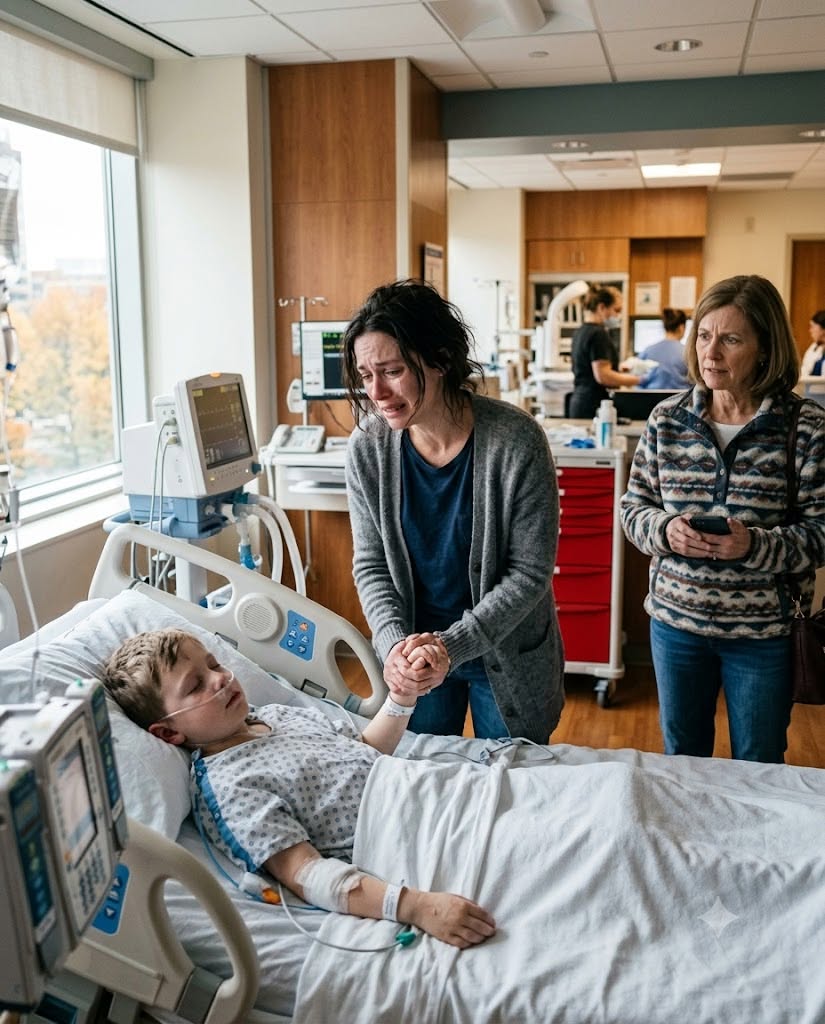
The hospital wasn’t the first place to call me.
It was almost midnight. I was alone in a hotel room, one heel already rubbing a blister into my foot, while the stale smell of hallway coffee clung stubbornly to my blazer. The television was muted, but a red breaking-news banner crawled across the bottom of the screen.
Then the camera showed yellow police tape.
Flashing lights.

And a small blue dinosaur blanket lying darkened in one corner.
My son’s blanket.
For a moment, everything inside me stopped.
All I could hear was the distant hum of the ice machine and the thin sound of my own breathing. I grabbed my phone and called my mother so quickly that I almost dropped it.
She answered sounding annoyed, as though I’d interrupted her favorite show.
“Mom, where is Noah?”
“He’s asleep, Emily. He’s perfectly fine.”
Her voice was calm.
Far too calm.
She didn’t sound sleepy. She didn’t sound confused. She didn’t sound like a grandmother who had just heard that something might have happened to her grandson.
She sounded certain.
A lie feels different when your body already knows the truth.
I was in Denver at 11:47 p.m., still wearing the navy blazer I’d bought on clearance because my promotion review was scheduled for the following morning. Noah was supposed to stay at my mother’s house in Dallas for three days. My younger sister, Madison, was there too.
I hadn’t wanted to leave him.
But my sitter had canceled. My ex-husband was deployed overseas. And that promotion was the narrow line between keeping our apartment and falling behind on bills again.
So I packed Noah’s dinosaur pajamas, his strawberry yogurt cups, and the blue blanket he carried everywhere. One corner had been rubbed so thin that it was almost white.
I kept telling myself that three days wasn’t forever.
Then my phone rang.
The number was from Dallas.
“Is this Emily Carter?”
“Yes.”
“This is the hospital intake desk. Your son, Noah Carter, was brought here tonight in critical condition. He was not brought in by your family.”
The gold pattern beneath my feet suddenly seemed to move.
Someone laughed somewhere outside my hotel room, and for reasons I couldn’t explain, that ordinary sound felt cruel.
“My mother just told me he was in bed,” I whispered.
There was a pause.
It was long enough to make my stomach twist.
“Ma’am, you need to come right away.”
I barely remember checking out of the hotel.
I remember my purse spilling across the lobby floor. I remember dropping my phone twice. I remember a clerk handing me a paper cup of coffee that I never touched.
At 12:32 a.m., my airline app showed the only red-eye flight I could catch.
Nine minutes later, I was in a rideshare with my suitcase open across my lap, staring at a picture of Noah smiling with strawberry yogurt smeared across his chin.
Noah was six.
He loved plastic dinosaurs, cuddling with me during thunderstorms, and sleeping with one sock on because, according to him, two socks made his “feet angry.”
He cried whenever animals got lost in cartoons.
He still asked me to check the closet for monsters before bed, then apologized to the closet whenever I told him there was nothing inside.
There was no world in which my little boy deserved to be hurt.
Yet all I could hear was my mother’s voice.
He’s perfectly fine.
No panic.
No questions.
No offer to check on him.
Just perfectly fine.
By 6:18 a.m., I was standing beneath the harsh white lights of a hospital corridor. A pediatric surgeon was waiting beside the ICU doors.
A detective stood beside him, holding a notebook in one hand and a police report folder under his arm.
My knees nearly buckled.
The surgeon spoke slowly.
Doctors know how to soften terrible news without hiding it.
Fractured wrist.
Bruised ribs.
Internal injuries.
Defensive wounds.
That last word hit me hardest.
Defensive.
My six-year-old had fought someone off.
The detective lowered his voice.
“Your mother and sister didn’t call 911. A neighbor heard screaming and found him unconscious near the backyard shed.”
The shed.
My mother’s locked shed.
The same shed Noah had once told me made “bad sounds” at night.
My mother had laughed it off. She said he was being dramatic because boys his age imagined things.
Trust isn’t always destroyed by one enormous betrayal.
Sometimes you hand it over slowly—in lunch bags, emergency contacts, spare keys, and the unquestioned belief that a grandmother would never allow a child to feel unsafe in her own backyard.
Through the ICU glass, I saw my son.
Tubes and wires surrounded his tiny body. One hand was wrapped in gauze. His face was swollen, and the white hospital sheets seemed to swallow him whole.
The monitor beeped steadily.
It was the only sound keeping me upright.
My mother and Madison were waiting at the end of the hallway.
Mom had tissues clenched in one hand, but her eyes were completely dry.
Madison kept rubbing the sleeve of her shirt as if something invisible were stuck there.
When they saw me, Mom opened her arms.
I walked straight past her.
“Emily,” she whispered. “Don’t make a scene.”
A scene?
My son was lying in the ICU, and she was worried about appearances.
The nurse checked my ID against Noah’s intake form before letting me inside. The detective remained near the door.
My mother and Madison followed, making soft crying sounds that seemed carefully loud enough for everyone to notice.
In the corner, a janitor in faded blue scrubs emptied the biohazard bin. He kept his head down, moving around everyone with the quiet caution of someone accustomed to stepping through other people’s worst moments.
The room smelled of antiseptic, plastic tubing, and fear.
I bent over Noah’s bed.
“Baby,” I whispered. “Mommy’s here.”
His eyelids fluttered.
For one terrible second, I wanted to turn around.
I wanted to grab my mother.
I wanted to shake the truth out of her.
I wanted to demand that Madison tell me what kind of sister could stand nearby while a child screamed beside a locked shed.
But Noah’s fingers moved against the blanket.
So I stayed.
His eyes opened slightly and found mine.
Then his gaze slipped over my shoulder.
The heart monitor suddenly screamed.
Noah lifted his bandaged hand.
Not toward Mom.
Not toward Madison.
Toward the corner of the room.
My mother gasped.
The detective immediately looked up.
Noah’s swollen lips parted.
One broken word escaped.
“Monster.”
The janitor stopped moving.
Madison made a sound as if someone had punched the air from her lungs.
My mother’s face went completely white.
Then Noah’s tiny hand began trembling harder.
And he whispered something else.
Something about the locked shed.
“Noah,” I whispered, leaning closer. “What about the shed?”
His lips trembled.
“Locked…”
“I know, baby. The shed was locked.”
He shook his head weakly.
“Not… from outside.”
The detective immediately stepped closer.
“What did he mean?”
I looked at Noah.
He was struggling to stay awake, but his eyes were fixed on me.
“Mommy… she locked me…”
My blood ran cold.
I slowly turned toward my mother.
She had stopped crying.
Madison was staring at the floor.
“Who locked you in the shed?” I asked.
Noah’s breathing became shallow.

He squeezed my finger.
“Madison.”
My sister’s head snapped up.
“No.”
The detective moved toward her.
Madison backed away.
“No, that’s not what happened.”
My mother suddenly stepped between them.
“She’s six years old,” she said. “He’s confused. Look at him.”
“He’s six,” I replied, my voice shaking. “Not stupid.”
The detective’s expression hardened.
“Mrs. Carter, I need everyone to remain calm.”
But I couldn’t.
Not anymore.
I looked at Madison.
“Why was my son in the shed?”
She didn’t answer.
My mother did.
“He wandered outside.”
I stared at her.
“You told me he was asleep.”
She swallowed.
“He was asleep when I checked.”
“Then why didn’t you call 911?”
Silence.
“Why did a neighbor find him unconscious?”
Nothing.
“And why did you tell me he was perfectly fine?”
My mother’s face tightened.
“Because I didn’t want you to panic.”
That sentence almost made me laugh.
I was standing beside my six-year-old son in an ICU bed with fractured bones and internal injuries.
She hadn’t wanted me to panic.
The detective looked at her.
“Mrs. Carter, please step outside with me.”
“No.”
My mother grabbed the edge of the bed.
“I am his grandmother.”
“And I’m his mother.”
The words came out before I could stop them.
The detective gently moved her away.
“Let’s go.”
My mother looked at me as she walked toward the door.
For the first time in my life, she looked afraid.
Not heartbroken.
Not devastated.
Afraid.
That was when I knew there was more.
Much more.
Two hours later, Noah was sedated for another procedure.
The detective came back into the waiting room.
He placed a photograph on the table.
It showed the inside of my mother’s shed.
I recognized the old wooden shelves immediately.
But something else caught my attention.
A small chair.
A blanket.
A plastic cup.
And a child’s drawing taped to the wall.
My stomach twisted.
“That wasn’t Noah’s,” I whispered.
“No.”
The detective looked at me.
“Your mother told us your son had never been inside that shed before tonight.”
“Then whose things are those?”
He didn’t answer immediately.
Instead, he placed another photograph beside the first.
This one showed the inside of a locked cabinet.
There were dozens of envelopes.
All addressed to me.
My name was written across every one.
Emily Carter.
Some were dated years ago.
Some were from before Noah was even born.
“What are these?”
“We found them after obtaining a warrant.”
I picked up one envelope.
The handwriting was unfamiliar.
I opened it.
Inside was a photograph.
A little girl.
Maybe eight or nine years old.
Standing beside my mother.
On the back, someone had written:
“She still asks about her sister.”
My hands began to shake.
“What does this mean?”
The detective looked at me carefully.
“Emily, your mother didn’t just hide what happened to Noah.”
He slid another photograph across the table.
“She appears to have been hiding something about your family for years.”
I called my mother from the waiting room.
She answered on the third ring.
“Emily.”
“Who is the girl?”
Silence.
“The girl in the photograph.”
Nothing.
“Mom, who is she?”
My mother’s breathing changed.
“You shouldn’t have found those.”
That answer was enough.
I closed my eyes.
“Who is she?”
“She was your sister.”
The room seemed to disappear.
“My what?”
“Your sister.”
“You told me I was an only child.”
“I was trying to protect you.”
“From what?”
My mother’s voice cracked.
“From the truth.”
I gripped the phone tighter.
“What truth?”
She didn’t answer.
Then Madison spoke in the background.
“Mom, tell her everything.”
My mother started crying.
And for the first time, I realized Madison wasn’t crying because of Noah.
She was crying because the secret was finally coming out.
The girl in the photograph was named Lily.
She was my mother’s daughter from a relationship before my father.
When I was three, Lily was eight.
My mother had given Lily to relatives after a family scandal and told everyone she had died.
But Lily hadn’t died.
She had grown up less than two hours away.
And for years, she had tried to contact my mother.
My mother never answered.
Then, six months earlier, Lily found Madison.
She wanted to meet me.
Madison agreed to help her.
But my mother found out.
She forbade them from telling me.

The shed became the place where Lily and Madison secretly met.
And Noah had discovered them.
That was why he had started talking about “bad sounds.”
That was why my mother had insisted he was imagining things.
But there was still one question I couldn’t understand.
“What happened to Noah?”
The detective answered before my mother could.
“Your son apparently discovered the shed’s hidden room.”
I stared at him.
“Hidden room?”
He nodded.
“There was a false wall behind the shelves.”
Inside that space, investigators found old photographs, letters, and records.
But they also found something else.
A second phone.
It contained messages between Madison and Lily.
And one message had been sent the night Noah was injured.
He saw everything. Mom says we can’t let him tell Emily.
I stopped breathing.
Madison had been there.
My mother had known.
And they had tried to silence a six-year-old who had accidentally discovered their secret.
But there was another message.
One that changed everything.
I won’t hurt him. If you want to scare him, do it yourself. I’m done protecting you.
It had been sent by Lily.
That meant Lily had been there too.
Three days later, Noah woke up.
His first question was whether his dinosaur blanket was still there.
I cried so hard I could barely answer.
“Yes, baby.”
He looked at me.
“Is Grandma mad?”
I kissed his forehead.
“No.”
I paused.
“She doesn’t get to be near you anymore.”
He thought about that.
Then he whispered, “Okay.”
The police eventually determined that Madison had locked Noah inside the shed after he discovered Lily hiding there.
She claimed she only meant to scare him.
But when Noah tried to escape, he fell, injured his wrist, and struck his head.
The defensive wounds came from trying to protect himself when Madison attempted to stop him from running.
My mother hadn’t caused the injuries herself.
But she had found Noah afterward.
She had known he was badly hurt.
And instead of calling 911, she had waited.
She had lied to me.
She had hoped the entire thing could disappear before I came home.
That was the part I could never forgive.
Not the family secret.
Not Lily.
Not even the lies about my childhood.
It was the decision she made when my son needed an adult.
She chose silence.
Months later, Noah was recovering.
The blue dinosaur blanket was still on his bed.
The shed was gone.
I had it torn down completely.
Lily eventually contacted me herself.
The first time we met, we sat across from each other in a quiet coffee shop.
She looked at me for a long time.
“I never wanted this to happen,” she said.
“I know.”
“I wanted a sister.”
I looked down at my hands.
“So did I.”
We both cried.
Not because the past could be repaired.
It couldn’t.
But because two sisters who had been separated by one person’s secret were finally sitting at the same table.
As for my mother, I never visited her again.
Months later, she sent me a letter.
There were only four sentences.
I thought I was protecting my family.
I was protecting myself.
I’m sorry.
Please forgive me.
I folded the letter and put it away.
I didn’t burn it.
I didn’t tear it up.
I simply refused to answer.
Because forgiveness doesn’t always mean opening the door again.
Sometimes it means finally closing the door that should have been closed years ago.
And every night, when I tucked Noah into bed, he still asked me to check the closet.
So I did.
I checked under the bed.
I checked behind the curtains.
Then I kissed his forehead.
“No monsters,” I told him.
He smiled sleepily.
“Good.”
I turned off the light.
And as I closed his bedroom door, I realized something.
The darkest secret in my family had never been hiding inside the locked shed.
It had been hiding in the people I trusted enough to give a key to.