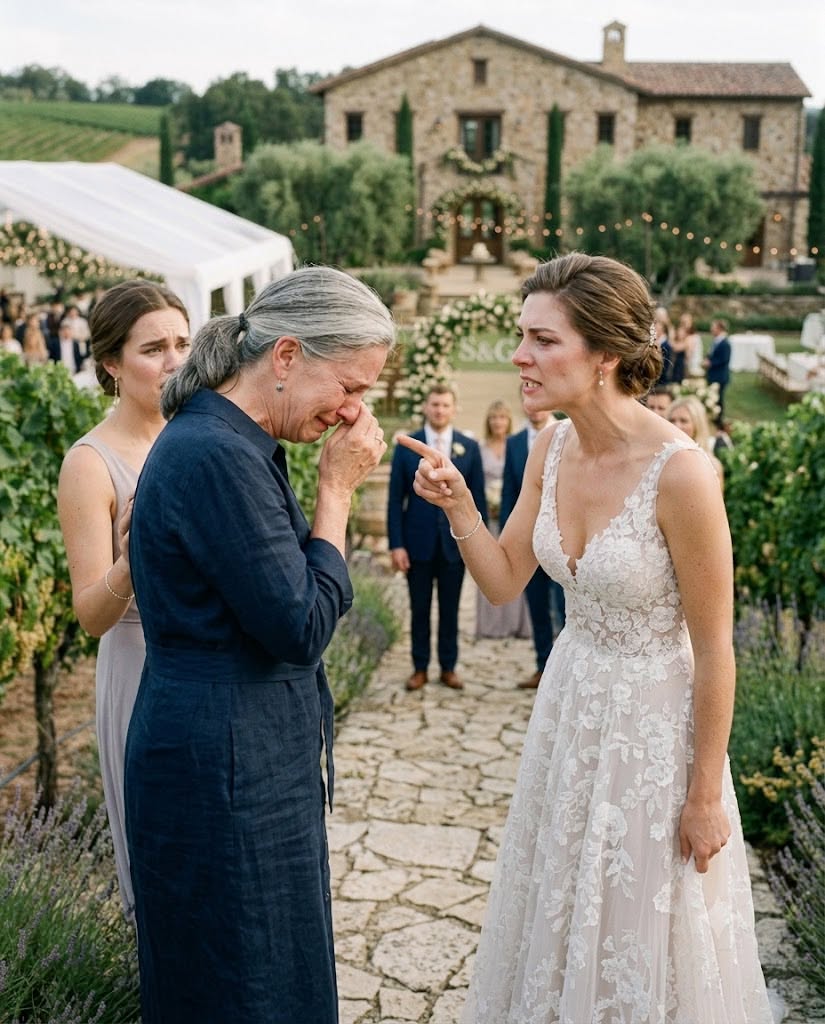
The ringing finally stopped—not because anyone had calmed down, but because my phone died after the fifty-ninth call.
I sat alone at the kitchen table, staring at the black screen as the morning sunlight slowly spilled across the hardwood floor. Beyond the windows, neat rows of grapevines stretched all the way toward the distant county road.
For the first time in years, the silence around me didn’t feel lonely.

It felt like the truth had finally revealed itself.
My name is Andrea. I’m sixty-five, widowed, and the sole owner of the farmhouse, the land surrounding it, and the eighty-acre vineyard my husband and I had spent decades building together.
My daughter Samantha was supposed to get married there that Saturday.
The ceremony was planned beside the rose garden. Dinner would be served beneath a massive white tent overlooking the vineyard. Nearly two hundred guests would raise glasses of wine made from grapes grown right there on my property.
And I had agreed to pay for almost all of it.
That morning, I called Samantha to ask what time the florist was expected to arrive.
She picked up after four rings.
“Hello, Mom.”
Something in her voice immediately made me uneasy.
“What time is the florist coming?” I asked. “Ben needs to know which gate to open.”
She hesitated.
“Mom, there’s something we need to talk about.”
I slowly set my coffee cup down.
“What is it?”
“I don’t think you should come to the wedding.”
For several seconds, I honestly thought I had heard her wrong.
The wedding was being held on my property.
Most of it was being paid for with my money.
“What are you talking about?”
“Greg thinks having you there might make his family uncomfortable.”
I stared at the wall in front of me.
“How would my being there make anyone uncomfortable?”
“You’re different from them. You don’t really fit into their kind of social environment.”
Then she finally said the words she’d been avoiding.
“My husband doesn’t want you there.”
Greg was technically still her fiancé, but Samantha had already started referring to him as her husband.
Only a week earlier, the three of us had sat together on my patio while I placed a small velvet-covered box in front of them.
Inside was the key to the restored stone house beside the creek.
It had solid oak floors, a newly renovated kitchen, tall windows overlooking the vineyard, and a large deck facing the water.
The house and surrounding property were worth at least eight million dollars.
I wanted my daughter to begin married life without the burden of a mortgage.
Samantha cried when she saw the key.
Greg simply turned it between his fingers, smiling with satisfaction.
“We’ll need to hire a professional landscaping company,” he had said, looking at the dirt beneath my fingernails. “We can’t have the place looking like a real farm when our friends come over.”
Samantha laughed as if he’d said something clever.
After that, Greg found something to criticize about everything.
My worn work boots.
The old cabinets in my farmhouse.
The denim shirts I wore.
Even the pickup truck I used to get around the property.
And Samantha never once defended me.
I kept making excuses for both of them.
That phone call ended that.
Sitting alone in my kitchen, I could finally admit what I had refused to see.
They wanted my vineyard.
They wanted the stone house.
They wanted the extravagant wedding.
They wanted the appearance of wealth created by decades of my work.
They just didn’t want me appearing in the wedding pictures.
I didn’t yell.
I didn’t argue.
I didn’t ask my daughter to change her mind.
I simply took another slow sip of coffee and said,
“I understand.”
Then I hung up.
A few minutes later, I walked into my study and opened my laptop.
At noon, the final payments for the caterer, florist, band, tent company, furniture supplier, and decorators were scheduled to come out of my account.
I stared at every pending payment.
Then I called Ben, the property manager.
“Good morning, Andrea.”
“Ben, I need you to change the code for the private entrance.”
There was a brief silence.
“All right.”
“And replace the locks on the stone house.”
This time, his pause was longer.
“Would you like to tell me what happened?”
“No.”
“Then I won’t press you.”
I looked down at the wedding contracts scattered across my desk.
“There’s one more thing. Don’t allow any vendors onto the property.”
His voice immediately turned serious.
“Understood.”
Two hours later, I came back to the farmhouse after trimming the roses beside the porch.
My phone was glowing on the kitchen counter.
The screen was packed with text messages, voicemail alerts, and repeated calls.
At the very top, four words appeared beside a huge number:
59 missed calls.
I stared at the number on my screen for several seconds.
Fifty-nine calls.
Thirty-seven text messages.
Nine voicemails.
And almost every message came from Samantha.
The first few were angry.
Then they became confused.
Then desperate.
I didn’t open any of them.
I poured myself another cup of coffee and sat back down at the kitchen table.
For the first time that morning, I wasn’t shaking.
I wasn’t crying.
I wasn’t even angry.
I was simply finished.
A few minutes later, Ben called.
I answered.
“Everything is locked down,” he said. “But Andrea, we have a problem.”
“What kind of problem?”
“There are already cars at the main entrance.”
I looked toward the window.
“How many?”
“Six so far. Mostly vendor vehicles.”
“Don’t let them in.”
“I won’t.”
There was a pause.
“There’s something else.”
“What?”
“Samantha and Greg are here.”
I closed my eyes.
“Do they have a key?”
“No.”
“Then they stay outside.”
Ben hesitated.
“They’re saying the wedding is Saturday. They say all the arrangements have already been paid for.”
I almost laughed.
“Not anymore.”
He understood.
“Should I call the sheriff if they refuse to leave?”
“Yes.”
The word came out calmly.
“Yes, Ben. If they refuse to leave my property, call the sheriff.”
After we hung up, I finally opened Samantha’s messages.
The first one read:
Mom, what is going on?
The next:
Why aren’t the vendors being allowed in?
Then:
Call me immediately.
Then:
Mom, this is serious.
The messages became more frantic.
You can’t do this to us.
The wedding is in four days.
Where is everyone supposed to go?
Then, nearly an hour later:
Greg says this is completely insane.
I kept scrolling.
Finally, I reached the message that made me stop.
Mom, please. We didn’t mean it the way it sounded.
I stared at those words for a long time.
That was when I realized something important.
They weren’t apologizing because they had hurt me.
They were apologizing because they had lost access to what I provided.
I put the phone down.
Then I opened my laptop.

The wedding contracts were still sitting in front of me.
I went through them one by one.
Caterer.
Florist.
Band.
Tent company.
Furniture.
Decorations.
Photographer.
Transportation.
Everything had been booked under my name.
Everything had been paid for by me.
And almost every contract contained the same clause.
The client could cancel.
The venue owner could deny access.
And any services already paid for would be subject to the individual vendor’s cancellation policy.
I started making calls.
One by one.
By lunchtime, every vendor had been notified.
The wedding was canceled at my property.
I didn’t ask for my money back.
I simply told them they were no longer authorized to enter the land.
Some were surprised.
Some were sympathetic.
One vendor even said, “Honestly, ma’am, I’ve been waiting for someone to tell me what was happening.”
I asked what she meant.
She lowered her voice.
“Your daughter kept telling everyone you were giving them the property.”
I froze.
“What did she tell you?”
“That the farmhouse and vineyard would eventually be theirs.”
I leaned back in my chair.
That explained a lot.
They hadn’t merely been planning a wedding.
They had already started planning my disappearance.
By late afternoon, the phone calls stopped.
Then my doorbell rang.
I knew who it was.
I walked to the front porch.
Samantha stood outside.
Greg was beside her.
Neither looked anything like the confident couple who had sat on my patio a week earlier.
Samantha’s eyes were red.
Greg looked furious.
“You can’t do this,” he said.
I opened the door but didn’t step outside.
“Do what?”
“Cancel our wedding.”
“It’s my property.”
“You promised us.”
“I promised you a wedding here.”
“You can’t just take it away!”
I looked at him.
“You told my daughter you didn’t want me at my own daughter’s wedding.”
He opened his mouth.
Nothing came out.
Samantha stepped forward.
“Mom, I was wrong.”
I looked at her.
“I know.”
She seemed surprised.
“Then please forgive me.”
“I forgive you.”
Her face softened with relief.
Then I continued.
“But forgiveness doesn’t mean I’m going to keep financing people who don’t respect me.”
Her expression changed.
“Mom…”
“I gave you an eight-million-dollar house.”
She looked down.
“You did.”
“I gave you the wedding.”
“Yes.”
“I gave you everything I thought a mother could give her daughter.”
She began to cry.
“And you decided I was embarrassing.”
“That isn’t what I meant.”
“Maybe not.”
I looked at Greg.
“But that is exactly what you said.”
He stepped forward.
“You’re twisting the situation.”
I smiled faintly.
“No, Greg. I’m finally listening to it.”
His face hardened.
“You don’t understand what our wedding means.”
“I understand perfectly.”
I pointed toward the vineyard.
“This place represents forty years of my life.”
Then toward the farmhouse.
“That house contains everything my husband and I built together.”
Finally, I looked at Samantha.
“And you were going to start your marriage by pretending none of it belonged to the woman who built it.”
Neither of them answered.
Then Greg said something I hadn’t expected.
“If you don’t let us use the property, we’ll take you to court.”
I nodded.
“You can do that.”
He blinked.
I continued.
“But before you do, you should probably speak to your attorney.”
“About what?”
“The deed.”
His expression changed.
“The deed to what?”
“The stone house.”
Samantha stopped crying.
“What about it?”
I looked directly at her.
“You don’t own it.”
Silence.

“I never transferred ownership.”
Samantha stared at me.
“But you gave us the key.”
“I gave you a key.”
Her face went pale.
“The house was going to be your wedding gift.”
“Was?”
“Yes.”
I paused.
“Until you told me I wasn’t welcome at the wedding.”
Greg’s jaw tightened.
“So you took it back?”
“No.”
I looked at Samantha.
“I simply decided not to give it to you.”
For the first time, neither of them had anything to say.
Then I noticed something else.
Greg wasn’t looking at me anymore.
He was staring at Samantha.
“What does that mean?” he asked her.
She whispered, “I thought the house was already ours.”
That sentence told me everything.
Greg had apparently believed the house was guaranteed.
Samantha had apparently believed it too.
And now neither of them knew what was happening next.
I closed the door.
I thought that would be the end.
It wasn’t.
The following morning, my attorney called.
“Andrea, I reviewed the documents you sent.”
“And?”
“You made the right decision not to transfer the property.”
I said nothing.
“There is something else you should know.”
“What?”
“The vineyard estate was listed as an asset in a loan application.”
I sat up straight.
“What loan application?”
“For Greg.”
My stomach tightened.
“What kind of loan?”
“A business loan.”
I stared at the wall.
“How much?”
“Two point six million dollars.”
For several seconds, I couldn’t speak.
“They used my property?”
“Apparently, they represented that they had an ownership interest in the estate.”
I felt something cold settle in my chest.
That explained the urgency.
The wedding wasn’t simply about a wedding.
The house wasn’t simply about a house.
They had already built financial plans around property they didn’t own.
My attorney continued.
“There is also a second issue.”
“What?”
“Your daughter appears to have signed a document stating that you had agreed to transfer the stone house after the wedding.”
I closed my eyes.
“So they were counting on it.”
“Yes.”
I looked toward the window.
The vineyard was glowing in the morning sun.
For decades, I had believed the land represented what my husband and I had built.
Now I understood that, to them, it represented something else.
Collateral.
Status.
Money.
A future they had already spent before they owned it.
That afternoon, I received one final message from Samantha.
Mom, I know I’ve made mistakes.
I read it.
Then another arrived.
Please don’t destroy my marriage over this.
I stared at the screen.
I typed a response.
Then deleted it.
Typed another.
Deleted that too.
Finally, I put the phone down.
I didn’t need to explain myself anymore.
Three days later, Samantha’s wedding took place at a small hotel twenty miles away.
There was no vineyard.
No stone house.
No two-hundred-person tent overlooking the vines.
And no wine from my property.
I didn’t attend.
Instead, I spent that afternoon sitting beneath the old oak tree my husband had planted forty years earlier.
For the first time in a very long time, I felt completely at peace.
Then my phone rang.
It was Ben.
“Everything okay?” I asked.
“Yes,” he said.
Then he laughed softly.
“You might want to come outside.”
“Why?”
“There’s a delivery at the gate.”
I walked outside.
A large truck was parked beside the road.
The driver handed me a wooden crate.
Inside were dozens of bottles of wine.
Each bottle carried a simple label.
Andrea Estate.
I smiled.
The grapes had been harvested months earlier.
My husband and I had started making that wine together before Samantha was even born.
I opened one bottle that evening.
I poured myself a glass.
Then I looked across the vineyard.
The land was still mine.
The farmhouse was still mine.
The stone house was still mine.
And, most importantly, so was the life I had spent decades building.
My phone remained silent.
No calls.
No messages.
No apologies.
Nothing.
For once, I didn’t need any.
Because I had finally learned the difference between being needed and being loved.
And I knew which one I wanted for the rest of my life.