
Part 1
I had always believed that losing the love of my life would be the greatest heartbreak I could ever endure.
I was wrong.
The real shock arrived after his funeral, when his attorney knocked on my front door, looked me in the eyes, and quietly said,
“Nancy… you walked right into Thomas’s trap.”
At seventy-three years old, I never imagined life could still surprise me.
Rain drifted steadily against the window of my tiny rented apartment while I sat at the kitchen table, stirring a cup of instant coffee that had become more of a habit than a pleasure. Outside, the streets of my hometown shimmered beneath the gray morning sky. I had left this place when I was only seventeen years old, convinced I was chasing a brighter future.
Now, more than five decades later, I had returned with silver hair, aching knees, and far fewer dreams than I once carried.
It was strange how a town could change completely and yet somehow remain exactly the same.
The storefronts were different.
The old movie theater had disappeared.
Even the oak trees lining Main Street had grown taller than I remembered.
Yet every corner still seemed to recognize me before I recognized it.
Retirement hadn’t lasted long.
My pension simply wasn’t enough to keep pace with rent, groceries, medications, and the endless little expenses that seemed to multiply with age. So after nearly fifty years as a nurse, I had pinned my old nursing badge onto a freshly pressed uniform and quietly returned to work at the local hospital.
I told myself I didn’t mind.
After all, caring for people was the only profession I’d ever truly loved.
What I never admitted—even to myself—was how lonely it felt going home every evening to an empty apartment.
I had never married.
I had never become a mother.
There had been kind men over the years. A few relationships had lasted months. One had nearly become serious.
But every single time, without meaning to, I compared them to the same boy.
Thomas.
Even thinking his name felt unfamiliar.
I hadn’t spoken it aloud in over fifty-six years.
Back when we were seventeen, Thomas and I believed love alone could conquer distance, time, and fear.
We were wrong.
I earned a scholarship to a university several hours away. It was everything I’d worked toward since childhood.
Thomas stayed behind to help run his father’s hardware business.
The night before I left, he met me at the old bus station carrying a paper bag filled with sandwiches his mother had made for the trip.
His hands trembled as he held mine.
“Please don’t go, Nancy.”
His voice had cracked the way only a seventeen-year-old boy’s heart could.
“I have to,” I whispered, fighting tears of my own. “I’ve worked too hard for this.”
“You can study somewhere closer.”
“I can’t throw away this opportunity.”
His eyes searched mine, desperate for something that wasn’t there.
“Then you’re breaking my heart.”
The bus arrived.
The driver loaded my suitcase.
I climbed aboard without looking back.
At least, that’s how I’d remembered it all these years.
I believed that was the last time I would ever see Thomas.
Life had other plans.
The ringing telephone pulled me out of the memory.
I glanced at the screen before answering.
Of course.
Raymond.
“Nancy, honey!” his cheerful voice boomed. “Just checking in on my favorite cousin.”
Favorite cousin.
It was almost funny.
We had barely exchanged birthday cards over the previous thirty years, yet ever since I’d returned to town, Raymond had suddenly become the picture of devoted family.
He called almost every week.
Sometimes twice.
Always friendly.
Always curious.
“How’s the apartment treating you?” he asked. “Rent must be eating up that pension.”
“I’m managing.”
“You sure? Living alone isn’t easy at our age.”
“I’ve handled worse.”
There was a brief pause before his voice softened.
“You’ve gotten all your paperwork sorted out, haven’t you?”
“What paperwork?”
“Oh, you know…” he chuckled. “A will. Bank information. Medical directives. Important things. A woman living by herself should make sure someone responsible is looking after everything.”
His words sounded caring.
Yet something underneath them felt strangely rehearsed.
“I’m doing just fine, Raymond.”
“You remember Aunt Margaret?”
“Of course.”
“I helped her with all those things before she passed. Family ought to take care of family.”
Something about the way he emphasized those last words made my coffee suddenly taste bitter.
I couldn’t explain why.
I simply felt uncomfortable.
“That was thoughtful of you.”
“I’d do the same for you.”
“I’m sure.”
“My shift starts soon,” I said quickly. “We’ll talk another time.”
Before he could continue, I ended the call.
For several seconds, I sat staring at the silent phone.
Why did every conversation with Raymond leave me feeling as though I’d narrowly escaped something I couldn’t quite see?
I shook the feeling away.
Maybe I was simply becoming suspicious in my old age.
The hospital greeted me with its familiar blend of disinfectant, polished floors, distant footsteps, and quiet anxiety.
Some things never changed.
Patients came.
Patients left.
Some recovered.
Some never did.
I pushed my medication cart down the long corridor, checking room numbers while mentally reviewing my morning assignments.
By ten o’clock my feet already ached.
Room 220.
New admission.
Long-term oncology care.
I pushed open the door while glancing down at the patient’s chart.
First name.
Thomas.
My steps slowed.
There had to be hundreds of men named Thomas across the state.
I kept reading.
The last name froze the breath inside my chest.
No.
It couldn’t possibly…
My fingers tightened around the clipboard.
Slowly, I raised my eyes toward the hospital bed.
For one endless moment the world became completely silent.
Time disappeared.
Fifty-six years disappeared.
The young boy standing beside a departing bus became an elderly man resting against white pillows.
His dark hair had turned silver.
Cancer had hollowed his face.
His shoulders were thinner.
His hands looked fragile beneath the blanket.
But his eyes…
His eyes hadn’t changed at all.
They were the same warm blue eyes that had begged me not to leave all those years ago.
He smiled gently.
Not with surprise.
Not with confusion.
With recognition.
As though he had been expecting me all along.
“Hello, Nancy,” he said softly.
My throat closed.
The blood pressure cuff nearly slipped from my fingers.
I stood motionless, staring at the only man I had ever truly loved.
Finally, after what felt like an entire lifetime compressed into a single heartbeat, I whispered,
“Thomas…”
His smile grew wider.
“My goodness,” I breathed.
“Thomas…”

Part 2
For several long seconds, neither of us spoke.
The years between us seemed to dissolve inside that quiet hospital room. I had imagined countless versions of what it might be like if I ever saw Thomas again, but none of them resembled reality. I had pictured chance encounters in grocery stores, perhaps passing each other on a crowded sidewalk.
Never this.
Never a hospital bed.
Never with death quietly waiting outside the door.
Finally, Thomas chuckled softly.
“You still stare when you’re surprised.”
The familiar teasing in his voice broke the spell.
I laughed through tears.
“And you still notice everything.”
“I’ve had fifty-six years to remember your expressions.”
I set the chart aside before realizing I had forgotten why I’d entered the room in the first place.
“My goodness…” I whispered again. “Thomas… it’s really you.”
“It’s really me.”
“You haven’t changed.”
He raised one thin eyebrow.
“Nancy, I’m seventy-three years old.”
“So am I.”
He smiled.
“I meant your eyes.”
For the first time since walking into Room 220, I allowed myself to breathe.
Professional instinct quickly returned.
I checked his blood pressure, listened to his lungs, adjusted his IV, and reviewed his medications with the same careful attention I gave every patient.
Only my trembling hands betrayed me.
When I finished, neither of us seemed eager for me to leave.
“So,” Thomas asked gently, “did nursing become everything you hoped?”
I pulled a chair beside his bed.
“It became my entire life.”
“You were always meant to help people.”
“And you?”
“I stayed.”
“I guessed that.”
“My father got sick not long after you left.”
“I’m sorry.”
“I took over the hardware store.”
“The same one?”
He nodded.
“It grew bigger than either of us ever expected.”
“I’m happy for you.”
“I was successful.”
The way he said it made me notice the difference between being successful and being happy.
There was silence again.
Then I finally asked the question that had lingered since I’d entered the room.
“Did you ever marry?”
Thomas looked toward the rain sliding down the window.
“No.”
I blinked.
“No?”
He slowly shook his head.
“I came close once.”
“What happened?”
“I couldn’t convince myself I was giving someone my whole heart.”
His eyes met mine.
“Part of it already belonged somewhere else.”
Emotion tightened my throat.
“I never married either.”
“I know.”
“You… know?”
“I asked around after you came back to town.”
I laughed nervously.
“So you’ve been investigating me?”
“A little.”
“You should be ashamed.”
“I don’t regret a minute of it.”
His smile carried the same warmth I remembered from seventeen.
Somehow it felt both wonderfully familiar and painfully bittersweet.
Over the following weeks, visiting Thomas became the brightest part of every shift.
Officially, I was checking medications.
Unofficially, I found every excuse to linger.
Sometimes I brought him fresh coffee from the cafeteria.
Sometimes we simply watched birds gathering outside his window.
Sometimes we talked until another nurse reminded me I still had an entire floor of patients waiting.
We shared stories that should have been exchanged decades earlier.
I told him about the cities where I’d worked, the overnight emergency shifts, the patients who still lived in my memory, and the quiet apartment where I returned after every long day.
He told me about expanding the family business after his father passed away, traveling for trade shows, restoring old furniture as a hobby, and learning to cook because there had never been anyone else to cook for.
“You still drink your coffee black?” he asked one afternoon.
“Still do.”
“I knew you would.”
“And you still hate sugar?”
“It ruins perfectly good coffee.”
I laughed.
“Some people would disagree.”
“They’re entitled to be wrong.”
For the first time in years, laughter came naturally.
Yet beneath every conversation lingered something heavier.
Thomas never complained about his illness.
Not once.
Stage-four cancer had stolen much of his strength, but it hadn’t stolen his peace.
That puzzled me more than anything.
Most patients in his condition wrestled with fear, anger, or regret.
Thomas carried none of those emotions.
Instead, he behaved like a man patiently waiting for something important to be completed.
One quiet morning, after I’d helped him sit more comfortably, he studied me with unusual seriousness.
“Nancy…”
“Yes?”
“Can I ask you something personal?”
“Of course.”
“Do you have anyone nearby?”
“What do you mean?”
“Family.”
I hesitated.
“Not really.”
“No children?”
I shook my head.
“No husband.”
“No.”
He waited.
“Just one distant cousin.”
“Raymond?”
I looked at him in surprise.
“You know his name?”
“I’ve heard it.”
“He calls quite a bit these days.”
Thomas’s expression changed so quickly that another nurse might have missed it.
His jaw tightened.
Only for a heartbeat.
Then his calm smile returned.
“He visits often?”
“Actually, no.”
“Just phone calls?”
“Mostly.”
“What does he want?”
I shrugged.
“He says he’s worried about me.”
Thomas remained quiet.
“He asks about my apartment.”
Silence.
“My finances.”
Still silence.
“My will.”
Thomas looked away toward the window.
“Does he?”
“I suppose he’s trying to be helpful.”
His fingers slowly tightened around the blanket.
“Perhaps.”
The conversation ended there.
At the time, I assumed talking about illness had simply exhausted him.
Only much later would I understand why hearing Raymond’s name disturbed him so deeply.
Meanwhile, Raymond’s calls became increasingly frequent.
Sometimes they arrived before breakfast.
Sometimes after I’d finished twelve-hour shifts.
Always cheerful.
Always prying.
“Nancy,” he said one evening, “are you seeing anyone these days?”
I laughed.
“At seventy-three?”
“People fall in love at every age.”
“I suppose they do.”
“You shouldn’t spend your remaining years alone.”
“I’m managing perfectly well.”
“Family should be looking after family.”
“There it is again.”
“What?”
“That sentence.”
“What sentence?”
“‘Family should look after family.’”
“Because it’s true.”
I changed the subject.
He changed it back.
“Have you updated your will yet?”
“No.”
“You really should.”
“I’ll get around to it.”
“You need someone responsible listed.”
“I’m perfectly capable of making my own decisions.”
“I didn’t mean—”
“I know exactly what you meant.”
The line became awkwardly quiet.
Then Raymond forced another laugh.
“I’m only trying to help.”
“I appreciate the concern.”
But I no longer believed that was all it was.
The questions kept growing stranger.
Which bank did I use?
Had I spoken to any attorneys?
Was I renting or thinking about buying?
How much did the hospital pay retired nurses?
Did I keep important documents inside the apartment?
Every conversation left me with the same uncomfortable feeling.
As though I had answered questions on an examination without knowing what subject I was being tested on.
One evening after work, I found myself thinking about Aunt Margaret.
Raymond often claimed he’d taken wonderful care of her during her final years.
Yet that wasn’t how I remembered it.
Margaret had spent her last months alone in a modest rented room.
She’d rarely received visitors.
She’d seemed anxious whenever money came up.
Back then I’d assumed old age had simply made her worry.
Now I wasn’t so sure.
The memory lingered in my mind as I walked into Thomas’s room the following afternoon.
He seemed unusually thoughtful.
“Nancy.”
“Yes?”
“Sit with me for a minute.”
I pulled my chair closer.
His hand searched beneath the blanket until it found mine.
The warmth of his touch surprised me despite how thin and fragile he’d become.
“I need to ask you something.”
His voice carried a seriousness I’d never heard before.
“What is it?”
He smiled sadly.
“I’ve rehearsed this conversation a thousand times.”
My heart began beating faster.
“I don’t know whether I’m brave enough.”
“You’ve always been brave.”
“I wasn’t brave enough when we were seventeen.”
Neither of us spoke.
Outside the hospital window, sunlight finally broke through the clouds.
“I’ve loved you,” Thomas whispered, “for my entire life.”
Tears instantly blurred my vision.
“I never stopped.”
“I know we lost decades.”
I couldn’t answer.
“I know I don’t have much time left.”
My fingers tightened around his.
“The doctors have been honest with me.”
I wanted to interrupt.
He gently shook his head.
“Please let me finish.”
I nodded.
“I’ve spent fifty-six years wondering what our lives might have been if you hadn’t boarded that bus.”
His voice trembled.
“I don’t regret your dreams.”
“I never wanted you to.”
“You became exactly the woman I always believed you would become.”
A tear rolled slowly down his cheek.
“But there’s still one dream I never stopped carrying.”
He took a slow, painful breath before looking directly into my eyes.
“Nancy…”
My own breathing nearly stopped.
“I’ve loved you every day since we were seventeen.”
He swallowed carefully.
“I know I’m dying.”
The words shattered my heart.
“But before I leave this world…”
He squeezed my hand with surprising strength.
“…will you marry me?”
For one impossible moment, everything inside me became still.
The hospital disappeared.
The years disappeared.
I was seventeen again, standing in a bus station while the boy I loved begged me not to leave.
Only now life had given us one final chance to answer the question it had interrupted more than half a century earlier.
Inside my mind, another voice suddenly echoed.
Raymond’s.
Don’t be foolish.
Don’t let emotions cloud your judgment.
But an even older voice—the one I’d buried all those years ago—rose quietly from somewhere deep inside my heart.
This time… don’t walk away.

Part 3
The room was so quiet I could hear the steady rhythm of the heart monitor beside Thomas’s bed.
For a moment, I couldn’t speak.
Fifty-six years of memories rushed through my mind all at once.
The bus station.
The goodbye.
Every birthday that passed without him.
Every Christmas I wondered where he was.
Every lonely evening when I convinced myself that some people simply weren’t meant to find lasting love.
And now the man I had loved since I was seventeen was asking me to become his wife.
Not because we had decades ahead of us.
Because we didn’t.
A sensible voice inside me whispered that this was impossible.
Too sudden.
Too emotional.
Too painful.
Another voice—the one I’d silenced all my life—answered just as quickly.
If you say no now, you’ll spend whatever years you have left wondering what might have happened. Again.
Tears streamed freely down my cheeks.
“Thomas…”
He gave me a gentle smile.
“You don’t have to.”
“I know.”
“I’ll understand if—”
“Yes.”
He blinked.
“I’ll marry you.”
The words came out almost as a whisper.
“Yes, Thomas.”
His eyes filled with tears.
“So that’s a yes?”
I laughed through my crying.
“Yes.”
He squeezed my hands with surprising strength.
“You’ve just made me the happiest man in the world.”
I leaned forward and kissed his forehead.
“I should have said yes fifty-six years ago.”
He smiled.
“No.”
I looked at him.
“You were meant to chase your dreams.”
“And you?”
“I was meant to wait.”
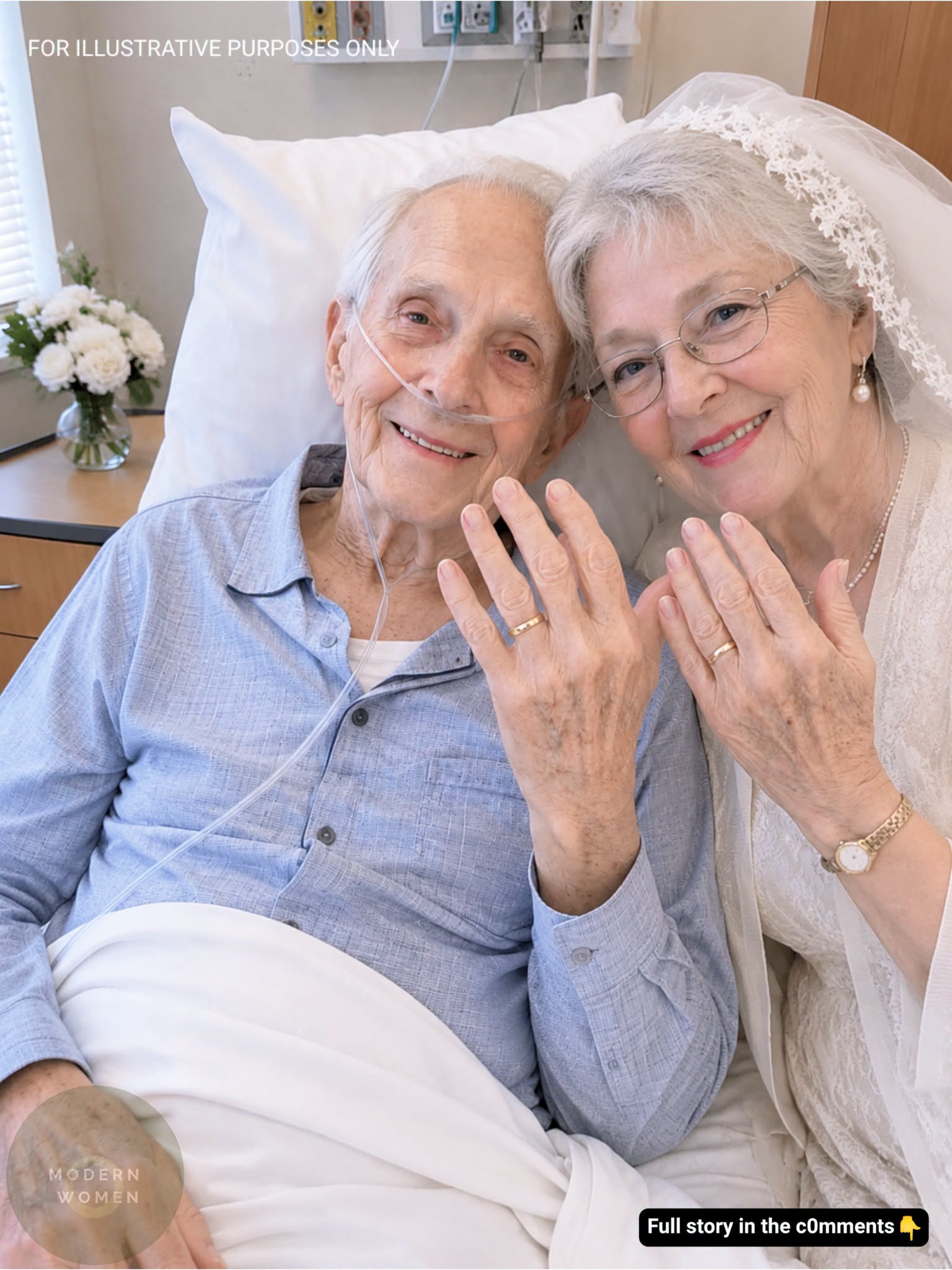
Three days later, our wedding took place inside Room 220.
The nurses decorated the room with fresh flowers from the hospital garden.
Someone borrowed white linens from another department.
A volunteer pianist quietly played music in the hallway.
It wasn’t grand.
It wasn’t elaborate.
It was perfect.
One nurse served as our witness.
The other witness was a quiet gentleman in a gray suit.
“My name is Walter,” he introduced himself. “I’ve been Thomas’s attorney for many years.”
I thought it was slightly unusual for a lawyer to attend such a small bedside wedding.
Thomas simply smiled.
“You’ll understand someday.”
I assumed he meant legal paperwork connected to the marriage.
I didn’t ask any questions.
When it came time to exchange vows, Thomas looked at me with tears shining in his eyes.
“I loved you when we were seventeen.”
His voice trembled.
“I loved you through every season we spent apart.”
He smiled.
“And I’ll love you for however many days I have left.”
By the time it was my turn to speak, I could barely see through my tears.
“I thought I had missed my chance.”
I held both of his hands.
“But life gave us one more.”
“I promise to love you for every day we still have.”
Walter quietly wiped his glasses.
Even the nurses were crying.
After the ceremony, Walter opened his briefcase.
“There are just a few documents for both of you.”
Thomas nodded.
“Go ahead.”
Walter carefully explained where each signature belonged.
“They’re standard legal documents connected to the marriage.”
I trusted Thomas completely.
Without hesitation, I signed each page where Walter indicated.
Thomas watched silently.
When everything was finished, he looked strangely relieved.
That evening, my phone rang.
Raymond.
“Nancy!”
His voice was louder than usual.
“Please tell me those rumors aren’t true.”
“What rumors?”
“That you actually married some dying man from the hospital.”
“I married Thomas.”
“Have you completely lost your mind?”
“I’ve known Thomas longer than I’ve known anyone.”
“You haven’t seen him in fifty years!”
“I’ve loved him for fifty-six.”
Raymond’s tone hardened.
“Listen to me.”
“I’m listening.”
“You’re being manipulated.”
“No.”
“Some stranger tells you a tragic story and suddenly you’re signing legal papers?”
“I know exactly who I married.”
“You need that marriage annulled immediately.”
“I won’t.”
“Nancy—”
“I said no.”
“You foolish woman!”
“I think this conversation is over.”
I ended the call before he could continue.
For the next month, I spent every free moment beside Thomas.
We watched old movies.
We laughed about teachers we’d both remembered differently.
We talked about the lives we might have shared.
Sometimes we simply held hands without speaking.
It wasn’t enough time.
It never could have been.
But somehow those few weeks carried the weight of an entire lifetime.
One quiet morning, before sunrise, Thomas opened his eyes and smiled at me.
“You came.”
“I told you I always would.”
“I know.”
He reached weakly for my hand.
“Thank you…”
“For what?”
“For giving me forever.”
A few minutes later, still holding my hand, Thomas peacefully slipped away.
I sat beside him for a long time before I found the strength to call the nurse.
The funeral was simple.
Exactly as Thomas had requested.
Friends from town attended.
Former employees from the hardware store.
Hospital staff.
People whose lives he had quietly touched over the decades.
As everyone slowly returned to their cars, Raymond approached me.
He adjusted his expensive tie before speaking.
“You know I’m your only living relative.”
I said nothing.
“Family should take care of family.”
“There you go again.”
He ignored my comment.
“We’ll need to discuss your affairs.”
“My affairs?”
“Financial matters.”
His smile was thin.
“Older women sometimes sign documents they don’t fully understand.”
“I understood every word Thomas ever said to me.”
His expression cooled.
“I helped Aunt Margaret with everything before she died.”
Something about the way he emphasized everything sent a chill through me.
“I need to go home.”
“We’ll be talking soon.”
I drove away without answering.
The following morning, there was a knock at my apartment door.
Walter stood outside carrying a polished wooden box.
“Mrs. Carter?”
I still wasn’t used to hearing Thomas’s last name attached to mine.
“May I come in?”
“Of course.”
He placed the box carefully on my coffee table before taking a seat.
“I’ve completed one final instruction Thomas left for me.”
“What instruction?”
“I mailed a formal legal notice to Raymond this morning.”
My eyebrows lifted.
“What kind of notice?”
Walter smiled gently.
“It informs him that every matter concerning your finances and future care is now protected by a trust.”
“I don’t understand.”
“You will.”
He reached into his jacket and unfolded a handwritten letter.
“Thomas asked me to read this exactly as he wrote it.”
Walter began reading.
“My darling Nancy… forgive me. I set a trap, but you were never meant to be caught in it.”
My heart began pounding.
“The papers you signed on our wedding day did much more than make you my wife.”
Walter looked up briefly.
“They established a discretionary trust funded entirely by Thomas’s estate.”
I stared silently.
“He also prepared a durable power of attorney.”
“I… did?”
“You appointed me—not Raymond—to protect your legal affairs if you ever became unable to manage them yourself.”
Walter continued reading.
“Raymond has spent years taking advantage of lonely elderly relatives.”
My breath caught.
“He did it to Aunt Margaret.”
I covered my mouth.
“He tried to warn her after discovering money disappearing from her accounts, but she refused to believe her own nephew would betray her. When she died, Raymond inherited far more than he deserved.”
Tears blurred my vision.
“When I learned you had returned to town and Raymond had suddenly become interested in your life, I knew exactly what he was planning.”
I whispered,
“He knew…”
Walter nodded.
“He requested a transfer into your hospital ward.”
“What?”
“He wanted to make certain he found you before Raymond could manipulate you.”
Every conversation.
Every smile.
Every carefully timed decision.
Everything suddenly made sense.

“The wedding wasn’t only about fulfilling his last wish,” Walter said quietly.
“It was about protecting you.”
I looked down at the wooden box.
“Open it.”
With trembling fingers, I lifted the brass latch.
Inside lay the deed to Thomas’s family home.
Trust documents naming me as beneficiary.
And beneath them…
A bundle of handwritten letters tied neatly with faded blue twine.
Fifty-five letters.
One for every year he had lived without writing to me.
On top rested a final note.
“Read one every Sunday morning with your coffee. That way I’ll still get to spend my Sundays with you.”
I pressed the note against my heart and sobbed.
“I don’t understand why he never sent them.”
Walter smiled sadly.
“He wrote them.”
“But?”
“He believed you had moved on.”
I closed my eyes.
“So he kept every one.”
“He hoped someday he’d be able to hand them to you himself.”
Silence settled over the room.
“The trap wasn’t for me.”
Walter smiled.
“No.”
“It was for Raymond.”
“Exactly.”
Thomas had built an iron wall of legal protection around me before saying goodbye.
Every document had been carefully prepared.
Every possibility anticipated.
Every loophole closed.
Three days later, Raymond appeared at my new front door, red-faced and furious.
By coincidence—or perhaps by Thomas’s careful planning—Walter happened to be sitting at my kitchen table enjoying tea.
“You manipulated her!” Raymond shouted.
Walter calmly folded his newspaper.
“Every document was signed voluntarily.”
“I’ll challenge everything.”
“You’re welcome to.”
Walter slid a folder across the table.
“I’ve already prepared our response.”
Raymond flipped through the pages.
His confidence slowly disappeared.
“You’ll lose,” Walter said calmly.
“And when you do, you’ll also be responsible for every legal fee.”
Raymond looked at me with disbelief.
“You foolish old woman.”
For the first time in years, I smiled without fear.
“No.”
I stood a little taller.
“I’m a woman who was deeply loved.”
There was nothing left for him to say.
He turned and walked away.
I never saw him again.
That spring, I moved into Thomas’s old family home.
It overlooked the same quiet streets where we’d once ridden bicycles after school.
The porch swing still creaked in the evening breeze.
His favorite coffee mug waited in the kitchen cabinet exactly where he’d always kept it.
Every Sunday morning, I brewed two cups of black coffee.
One for me.
One beside the stack of letters.
Then I untied the ribbon and opened exactly one.
Sometimes they made me laugh.
Sometimes they made me cry.
Sometimes they described ordinary days from decades ago.
Sometimes they spoke about dreams we’d never shared.
Each letter reminded me that love isn’t measured by the number of years two people spend together.
Sometimes it’s measured by the years they spend faithfully carrying each other in their hearts.
For most of my life, I believed love had passed me by.
I thought I’d missed my chance forever.
But Thomas proved something I never expected.
Real love doesn’t always arrive when we want it.
Sometimes it waits.
Sometimes it survives fifty-six years of silence.
And sometimes, even after saying goodbye, it finds one final way to keep its promise.
Because the greatest gift Thomas left me wasn’t his house.
It wasn’t his savings.
It wasn’t even the letters.
It was the certainty that I had never been forgotten.
I had been loved every single day.
And that love protected me long after he was gone.