
Aug
Part 1 — The Whisper That Changed Everything
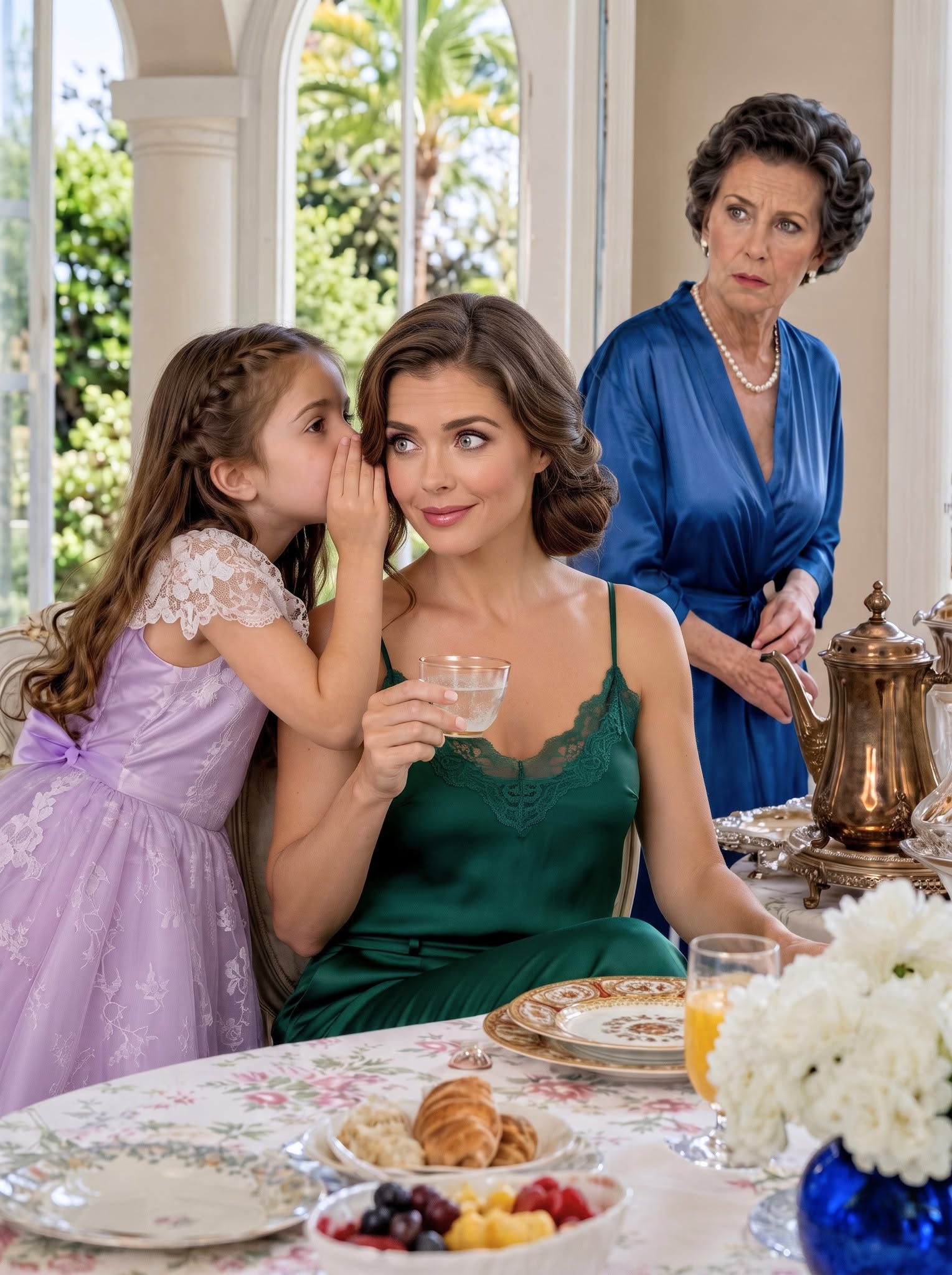
“Mommy… Grandma puts something white in your tea when she thinks you aren’t watching.”
My eight-year-old daughter, Sophie, whispered those words on an ordinary Tuesday afternoon in our San Diego home.
I was standing at the foot of my bed, folding one of my husband’s blue dress shirts.
My hands stopped in midair.
For a few seconds, I thought I had misunderstood her.
“What did you say, sweetheart?”
Sophie stepped closer.
She glanced toward the bedroom door before taking my hand.
“Grandma Ruth has a little white jar in the kitchen,” she whispered. “She puts powder from it into your tea. Then she stirs it really fast until you can’t see it anymore.”
My stomach tightened.
“How many times have you seen her do that?”
Sophie shrugged nervously.
“A lot.”
“A lot?”
“She does it in the morning. Sometimes when you’re upstairs getting dressed.”
My heart began pounding harder.
“Why didn’t you tell me before?”
Sophie looked ashamed.
“I thought it was medicine. Grandma said your stomach gets upset, so I thought she was helping you.”
Before I could ask another question, footsteps sounded in the hallway.
The bedroom door opened.
Ruth walked in carrying a basket of clean laundry.
My mother-in-law had lived with us for almost ten years.
She was sixty-seven, soft-spoken, silver-haired, and always dressed neatly even when she had nowhere to go. To everyone who knew us, Ruth was practically a second mother to me.
My own mother, Linda, had died during my final year of college.
Losing her at twenty-one had left an emptiness I never expected another person to fill.
Ruth never tried to replace her.
That was probably why I grew to love her.
When I married her son, Daniel, Ruth welcomed me immediately.
She taught me Daniel’s grandmother’s apple-pie recipe. She sat beside me through my pregnancy with Sophie. She stayed overnight at the hospital when Sophie was born.
When Ruth developed financial problems after her husband died, Daniel and I invited her to move into our guest room.
I paid for dental work she couldn’t afford.
I covered several of her prescriptions.
I paid for flights when she wanted to visit her sister in Arizona.
And Ruth gave back in a hundred small ways.
She cooked.
She helped with Sophie.
She watered my plants when I traveled.
And every morning, almost without exception, she made me chamomile tea.
“Drink it while it’s warm, Claire,” she always said.
“It’ll settle your stomach.”
For years, that cup had represented care.
Love.
Family.
Now my daughter was telling me something else was going into it.
Ruth smiled as she entered the room.
“There are my girls.”
Sophie immediately released my hand.
Ruth placed the laundry basket on a chair.
“I made tea, Claire. It’s downstairs.”
For the first time in ten years, those words frightened me.
I forced myself to smile.
“Thanks. I’ll get it in a minute.”
Ruth looked at me for slightly too long.
Then she smiled back.
“Don’t let it get cold.”
The moment she left, I closed the door.
Sophie looked up at me.
“Am I in trouble?”
I dropped to my knees and hugged her.
“No, baby. You did exactly the right thing.”
And although I didn’t know it yet, that quiet warning from my daughter was about to uncover a betrayal that reached far beyond my mother-in-law.
Because Ruth wasn’t acting alone.
And the person behind her was someone who shared my own blood.
Part 2 — The Cup I Didn’t Drink
My tea was waiting on the kitchen table.
Same blue ceramic mug.
Same lemon slice.
Same faint smell of chamomile.
Nothing about it looked unusual.
Ruth stood at the counter slicing vegetables.
“Your tea’s getting cold,” she said.
I sat down.
My hands almost trembled when I picked up the mug.
I didn’t drink.
Instead, I pretended to blow across the surface.
When Ruth turned toward the refrigerator, I tilted the mug slightly.
That was when I saw them.
Tiny pale grains were clinging to the bottom.
Most had dissolved.
A few hadn’t.
My skin went cold.
I set the mug down.
“You okay?” Ruth asked.
“Fine.”
“You look pale.”
“I’ve been tired.”
Her expression softened instantly.
Too instantly.
“You’ve been tired for months, sweetheart. You work too much.”
That part was true.
I owned a small interior-design company and often worked long hours. Daniel was an architect, and between our businesses, Sophie, bills, and family responsibilities, exhaustion wasn’t unusual.
But what I had experienced during the previous six months was different.
I was tired even after sleeping ten hours.
My joints sometimes ached for no reason.
I had developed unexplained bruises.
My appetite had changed.
And routine blood work had shown liver abnormalities that concerned my doctor.
Nothing was severe enough to explain the bigger picture.
Every test seemed to lead nowhere.
At one point, I had convinced myself it was stress.
Now I looked at my untouched tea.
And wondered how many cups I had consumed.
Hundreds?
Thousands?
Ruth turned away again.
I carried the mug to the sink.
“What are you doing?” she asked.
“I forgot I’m getting blood work tomorrow. I probably shouldn’t have anything except water.”
It was a ridiculous excuse.
But she accepted it.
Or pretended to.
I poured the tea down the drain.
As the last drops disappeared, Ruth stared at me.
She said nothing.
That evening she made chicken soup.
“You need to eat,” she told me. “You’re losing weight.”
Daniel looked up from his phone.
“She’s right.”
Normally, their concern would have comforted me.
Instead, I found myself studying both of them.
Did Daniel know?
The thought made me feel sick.
My husband and I had been married twelve years.
He wasn’t perfect.
Neither was I.
But Daniel had been the person beside me through my mother’s death, my first failed business, Sophie’s difficult birth, and every ordinary day in between.
I hated myself for even considering it.
After dinner, I returned to the kitchen and began wiping the counter.
Behind several tea boxes sat a small white ceramic container.
I recognized it immediately from Sophie’s description.
I reached toward it.
“What are you looking for?”
Ruth’s voice came from directly behind me.
I nearly jumped.
“Sugar.”
She walked toward me.
Her pleasant smile remained in place, but her eyes had changed.
“Oh, not that one.”
She picked up the container before I could touch it.
“These are dried herbs.”
“Which herbs?”
“They’re for digestion.”
“Can I see?”
For one brief second, neither of us moved.
Then Ruth laughed.
“You wouldn’t like the smell.”
She placed the container in a cabinet above the refrigerator.
Too high for Sophie to reach.
Then she closed the door.
That night, I lay beside Daniel without sleeping.
He was breathing steadily.
I stared into the darkness.
At 4:47 a.m., I finally made a decision.
I needed to see what Ruth did when she believed no one was watching.

Part 3 — The Morning I Saw It Myself
At 5:25 the next morning, I was already awake.
Daniel remained upstairs.
Sophie was sleeping.
I quietly stood in the hallway where I could see part of the kitchen through the reflection in a glass cabinet.
At 5:38, Ruth entered.
She turned on a small lamp.
Filled the kettle.
Removed my blue mug.
Everything looked painfully ordinary.
Then she opened the cabinet above the refrigerator.
My heart began hammering.
Ruth took out the white container.
She looked toward the hallway.
Then toward the stairs.
She opened it.
Using a small spoon, she removed a measured amount of white powder and tipped it into my tea.
She stirred.
Paused.
Then added a little more.
She stirred again until it disappeared.
There was no hesitation.
No confusion.
No fumbling.
She moved with the calm precision of someone completing a familiar task.
I pressed my hand over my mouth.
At that moment, the worst part wasn’t fear.
It was grief.
Because I suddenly remembered all the mornings she had smiled at me.
All the times she had touched my shoulder and said, “Finish your tea, Claire.”
All those years when I had believed I was being cared for.
I slipped upstairs before she saw me.
At 6:15, I texted my closest friend.
Rachel. I need your help. Please don’t call me.
Rachel Kim had been my friend since college and worked in a clinical laboratory at a hospital in La Jolla.
We met in the hospital parking garage less than two hours later.
When she saw my face, she stopped joking.
“What happened?”
“I think someone has been putting something in my food.”
Rachel stared at me.
“Who?”
“My mother-in-law.”
She thought I was exaggerating.
Then I told her about Sophie.
The powder.
The symptoms.
What I had witnessed that morning.
Rachel’s expression changed completely.
She didn’t lecture me.
She didn’t tell me I was being paranoid.
She helped me contact the appropriate medical staff and arrange testing.
By early afternoon, I was sitting in a small consultation room.
Rachel was across from me.
A physician sat beside her.
The explanation was careful.
They had found evidence consistent with repeated exposure to a medication that had no legitimate reason to be in my system.
It was not something normally found in food.
And it was not something I had ever been prescribed.
The doctor said continued exposure could explain at least some of my symptoms and might eventually cause serious health problems.
I barely heard the rest.
One thought kept repeating.
She really did it.
This wasn’t my imagination.
I wasn’t misunderstanding some herbal supplement.
Someone had been deliberately putting medication into my tea.
Rachel reached across the table.
“Claire, listen to me. Do not confront her by yourself.”
“I have to go home.”
“You have to be careful.”
“My daughter is there.”
“Then Sophie doesn’t eat or drink anything you haven’t personally prepared until this is resolved.”
My stomach dropped.
I hadn’t even thought of that.
Rachel continued.
“Document what you safely can. Preserve evidence. And contact law enforcement.”
I nodded.
But another question was already forming.
Why?
Ruth had no life-insurance policy on me.
She didn’t inherit my business.
If I died, she gained nothing.
And if she hated me, she had hidden it extraordinarily well for ten years.
There had to be something I didn’t know.
That afternoon, I bought a small security camera.
By dinner, it was positioned where it could capture most of the kitchen.
Then, while Ruth was upstairs showering, I opened the cabinet.
The white container was still there.
I collected a small sample without disturbing the rest.
As I replaced the container, something beneath it caught my attention.
A folded pharmacy receipt.
I opened it.
The receipt had been issued several weeks earlier.
The name on it was:
Marcus Hale.
I read it twice.
I didn’t know anyone named Marcus Hale.
I photographed the receipt and returned it exactly where I had found it.
That evening, Ruth sat beside Sophie on the couch helping with homework.
She looked like the same grandmother who had baked birthday cakes and attended every school play.
I watched her laughing with my daughter.
And wondered who Marcus Hale was.
The answer arrived sooner than I expected.
Part 4 — The Camera Caught More Than I Expected
For the next two days, I pretended everything was normal.
I never drank Ruth’s tea.
When she wasn’t looking, I poured it out.
I ate only food I prepared myself.
I kept Sophie close.
Daniel noticed my behavior.
“Are you mad at my mom?”
“No.”
“You’ve barely spoken to her.”
“I’ve been busy.”
He studied me.
I hated lying to him.
But until I knew who I could trust, I wasn’t telling anyone.
On Friday morning, I reviewed the camera footage after dropping Sophie at school.
At 5:41 a.m., Ruth prepared my tea.
White container.
Powder.
Stirring.
Exactly as before.
At 11:17 a.m., she entered the kitchen carrying her phone.
She was speaking quietly.
I increased the volume.
“I’m doing what you asked.”
Pause.
“No, she hasn’t signed anything.”
My entire body stiffened.
Ruth glanced toward the hallway.
“She’s getting suspicious.”
Another pause.
“I said she’s getting suspicious.”
I moved closer to the screen.
Then Ruth said something that made me stop breathing.
“You told me this would only make her weak enough to reconsider. You never said she’d end up in the hospital.”
I replayed it.
Then again.
Reconsider what?
Ruth listened to whoever was on the other end.
Finally, she whispered:
“You promised Daniel would never find out.”
Daniel.
My husband.
So he didn’t know.
Relief hit me so suddenly that I nearly cried.
But it lasted only seconds.
Because Ruth continued.
“No, Marcus. I’m done.”
Marcus.
Marcus Hale.
The name on the receipt.
Ruth lowered her voice.
“You deal with your sister yourself.”
I froze.
My sister?
Ruth didn’t have a sister whose brother was named Marcus.
Then I realized she wasn’t talking about herself.
She was talking to Marcus.
Your sister.
His sister.
Me.
My hands began shaking.
Marcus Hale wasn’t a stranger.
Not really.
Somehow, he was connected to my own family.
But I had no brother named Marcus.
At least, I didn’t think I did.

Part 5 — My Mother’s House
The answer began with a piece of property.
When my mother died, she left my younger brother, Adam, and me a commercial building in North Park.
Most people would have sold it immediately.
The land alone was worth millions.
But the building wasn’t simply an investment.
My mother had converted the first floor into affordable studios for local artists and small nonprofit organizations.
She loved that place.
When she became sick, she made Adam and me promise we wouldn’t rush to sell it just because a developer waved money at us.
For years, Adam agreed.
Then his life changed.
His construction company expanded too quickly.
A major project failed.
He borrowed money.
Then borrowed more.
Two years earlier, a developer offered us nearly seven million dollars for the North Park property.
Adam wanted the deal.
I refused.
Not forever.
I simply wanted a plan protecting the tenants and preserving part of my mother’s legacy.
Our disagreement grew ugly.
Adam accused me of being sentimental with money that belonged equally to both of us.
I accused him of trying to erase our mother’s work to fix his financial mistakes.
Eventually, we stopped speaking except when necessary.
But Adam wasn’t Marcus Hale.
That evening, I opened a box of my mother’s old documents.
Tax records.
Photographs.
Letters.
Estate files.
Buried inside an envelope marked Family Records, I found my mother’s birth certificate.
Then my grandmother’s.
Then an old legal document involving my grandfather.
One name made my hands stop.
Marcus Andrew Hale.
I stared at it.
Beside his name was a handwritten note from my mother.
Dad’s son from his first marriage. Contacted us in 2003. No relationship.
My grandfather had been married before he met my grandmother.
I knew that.
What I had never known was that his first marriage had produced a son.
A son named Marcus Hale.
Technically, Marcus was my mother’s half-brother.
My uncle.
I sat on the floor surrounded by papers.
Why had Ruth been speaking to an uncle I had never met?
Then I found a photograph.
It had been taken at my mother’s funeral.
Dozens of people stood outside the church.
And near the edge of the picture was a man I recognized.
Not because I knew his face.
Because I had seen him recently.
Three months earlier, Adam had brought the same man to a meeting about selling the North Park property.
Adam had introduced him as Mr. Hale, a private investor helping restructure his business debt.
I had never connected the name.
Suddenly, everything became horrifyingly clear.
Marcus hadn’t entered my life through Ruth.
He had entered through Adam.
My brother.
Part 6 — “Don’t Let Sophie Drink That!”
The next morning, I decided I couldn’t keep Daniel in the dark much longer.
But before I could tell him, Ruth created the confrontation herself.
We were sitting at breakfast.
Daniel was scrolling through emails.
Sophie was eating cereal.
Ruth placed my tea in front of me.
“There you go, Claire.”
I looked at the mug.
Then at her.
“Thank you.”
My voice sounded surprisingly calm.
I picked it up.
Ruth watched.
I lifted it toward my lips.
At that exact moment, Sophie came bouncing from her chair.
“Mommy, can I taste it?”
Before I could answer, Ruth lunged forward.
“NO!”
Her voice cracked through the kitchen.
Sophie jumped.
Daniel looked up immediately.
Ruth grabbed the mug from my hand.
Tea splashed across the table.
The room went completely silent.
Daniel stared at his mother.
“Mom?”
Ruth’s face had gone white.
“What was that?”
“It’s too hot.”
Daniel looked at the tea dripping from her fingers.
“Then why did you scream?”
“I didn’t want Sophie to burn herself.”
Daniel’s eyes narrowed.
Sophie looked confused.
“But Grandma, you let Mommy drink it.”
Ruth said nothing.
Daniel slowly put down his phone.
“Mom, what’s in the tea?”
“Chamomile.”
“Then why can’t Sophie have it?”
Ruth’s mouth opened.
Nothing came out.
I stood.
“That’s enough.”
Daniel turned toward me.
I looked at Ruth.
“I know.”
The color drained from her face.
“Claire—”
“I know about the powder.”
Daniel stood so quickly his chair scraped against the floor.
“What powder?”
I continued looking at Ruth.
“I know about the container. I know about the test results. I know about Marcus Hale.”
At the name Marcus, Ruth seemed to collapse inward.
Daniel stared between us.
“What is she talking about?”
Ruth began crying.
I had seen her cry many times.
At funerals.
At weddings.
When Sophie was born.
But these tears felt different.
They weren’t tears of innocence.
They were tears of exposure.
Daniel looked at me.
“Claire, please tell me what’s happening.”
So I did.
All of it.
Sophie’s warning.
The powder.
The tests.
The receipt.
The camera.
The phone call.
Daniel’s face changed from disbelief to horror.
He turned toward his mother.
“You put something in my wife’s tea?”
Ruth covered her mouth.
“Daniel…”
“For how long?”
She shook her head.
“For how long?”
“Months.”
Daniel stepped backward as if she had struck him.
Sophie began crying.
I immediately took her upstairs and called Rachel, who came to pick her up.
When I returned, Daniel was standing near the kitchen window.
Ruth sat at the table.
“I want the truth,” I said.
She stared at her hands.
“You won’t understand.”
“Try me.”
And that was when Ruth finally told us about my brother.
Part 7 — The Brother I Thought I Knew
Adam had contacted Ruth almost eight months earlier.
At first, it had been innocent.
He knew Daniel’s architecture firm had lost two major contracts.
He also knew Daniel hadn’t told me how serious the company’s financial situation had become.
Adam offered to help.
Not Daniel.
Ruth.
He told her he could introduce Daniel to investors after the North Park property was sold.
There was only one problem.
Me.
I wouldn’t sign.
Then Adam introduced Ruth to Marcus Hale.
Marcus presented himself as a financial adviser.
He claimed he knew of a medication that would make me tired and emotionally overwhelmed, but not seriously ill.
According to Ruth, the idea wasn’t to hurt me.
It was to make me exhausted.
Foggy.
Vulnerable.
Adam believed that if I became too overwhelmed to manage my business and the property dispute, Daniel could convince me to approve the sale.
Ruth would receive enough money afterward to help rescue Daniel’s firm.
It was monstrous.
And Ruth had agreed.
“Why?” Daniel asked.
His voice was barely audible.
Ruth looked at him.
“Because you were losing everything.”
“That was my problem!”
“You wouldn’t ask Claire for help.”
“Then I lose the company!”
Ruth started crying harder.
“You worked fifteen years for it.”
Daniel slammed his palm against the counter.
“So you poisoned my wife?”
“I didn’t think it was poison!”
“You secretly put medication in her tea!”
Ruth flinched.
“I thought it would make her tired.”
“She has been sick for six months!”
“I know.”
That answer silenced all of us.
I stared at her.
“You knew?”
Ruth looked at me.
And that was the moment whatever remained between us broke.
“At first I didn’t,” she whispered. “Then you started getting sick.”
“And you kept doing it.”
She cried.
I didn’t.
Not anymore.
“You watched me go to doctors.”
“I was scared.”
“You watched me ask whether I might have an autoimmune disease.”
“I know.”
“You sat beside me after my biopsy and held my hand.”
Her shoulders shook.
“I know.”
I felt something inside me turn cold.
“Then don’t tell me you did this because you loved your son.”
She looked up.
“You had months to stop.”
Ruth lowered her eyes.
Daniel looked devastated.
“Where is Adam?”
I asked.
Ruth swallowed.
“He’s meeting Marcus tonight.”
“Where?”
She hesitated.
“Claire…”
“Where?”
Finally, she gave me the address of a hotel restaurant near Mission Valley.
I didn’t go there.
I called the police.
And I handed over everything.
The sample.
The medical records.
The receipt.
The video footage.
The recording of Ruth’s conversation.
For the first time since Sophie’s warning, the secret was no longer mine to carry alone.

Part 8 — The Video That Hurt the Most
I thought I already knew the worst.
I was wrong.
When investigators reviewed several days of camera footage, they found something I had missed.
Three nights before Sophie warned me, someone had entered our kitchen at 11:43 p.m.
Adam.
My brother.
Ruth had let him in through the side door.
They spoke quietly beside the counter.
The camera captured everything.
Adam handed Ruth a small paper bag.
She shook her head.
“I don’t want to do this anymore.”
“You’re almost done.”
“She’s getting worse.”
“She’ll recover after she signs.”
“That’s what Marcus said last time.”
Adam became impatient.
“Do you understand what happens if she doesn’t sign? I lose my company. Daniel’s business is next. Everyone loses.”
Ruth whispered something we couldn’t hear.
Then Adam said:
“My sister has spent her whole life thinking she’s the only person who knows what Mom would have wanted.”
I felt as though someone had punched me.
Daniel reached for my hand.
I couldn’t take it.
I wasn’t angry with him.
I simply couldn’t bear being touched.
On the recording, Adam continued.
“She’ll sign. Then you stop. That’s it.”
Ruth asked, “And if she doesn’t?”
Adam stared at her.
Then he said:
“We keep making her understand she can’t carry everything herself.”
That sentence destroyed something in me.
Adam had been my little brother.
I had walked him to kindergarten.
When our father left, I helped Mom raise him.
I gave him money for his first truck.
When his company nearly failed six years earlier, I personally guaranteed a loan that kept twelve of his employees working.
When his son needed surgery, I stayed at the hospital all night.
And somewhere along the way, he had decided my body was simply another obstacle in a business transaction.
When police questioned Adam, he denied everything.
Then they showed him the video.
His story changed.
He blamed Marcus.
Marcus blamed Ruth.
Ruth blamed Adam.
Everyone suddenly became a victim of everyone else.
But I had learned something during those months.
People reveal their character most clearly when consequences finally arrive.
Adam called me from his attorney’s office.
I almost didn’t answer.
But I wanted to hear what he could possibly say.
“Claire, I never wanted you hurt.”
I closed my eyes.
“You had someone secretly put medication in my tea.”
“I thought it was harmless.”
“You watched me get sick.”
“I panicked.”
“No. You waited.”
Silence.
Then he said the sentence that ended our relationship.
“You have to understand how much pressure I was under.”
I almost laughed.
For months, everyone had apparently had pressure.
Ruth had pressure.
Adam had pressure.
Marcus had financial problems.
Daniel’s business had problems.
And somehow, every road led back to my cup.
“No,” I said quietly. “You need to understand something.”
“What?”
“Your problems did not give you ownership of my life.”
He began speaking.
I hung up.
Part 9 — What Daniel Had Been Hiding
There was still one truth left.
Daniel really had been in financial trouble.
Much worse trouble than he had admitted.
His architecture company was close to shutting down.
He had drained most of his savings trying to keep employees paid.
He had even taken out a personal loan.
For months, he had hidden it because he was ashamed.
When I asked why, he said:
“Your business was doing well. Sophie was happy. Your health was getting worse. I couldn’t put one more problem on you.”
I looked at him.
“You should have.”
“I know.”
“I’m your wife.”
“I know.”
“We could have closed the firm.”
He nodded.
“We could have sold the house.”
He nodded again.
“We could have started over.”
His eyes filled with tears.
“I know.”
“But because you hid the truth, your mother believed she had to save you.”
Daniel looked away.
That didn’t make him responsible for what Ruth did.
But secrets had created the environment where manipulation grew.
Adam knew Daniel was struggling.
Ruth knew.
Marcus knew.
I didn’t.
Everyone had been making decisions around me while pretending to protect me.
And protection built on deception isn’t protection.
It’s control.
Daniel moved into a hotel for several weeks.
Not because I believed he had participated.
There was no evidence he had.
But I needed space.
I needed to know that when I looked at someone across the breakfast table, I wasn’t wondering what they knew that I didn’t.
Ruth moved out immediately.
The woman who had lived in my home for ten years left carrying two suitcases.
Before she walked through the door, she turned to me.
“I did love you.”
I believed her.
That was what made it worse.
“I think you did,” I said.
She began crying.
“But love doesn’t mean much when you choose to hurt someone for your own reasons.”
“I’m sorry.”
“I know.”
“Will you ever forgive me?”
I looked at her.
“I don’t know.”
That was the truth.
Forgiveness isn’t the same as pretending something didn’t happen.
It doesn’t erase consequences.
And it doesn’t guarantee reconciliation.
Sometimes forgiveness simply means deciding that another person’s choices will no longer control the rest of your life.
But I wasn’t there yet.
Part 10 — One Year Later
My recovery wasn’t immediate.
It took months for my health to stabilize.
Some symptoms improved quickly.
Others lingered.
Rachel attended more appointments with me than I can count.
Daniel closed his architecture firm.
For a while, I thought losing the company would destroy him.
Instead, something unexpected happened.
He took a salaried position with another firm.
He came home at six.
He stopped checking emails during dinner.
He started taking Sophie to school.
One evening, six months after he moved out, he asked if we could talk.
We sat on a bench overlooking Mission Bay.
“I spent years thinking failure meant losing the company,” he said.
“And?”
“I almost lost my family because I was too proud to admit I needed help.”
We didn’t magically repair our marriage that evening.
Life doesn’t work that way.
Trust returned slowly.
Counseling.
Conversations.
Arguments.
More conversations.
Eventually, Daniel moved home.
Not because everything had gone back to normal.
Because we decided to build something more honest than what we had before.
My relationship with Ruth remained different.
She accepted responsibility for what she had done and cooperated fully with investigators.
I allowed Sophie limited contact with her much later, under carefully controlled circumstances.
That decision wasn’t easy.
Some people in our family criticized me for being too forgiving.
Others thought I was cruel for creating boundaries.
I stopped asking other people what they thought.
They hadn’t lived inside my kitchen.
They hadn’t watched someone they trusted stir something into their cup.
As for Adam, we sold his share of the North Park property to a community development organization after a long legal process.
I kept mine.
The building was renovated.
The artists stayed.
One of the studios was renamed the Linda Morgan Community Room, after our mother.
Adam and I no longer have a relationship.
Maybe that will change someday.
Maybe it won’t.
I’ve learned not every broken relationship needs to be repaired in order for a person to heal.
Marcus disappeared from my world as quickly as he had entered it.
The legal consequences surrounding everyone involved became complicated, and I stopped following every development.
At some point, I realized justice didn’t require me to spend every morning thinking about them.
My life needed room for something besides betrayal.
The most important change happened with Sophie.
One night, almost a year after everything began, I tucked her into bed.
She was nine now.
She looked at me seriously.
“Mom?”
“Yes?”
“Are you still mad that I watched Grandma?”
My heart broke.
I sat beside her.
“Sophie, look at me.”
She did.
“You saved me.”
Her eyes widened.
“I did?”
“You noticed something didn’t feel right. And you told someone you trusted.”
She thought about that.
“But Grandma told me not to snoop.”
“There’s a difference between snooping and paying attention when something feels wrong.”
She nodded slowly.
I kissed her forehead.
“You never have to keep a secret that makes you scared.”
She wrapped her arms around my neck.
“I love you, Mommy.”
“I love you too.”
After she fell asleep, I went downstairs.
Daniel was loading the dishwasher.
A cup of chamomile tea sat on the counter.
For months after Ruth left, I couldn’t drink it.
Even the smell made my stomach tighten.
But that evening, I made a cup myself.
I carried it onto the patio.
The San Diego night was warm.
The city lights shimmered beyond our neighborhood.
Daniel stepped outside.
“You okay?”
I looked at the tea.
Then at him.
“Yeah.”
And for the first time, I meant it.
I used to believe betrayal always came from enemies.
It doesn’t.
Sometimes it comes carrying clean laundry.
Sometimes it remembers your birthday.
Sometimes it sits beside you in a hospital waiting room.
Sometimes it tells itself that what it’s doing is justified because the reasons are complicated.
But love without respect can become dangerous.
Family without honesty can become a prison.
And trust should never require you to ignore your instincts.
I spent ten years believing Ruth’s morning tea was proof that someone cared for me.
In the end, it was an eight-year-old girl who taught me what real care looked like.
Sophie noticed.
Sophie questioned.
And Sophie spoke.
One tiny sentence from my daughter uncovered months of deception, exposed a conspiracy inside two families, and probably saved my life.
So whenever people ask me what I remember most about that year, I don’t remember the police interviews.
I don’t remember the hospital rooms.
I don’t even remember the video of my own brother standing in my kitchen.
I remember Sophie standing beside my bed.
Her little hand reaching for mine.
Her voice barely louder than a whisper.
“Mommy… Grandma puts something white in your tea.”
And I remember how close I came to dismissing it.
Children notice more than we think.
Sometimes they see the truth long before adults are ready to face it.
And sometimes the smallest voice in the room is the one we most need to hear.