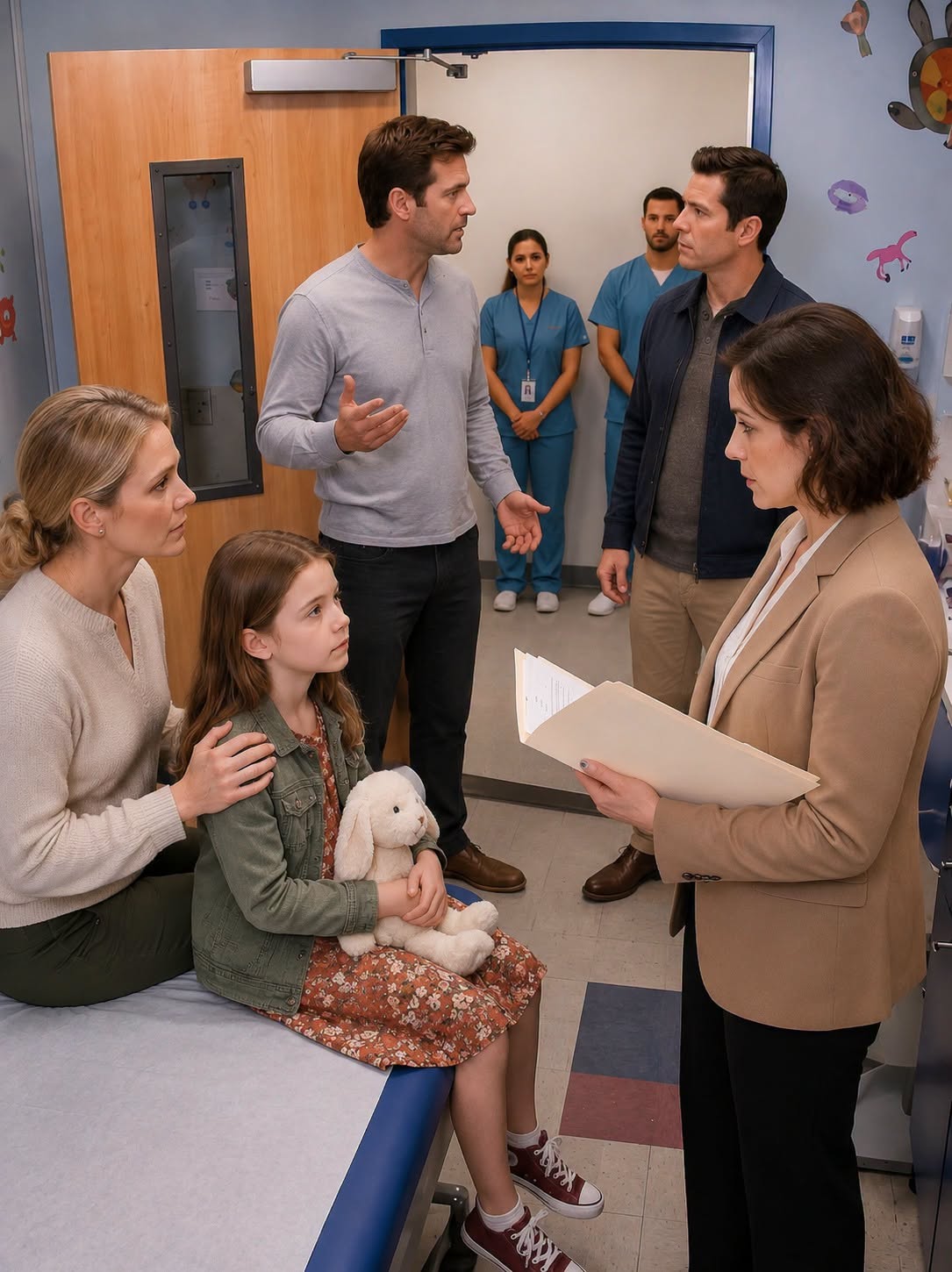

Part 1 – The Test Result That Made Everyone Look at My Husband
My name is Rachel, and before that week, I believed I already knew what the worst moment of a mother’s life felt like.
I thought it would be the phone call from a doctor saying your child was seriously ill.
I thought it would be the sound of an ambulance arriving.
I thought it would be standing helplessly beside a hospital bed, watching someone you love suffer while you could do nothing to fix it.
I never imagined the most terrifying moment would begin with a single sentence from a pediatrician.
“Rachel, I need you to come into the hallway. I need to discuss one of Sophie’s test results privately.”
Those words still replay in my mind.
Because at that moment, I had no idea that one medical result would nearly destroy my family, damage the trust between the people I loved most, and force us to confront a truth none of us could have imagined.
My daughter Sophie was ten years old.
She was bright, stubborn, funny, and the kind of child who could turn an ordinary afternoon into an adventure. She loved drawing, soccer, strawberry milkshakes, and asking endless questions about everything around her.
She was also the child I had spent the last ten years protecting.
And that was why, when something started feeling wrong, my instincts immediately told me something was not normal.
At first, I tried to convince myself it was nothing serious.
Children get sick.
They get stomach bugs.
They get tired from school.
They complain about headaches when they are stressed.
That was what I told myself when Sophie first started saying she didn’t feel well.
It began with small things.
A headache before school.
A loss of appetite at dinner.
A complaint that she felt dizzy when she stood up too quickly.
I assumed she was fighting off a virus or dealing with exhaustion from her busy schedule.
But then the symptoms started becoming harder to ignore.
She began waking up nauseous in the mornings.
Some days, she would take only a few bites of breakfast before pushing her plate away.
“I’m just not hungry, Mom,” she would say.
When I asked what was wrong, she would shrug.
“I don’t know. I just feel weird.”
That answer bothered me more than anything else.
Because children usually have an explanation.
They know if their stomach hurts.
They know if their throat is sore.
They know if something happened at school.
But Sophie couldn’t explain what she was feeling.
She only knew that something wasn’t right.
After a few weeks of watching her become more tired and pale, I finally made an appointment with her pediatrician.
Sophie wasn’t happy about missing school.
“Mom, I’m fine,” she insisted while putting on her shoes.
“You said that yesterday, and then you fell asleep on the couch at four in the afternoon.”
“I was tired.”
“You’re always tired lately.”
She rolled her eyes the way only a ten-year-old can.
“It’s probably just a stupid stomach bug.”
I smiled because that was exactly what I wanted to believe too.
A simple explanation.
Something temporary.
Something that would disappear after a few days.
I had no idea how wrong I was.
At the pediatrician’s office, the doctor examined Sophie carefully and asked her several questions.
When did the headaches start?
How often was she nauseous?
Was her vision normal?
Had she noticed any changes in her energy?
Sophie answered casually, almost like she didn’t realize how important her answers were.
“Yes, I’ve had headaches.”
“Sometimes.”
“Mostly in the morning.”
The doctor looked at me after that answer.
It was a small moment, but I noticed.
The kind of moment parents recognize immediately.
The moment when a doctor hears something that changes the way they are thinking.
The doctor ordered blood tests and urine tests to rule out several possibilities.
Sophie sat beside me in the examination room, swinging her legs while complaining that hospitals always smelled strange.
“I’m telling you, Mom, they make these places smell like cleaning products on purpose.”
I laughed because she was still my Sophie.
Still making jokes.
Still acting like everything was normal.
The nurse collected the samples, and we waited.
I expected the doctor to come back with ordinary instructions.
Drink more fluids.
Get more rest.
Maybe take medication for nausea.
I expected to leave that office feeling relieved.
Instead, when the doctor walked back into the room, I immediately knew something had changed.
Her expression was different.
She wasn’t panicked.
She wasn’t rushing.
But she was serious.
“Rachel, can I speak with you privately for a moment?”
My stomach dropped.
I followed her into the hallway while Sophie stayed inside with a nurse.
“Is she okay?” I asked immediately.
The doctor took a breath.
“I need to explain something carefully.”
I waited.
“Some of Sophie’s test results came back unusual.”
I felt my heartbeat increase.
“What kind of unusual?”
The doctor looked down at the paper in her hand.
“One of her tests showed elevated levels of hCG.”
I stared at her.
The word meant nothing to me at first.
Then she explained.
“hCG is a hormone most commonly associated with pregnancy.”
For a moment, I honestly thought I had misunderstood her.
I waited for her to continue.
I waited for the part where she would explain it was a mistake.
But she didn’t.
“She’s ten years old,” I whispered.
“I know.”
“My daughter is ten.”
“I understand, Rachel. But we need to investigate why this hormone is present.”
My mind immediately started searching for another explanation.
A laboratory error.
A mistake.
Anything.
Because the alternative was something I couldn’t even allow myself to think about.
The doctor quickly explained that the result did not automatically tell them what had happened. A positive hCG result meant the hormone was detected, but they needed more information to understand why.
Still, my mind was already racing.
My daughter.
My little girl.
How could this be happening?
I walked back into the room and looked at Sophie.
She was sitting there coloring on a piece of paper, completely unaware that my entire world had just shifted.
She looked up.
“Mom? Why do you look scared?”
I forced myself to smile.
“I’m okay, sweetheart.”
But I wasn’t.
Not even close.
The first person I called was Sophie’s biological father, Eric.
Although we had divorced years earlier, he was still Sophie’s father, and I knew he needed to know.
The moment I told him about the test result, his voice changed.
“What did you say?”
“I said the doctor found hCG in her blood.”
There was silence.
Then he asked the question I had been trying not to hear.
“Who has been alone with her recently?”
I closed my eyes.
“Eric—”
“No, Rachel. Think carefully.”
His voice became sharper.
“Who has access to her?”
I knew exactly where his thoughts were going.
And I hated that mine went there too.
Daniel.
My husband.
Sophie’s stepfather.
Daniel had been in her life for almost five years.
He was the man who helped her with homework.
The man who drove her to soccer practice.
The man who made pancakes every Saturday morning because he believed chocolate chips improved everything.
He had never given me a reason to doubt him.
Not once.
But fear has a way of making impossible thoughts feel possible.
Eric’s voice broke through my silence.
“Rachel, she needs to be away from him until we know what happened.”
My chest tightened.
Part of me immediately wanted to defend Daniel.
To say, “You’re wrong. You don’t know him.”
But another part of me—the part that was Sophie’s mother—knew one thing above everything else.
I had to protect my daughter first.
“I’ll keep her with me,” I said quietly.
When I told Daniel what the doctor had found, his face changed instantly.
Not anger.
Not defensiveness.
Pain.
“You think I could do something like that to Sophie?”
The question broke my heart because I heard how deeply it hurt him.
“Daniel, I’m not accusing you.”
“But you’re asking me to leave.”
“I don’t know what this test means yet.”
My voice shook.
“I don’t know what happened. But until we understand everything, I have to put Sophie first.”
He looked at me for a long moment.
Then he nodded slowly.
“You should put her first.”
His voice became quieter.
“I just wish you knew me well enough to know I would never hurt her.”
Those words stayed with me.
Because at that moment, I didn’t know what the truth was.
I only knew I was terrified.
And fear was already beginning to change the way I saw the people closest to me.
By the time we arrived at the hospital for further testing, Eric was already there.
His anger toward Daniel was impossible to miss.
He demanded answers.
He wanted explanations.
He wanted someone responsible.
But nobody had answers yet.
The doctors ordered more bloodwork and an ultrasound while a specialist spoke with Sophie privately.
I waited outside the room, barely able to breathe.
Every possible nightmare ran through my mind.
Then, hours later, the doctor asked Eric, Daniel, and me to meet in a consultation room.
I knew whatever she said next would change everything.
I sat down.
The doctor looked at all three of us.
Then she spoke.
“The ultrasound shows no pregnancy.”
Eric immediately leaned forward.
“Then why was the test positive?”
The doctor folded her hands.
“That is what we need to determine.”
And for the first time that day, I wondered if we had all been looking in the wrong direction.

Part 2 – The Answer Was Hidden Somewhere We Never Thought to Look
For several seconds after the doctor told us the ultrasound showed no pregnancy, nobody in the consultation room spoke.
The silence felt heavier than any accusation.
Eric had spent the last several hours convinced that we were facing one kind of nightmare. Daniel had been forced to sit there while the people around him quietly wondered whether he had done something unforgivable. And I had been trapped between two impossible fears: protecting my daughter and questioning the man I loved.
But now the situation had changed.
The one explanation everyone had immediately feared was no longer the answer.
The doctor looked at the three of us carefully before continuing.
“I understand that this result creates more questions, but I want everyone to understand something important. Sophie’s hCG level is real. The laboratory result was not a mistake.”
My hands tightened around the edge of my chair.
“If she isn’t pregnant, then what is causing it?”
The doctor paused.
“That is exactly what we need to investigate.”
She explained that hCG was most commonly associated with pregnancy, but it was not produced only during pregnancy. In rare situations, certain medical conditions could cause the body to produce the hormone.
At the time, I barely understood what she was saying.
My mind was still trying to catch up.
A few hours earlier, one test result had made everyone look at Daniel.
Now the doctors were saying the test had been telling us something completely different.
Eric leaned forward.
“Are you saying there is another reason a child could have this hormone?”
“Yes,” the doctor answered carefully. “Rare reasons. But yes.”
Eric looked toward Daniel, then quickly looked away.
For the first time since we entered the hospital, there was uncertainty on his face instead of anger.
The doctors continued examining Sophie’s symptoms.
That was when they noticed something none of us had paid enough attention to.
Her headaches.
Her nausea.
The vomiting.
Her exhaustion.
And something she had never thought was important enough to mention.
Her vision.
During another conversation with the specialist, Sophie admitted that sometimes things looked blurry.
Especially when she tried to look upward.
“I thought that happened to everyone,” she said.
The doctor immediately asked more questions.
“Do you ever see double?”
Sophie hesitated.
“Sometimes.”
My heart sank.
I turned toward her.
“You never told me that.”
She looked guilty.
“I didn’t think it mattered.”
That sentence almost broke me.
Because she was only ten years old.
She didn’t understand that small changes in her body could be important clues. She didn’t know that the things she considered normal could be the very things doctors needed to hear.
The medical team started connecting everything.
The headaches.
The morning nausea.
The vomiting.
The tiredness.
The vision problems.
The unusual hormone level.
Together, they created a picture none of us had been prepared to see.
A neurologist was called to evaluate Sophie.
When he entered the room, he was calm and gentle, the kind of doctor who knew that children noticed more than adults thought they did.
He knelt down beside Sophie’s bed.
“Can I ask you a few questions?”
She nodded.
After examining her, he stepped outside to speak with us.
“I recommend we get an MRI.”
I immediately felt panic rise in my chest.
“An MRI? Why?”
He looked at me carefully.
“Because the symptoms we’re seeing suggest we need to look beyond the original assumption.”
Eric frowned.
“But what does her brain have to do with a pregnancy hormone?”
The neurologist answered slowly.
“Pregnancy is not the only situation where the body can produce hCG.”
I felt Daniel reach toward me.
A small gesture.
Almost instinctive.
But I couldn’t look at him.
Because guilt had already started settling over me.
Only hours earlier, I had looked at him and wondered if he was capable of hurting my child.
Now I was beginning to realize that while everyone was searching for someone to blame, Sophie had been silently showing us signs that something was wrong inside her body.
The MRI was scheduled as quickly as possible.
When the nurse came to prepare Sophie, she looked nervous.
She tried to hide it, but I knew my daughter too well.
She was scared.
I walked beside her through the hallway toward the imaging department.
The hospital lights above us seemed too bright.
Everything felt unreal.
Sophie held my hand tightly.
“Mom?”
“Yes, sweetheart?”
“Do the doctors know what’s wrong with me?”
I swallowed the fear in my throat.
“Not yet. But they’re trying to find out.”
She was quiet for a moment.
Then she asked the question that hurt me more than anything else.
“Am I in trouble?”
I stopped walking.
The fact that my ten-year-old daughter thought she was somehow in trouble because adults had been asking difficult questions nearly shattered me.
I knelt down beside her.
“No, Sophie. Listen to me.”
I held her hands.
“You are not in trouble. None of this is your fault. Nothing that happens is because of something you did.”
She nodded, but I could tell she was still confused.
Children should worry about homework and friends.
They should worry about birthday parties and cartoons.
They should not be lying in a hospital bed wondering why grown-ups are afraid.
After the MRI began, Eric and I waited in silence.
Daniel stayed at the other end of the waiting room.
Not because he wanted distance.
Because he respected the boundaries we had created earlier.
That hurt even more.
Because even after being treated like someone dangerous, he was still trying to do what he thought was best for Sophie.
Forty minutes passed.
Then another ten.
Every second felt endless.
Finally, the doors opened.
The neurologist walked out with a radiologist beside him.
My heart immediately started racing.
“Is Sophie okay?”
The doctor didn’t answer right away.
That scared me more than anything.
He motioned for us to follow him into a private consultation room.
A large screen was waiting.
Sophie’s MRI images appeared.
The neurologist pointed toward an area deep inside her brain.
“There is an abnormal mass here.”
The room went completely silent.
I stared at the image.
A place inside my daughter’s head.
A place we never knew existed.
A place that explained everything.
The doctor continued carefully.
“We need more tests to determine exactly what this is, but this finding may explain the symptoms Sophie has been experiencing.”
My voice barely worked.
“Are you saying this caused the positive test?”
“It is possible.”
Eric looked confused.
“How?”
The neurologist explained that certain rare tumors, including some germ cell tumors, could produce hCG.
The same hormone that had caused the pregnancy test to come back positive.
The same hormone that had led all of us toward the wrong fear.
I felt tears forming in my eyes.
Not because I finally understood everything.
But because I realized how close we had come to destroying something precious because we misunderstood one piece of information.
Daniel had been the first person everyone suspected.
And now he was sitting outside that room, waiting to know whether the child he loved was going to be okay.
I covered my face with my hands.
The guilt was overwhelming.
The fear.
The confusion.
The shame.
Everything hit me at once.
Eric finally asked the question none of us wanted to say.
“What happens now?”
The doctor answered honestly.
“Now we focus on Sophie.”
And that sentence changed everything.
Because for the first time all day, we stopped looking for someone to blame.
We stopped searching for the person responsible.
There was only one person who mattered.
Our daughter.
When I returned to Sophie’s room, she looked at me immediately.
“Did they find out?”
I sat beside her bed.
“They found something, sweetheart. Something that might explain why you’ve been feeling sick.”
Her eyes widened.
“Is it bad?”
I wanted to lie.
I wanted to tell her everything was fine.
But I knew she deserved honesty.
“The doctors found something they need to treat. But they’re going to help you.”
She looked down at her hands.
“Am I going to be okay?”
That question was one I wished I could answer with certainty.
Instead, I hugged her.
“We’re going to do everything we can.”
A few minutes later, Daniel quietly entered the room.
He stopped near the doorway.
Sophie immediately noticed.
“Why are you standing there?”
He gave a small smile.
“I didn’t want to bother you.”
“You’re not bothering me.”
She held out her hand.
He walked over and sat beside her.
The moment I saw them together, I felt the full weight of what had almost happened.
A test result had created fear.
Fear had created suspicion.
And suspicion had almost taken away a father figure from a little girl who needed him.
But now we knew the truth.
The positive pregnancy test was never a story about what someone had done to Sophie.
It was a clue.
A frightening, confusing clue.
But a clue that had led doctors to the real danger hiding inside her.
And as I watched Daniel hold Sophie’s hand, I realized something I would never forget.
Sometimes the thing that scares you the most is not the final answer.
Sometimes it is the first clue that finally leads you toward the truth.

Part 3 – The Test That Almost Destroyed Us Became the Hope That Saved Her
The days after Sophie’s diagnosis became a blur of hospital rooms, medical conversations, and moments where time seemed to move both too quickly and painfully slowly.
One moment, I was sitting beside my ten-year-old daughter, watching her complain about hospital food and asking when she could go home.
The next, I was sitting across from a team of specialists discussing tumors, treatment plans, scans, and hormone levels I had never even heard of before.
The world Sophie and I knew had changed overnight.
But one thing became clear very quickly.
We were no longer searching for the reason behind a terrifying pregnancy test.
We finally knew the test had never been telling us what we first thought.
It had been warning us that something else was happening inside Sophie’s body.
The doctors explained everything again in a way we could understand.
The positive pregnancy test had detected hCG.
The hormone was real.
The result was real.
But the meaning behind it was completely different from what everyone had assumed.
The source was not a pregnancy.
It was the mass found inside Sophie’s brain.
The doctors believed it was an intracranial germ cell tumor, a rare condition that could produce hCG.
The same hormone that had caused panic was now becoming a medical marker.
A number the doctors could track.
A number that could help them understand whether Sophie was responding to treatment.
It was difficult to accept that something so terrifying could also become something useful.
The result that had made me feel like my entire world was collapsing was now one of the things giving us hope.
But before we could move forward, there was something I needed to face.
Daniel.
Even though Sophie’s health was our priority, I could not forget what had happened between us.
I remembered his expression when I told him I needed him to stay away from Sophie.
Not anger.
Not resentment.
Just heartbreak.
He had spent five years loving my daughter.
Helping raise her.
Showing up for her.
And in the space of a few hours, one test result had made him feel like everything he had built with her could disappear.
I found him alone near the hospital elevators one evening.
He was carrying Sophie’s favorite blanket and a bag filled with things she needed.
Her headphones.
Her drawing supplies.
Her stuffed fox she had slept with since she was little.
Even after everything, he was still thinking about her comfort.
I stood there for a moment before finally speaking.
“Daniel.”
He turned around.
“I’m sorry.”
He looked at me quietly.
I continued before I lost my courage.
“I’m sorry I looked at you and wondered if you could hurt her.”
His expression softened, but he didn’t immediately answer.
“Rachel…”
“No. I need to say this.”
My voice shook.
“I know protecting Sophie was my responsibility. I know I had to take every possibility seriously. But I also know that fear made me forget who you were.”
Daniel looked down.
For several seconds, neither of us spoke.
Then he finally said something I would never forget.
“You were scared for your daughter.”
A tear slipped down my cheek.
“That doesn’t mean it didn’t hurt you.”
“No,” he admitted quietly. “It hurt.”
His honesty hurt more than anger would have.
Because anger would have been easier.
But he wasn’t trying to punish me.
He was just telling the truth.
“I spent that whole day wondering if the person I loved thought I was capable of something horrible.”
I closed my eyes.
“I know.”
“But I also knew Sophie needed you to be her mother first.”
That was Daniel.
Even after being wounded, his first thought was still Sophie.
We didn’t pretend everything was instantly fixed.
Trust doesn’t repair itself in one conversation.
Some wounds need time.
But we decided that what happened would not become another thing that damaged our family.
We would talk about it.
We would face it.
And we would rebuild.
Because Sophie needed us stronger, not divided.
Eric also had his own apology to make.
A few days later, he found Daniel in the hospital cafeteria.
I was nearby when I heard Eric speak.
“I owe you an apology.”
Daniel looked up.
Eric took a deep breath.
“I heard that test result and immediately assumed the worst.”
Daniel stayed silent.

“I was angry. I was terrified. And I focused on finding someone responsible before we even knew what happened.”
He looked down.
“I could have destroyed your life.”
Daniel nodded slowly.
“You were afraid.”
“That doesn’t excuse it.”
“No,” Daniel said. “It doesn’t.”
The conversation was uncomfortable, but it was necessary.
They didn’t suddenly become best friends.
They didn’t forget everything.
But something changed.
The competition between them disappeared.
They were no longer two men fighting for a place in Sophie’s life.
They were two people who loved the same child and needed to protect her together.
Treatment began soon after.
The weeks that followed tested all of us.
There were hospital visits.
Medication schedules.
Blood tests.
Long conversations with doctors.
There were mornings when Sophie was too tired to get out of bed.
There were afternoons when she just wanted to watch movies and forget that hospitals existed.
But Sophie remained Sophie.
That was the thing that amazed me.
Even during the hardest days, she found ways to make us smile.
One afternoon, after a treatment session, she looked at the hospital meal tray and frowned.
“Mom, I think this food is part of the treatment.”
I laughed.
“What do you mean?”
“No child would willingly eat this. They’re trying to make me stronger by surviving it.”
Even the nurse laughed.
That was my daughter.
Still funny.
Still stubborn.
Still fighting.
Daniel adjusted his entire life around her treatment.
He learned every medication name.
He wrote down questions before every appointment.
He kept track of symptoms because he wanted to notice every small change.
Eric also became different.
He stopped looking at Daniel as a threat.
Instead, he started seeing him as someone who genuinely loved Sophie.
And Sophie noticed.
Children notice more than adults think.
One evening, while we were sitting together in the hospital room, Sophie looked between Daniel and Eric.
“You two don’t argue anymore.”
Eric smiled.
“We’re trying not to.”
“Good,” she said seriously.
Then she added:
“Because I’m tired of being the reason adults act weird.”
Her words hit all of us.
Because she was right.
She had already been carrying enough.
The doctors continued monitoring Sophie’s hCG levels throughout treatment.
Every blood test became a moment of fear and hope.
I hated that number.
But I also depended on it.
The first time I heard about hCG, I thought it meant my daughter’s life had been destroyed.
Now, every time the number dropped, I felt a little more hope.
The oncologist reminded us that one result alone could not determine everything.
They looked at scans.
Symptoms.
Overall progress.
But the downward trend was exactly what they wanted to see.
One day, Sophie noticed me staring at her bloodwork.
“Mom?”
“Yes?”
“Are you looking at the pregnancy number again?”
I almost laughed.
“Yes.”
She tilted her head.
“But I wasn’t pregnant.”
“No.”
“Then why is it there?”
I smiled sadly.
“Because your body was making something that helped doctors find out what was happening.”
She thought about that.
“So it was a confusing clue.”
“Exactly.”
She nodded.
“I guess my body was trying to tell everyone something.”
That sentence stayed with me.
Because it was true.
Her body had been trying to communicate.
We just misunderstood the message at first.
Months passed.
Slowly, things began improving.
Sophie’s headaches became less frequent.
Her nausea became easier to manage.
Her energy started returning.
She still needed follow-up appointments and continued monitoring, but the doctors finally began talking about the future instead of only talking about the next emergency.
That was the moment I realized we had turned a corner.
One morning, Sophie returned to school on a reduced schedule.
Daniel drove her.
Eric met us outside.
Watching the two of them stand together felt almost impossible compared to where we had started.
Months earlier, they had barely been able to look at each other.
Now they were discussing who would pick Sophie up after class.
Sophie rolled her eyes.
“You know, having three adults follow me everywhere makes me feel famous.”
I laughed.
“You’re not famous.”
“Yes, I am.”
“For what?”
She smiled.
“For surviving hospitals.”
And honestly?
She was right.
Nearly a year after that first terrifying appointment, we returned for another follow-up.
The doctor reviewed Sophie’s latest scans and bloodwork.
The results were encouraging.
Her hCG levels continued moving in the right direction.
The treatment had worked.
The tumor had responded.
Sophie still had a journey ahead, but the future no longer felt impossible.
As we left the appointment, Sophie held my hand.
Then she asked:
“Mom?”
“Yes?”
“Do you still hate pregnancy tests?”
I laughed.
“I have complicated feelings about them.”
She smiled.
“But mine helped the doctors find the tumor, right?”
I looked at my daughter.
The same little girl whose unexpected test result had almost destroyed everything.
The same little girl who had spent months fighting something she never understood.
“Yes,” I said softly. “It helped them keep looking.”
Sophie nodded.
“Then I guess it wasn’t a bad test.”
She looked out the car window.
“It was just confusing.”
Her words were simple.
But they explained everything.
The test itself never betrayed us.
It never accused Daniel.
It never lied.
It only showed us a signal.
A clue.
What almost destroyed our family was not the result.
It was everything we assumed before we understood it.
Fear made us jump to the worst possible conclusion.
Fear made us look for someone to blame.
Fear almost took away a person who had spent years loving my daughter.
But the truth was waiting somewhere else.
Hidden inside a medical mystery we never expected.
The same test that brought our family to the edge of breaking apart eventually became the clue that helped doctors save Sophie.
And every time I think back to that day, I remember something important.
Sometimes the first answer you receive is not the truth.
Sometimes it is only the beginning of the search.
And sometimes the thing that scares you the most is the very thing that leads you to the hope you desperately need.