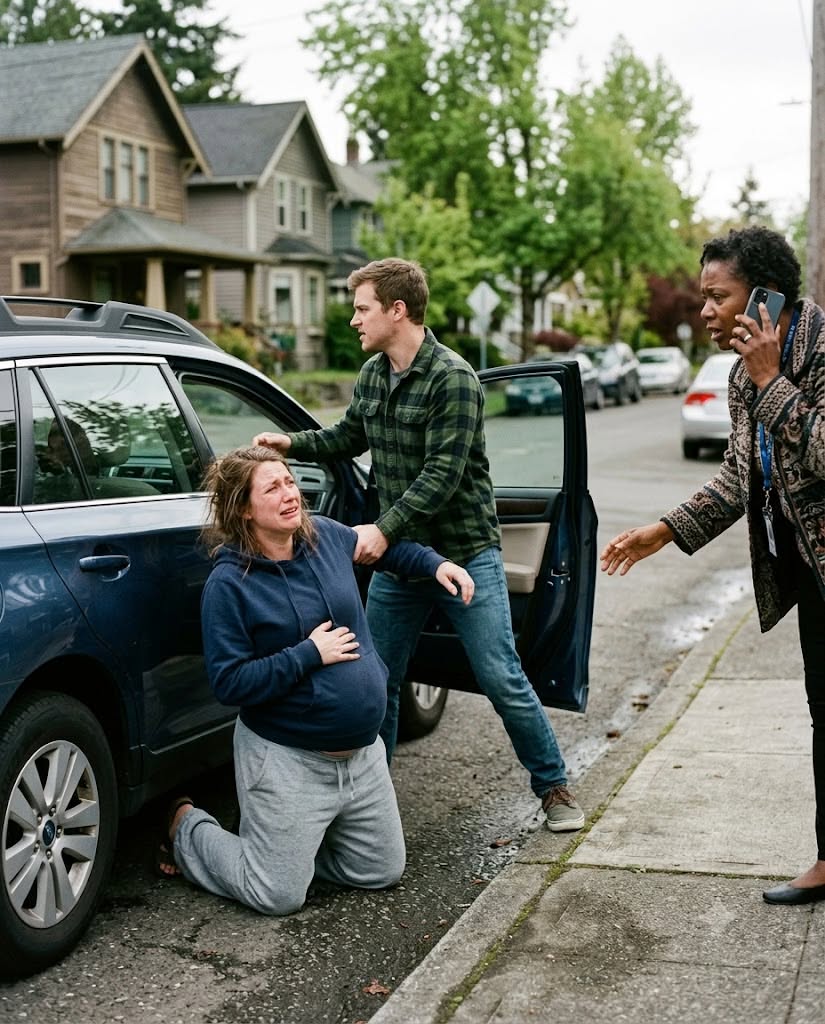
My name is Claire.
That morning, Eric was driving me to my prenatal appointment before heading to work.
About fifteen minutes into the drive, a sudden, stabbing pain tore across my stomach.
“Eric, please pull over.”
“You’re fine.”

Another wave hit me.
This one was stronger.
“No. Something feels wrong.”
Eric suddenly turned onto a quiet side street and slammed on the brakes.
Then he looked at me with anger in his eyes.
“You always do this. Every time something matters to me, suddenly you need attention.”
I stared at him in disbelief.
“I’m eight months pregnant.”
“Stop pretending.”
He got out, walked around to my side, opened the door, and grabbed my arm.
“Eric, you’re hurting me.”
“Then get out.”
My feet hit the pavement.
Another cramp ripped through me, forcing me to bend over.
“Please,” I begged. “Take me to the hospital.”
Instead, Eric climbed back into the driver’s seat.
“My purse is still inside!”
He lowered the window.
“You’ll figure it out.”
Then he drove away.
Just like that, he left me standing alone on the street.
I struggled to stay upright until a woman named Dana noticed me.
She immediately called 911.
At the hospital, the doctors told me I was showing signs of early labor and possible placental complications.
My baby’s heartbeat was still strong.
But they needed to stop the contractions before things got worse.
My sister Megan arrived first.
The moment she saw the bruises beginning to form on my arm, she called our father.
Dad listened without saying much.
Then he asked one question.
“Did Eric put his hands on her?”
“Yes.”
Dad hung up.
Forty minutes later, my phone rang.
“Claire, you’re not going home with him tonight.”
Before I could respond, a nurse entered the room.
“There’s a police officer here who would like to speak with you.”
I looked at Megan.
“Why?”
She answered quietly.
“Because Dana told the paramedics exactly what she saw.”
And that was when I realized Eric had a much bigger problem than simply having to answer my accusations.
This time, it wasn’t just my word against his.
There was a witness.
And while I was lying in a hospital bed, Dad was already taking care of the house.
The nurse had barely finished speaking when the police officer stepped into my room.
He introduced himself and asked if I was Claire.
I nodded.
He pulled a chair beside my bed.
“I need to ask you about what happened this morning.”
My hands tightened around the blanket.
“I told you, I didn’t have my phone or purse. My husband drove away.”
“I know,” he said. “A woman named Dana called 911. She stayed with you until the ambulance arrived.”
I nodded again.
“She saw everything.”
The officer opened his notebook.
“Did your husband physically remove you from the vehicle?”
I looked down at the bruises forming around my arm.
“Yes.”
“And did he know you were eight months pregnant?”
“Yes.”
“Did you tell him you believed you were having a medical emergency?”
“Yes.”
The officer wrote something down.
Then he looked at me.
“Claire, your husband may try to tell people that you were exaggerating or that he didn’t understand how serious the situation was. But we have a witness who says otherwise.”
For the first time that day, I felt like someone believed me without asking me to prove that I was hurt.
Then the door opened.
My father walked in.
His expression was completely different from the man I knew that morning.
Calm.
Controlled.
But angry underneath.
“Dad?”
He came straight to my bedside.
“How are you?”
“The doctors say the baby is stable.”
He nodded.
Then he looked at the officer.
“Did she tell you everything?”
“Yes.”
Dad’s jaw tightened.
“I see.”
The officer stood.
“I’ll need a formal statement once she’s medically stable enough.”
Dad nodded.
“You’ll get it.”
The officer left.
For several seconds, neither of us spoke.
Then Dad pulled the chair closer.
“Claire, you’re not going home with Eric tonight.”
I stared at him.
“Where am I supposed to go?”
“With us.”
“Dad…”
“No.”
His voice was firm.
“You’re eight months pregnant. You were left on the side of the road without a phone, without your purse, and without anyone to help you.”
He paused.
“That’s not a husband having a bad day.”
I looked away.
Because deep down, I knew he was right.
I’d spent years making excuses for Eric.
He was stressed.
He was tired.
Work was difficult.
He didn’t mean it.
I had told myself those things so many times that they had started to sound like facts.
But today, there was no excuse left.
A stranger named Dana had shown me more concern in ten minutes than my own husband had shown me in months.
Then Megan walked back into the room.
She was carrying a bag.
“I brought you some clothes.”
She placed it beside my bed.
“Thank you.”
She sat beside me.
Then she looked at Dad.
“Did you do it?”
Dad nodded.
“It’s done.”
I frowned.
“Did you do what?”
Dad looked at me.
“I changed the locks.”
My heart skipped.
“On the house?”
“Yes.”
“Dad, that’s Eric’s house too.”
“He can deal with that later.”
“Dad…”
“He abandoned you while you were having contractions.”

His voice softened.
“I am not going to let him walk back into that house tonight and pretend nothing happened.”
I didn’t know what to say.
Then my phone—my sister’s phone—started ringing.
Megan looked at the screen.
“It’s Eric.”
No one moved.
It stopped.
Then started again.
Dad looked at me.
“You don’t have to answer.”
I shook my head.
“I don’t want to.”
Megan silenced the call.
A few seconds later, a message appeared.
Claire, where are you? We need to talk.
Then another.
I’m sorry. I was angry.
Then another.
Please don’t make this bigger than it is.
I stared at the screen.
That last message changed something inside me.
Don’t make this bigger than it is.
I looked at the bruises on my arm.
At the hospital monitor beside my bed.
At my father’s face.
And I finally understood.
He still didn’t get it.
He wasn’t sorry that he had abandoned me.
He was sorry that there might be consequences.
Hours later, the contractions finally slowed.
The doctors told me the baby was stable, but I would need strict monitoring and bed rest.
That evening, Eric came to the hospital.
I heard his voice before I saw him.
“Where is Claire?”
A nurse tried to stop him.
“Sir, you need to wait.”
“I’m her husband.”
Then Dad stepped into the hallway.
“You’re not going in.”
Eric stopped.
“What?”
“You heard me.”
“I need to see my wife.”
“You had your chance.”
Eric’s face hardened.
“This is between Claire and me.”
“No.”
Dad took one step closer.
“You made it everyone’s business when you left my pregnant daughter on the side of the road.”
Eric glanced toward my room.
“I didn’t know it was that serious.”
“You knew she was eight months pregnant.”
“She was panicking.”
“She was in pain.”
Eric shook his head.
“She does this all the time.”
Dad’s expression changed.
“You’re still saying that?”
Eric fell silent.
Then the police officer stepped into the hallway.
Eric immediately looked nervous.
The officer approached him.
“Mr. Carter?”
“Yes?”
“I need to speak with you.”
Eric looked at Dad.
Then at the officer.
“About what?”
“About what happened this morning.”
“I already explained.”
“You haven’t explained it to me.”
The officer’s voice remained calm.
“But a witness has.”
Eric’s face lost its color.
He looked toward my hospital room.
And for the first time, I saw something in his eyes I hadn’t seen that morning.
Fear.
Not concern.
Not regret.
Fear of consequences.
The next morning, I gave my formal statement.
I told the truth.
Every detail.
I told them about the pain.
His refusal to stop.
The way he grabbed my arm.
The way he left.
And the fact that my purse and phone were still inside his car.
Dana gave her statement too.
She described exactly what she had witnessed.
That made all the difference.
It wasn’t my word against Eric’s anymore.
There was an independent witness.
There were medical records.
There were bruises.
And there was the emergency call.
Eric could no longer rewrite what happened.
A week later, I was released from the hospital.
But I didn’t go home.
I went to my parents’ house.
Eric had expected me to return.

Instead, he came home to a house with changed locks and a note from my attorney.
He called me dozens of times.
I didn’t answer.
He sent flowers.
I returned them.
He apologized.
Then blamed me.
Then apologized again.
Eventually, he asked to see the baby.
That was the hardest part.
Because I never wanted my child to grow up believing his father didn’t love him.
But I also couldn’t pretend that what Eric had done was acceptable.
So I made a decision.
I would protect my child without using him as a weapon against his father.
And I would protect myself without feeling guilty for it.
The divorce process began soon afterward.
Eric fought at first.
He claimed I had overreacted.
He said he had been under pressure.
He said he never intended to hurt me.
But every version of his story collapsed against the evidence.
Dana’s statement.
The police report.
The hospital records.
The bruises.
Everything.
Months later, our son was born.
He arrived early, but healthy.
The moment the nurse placed him in my arms, I cried.
Not because I was afraid anymore.
Because I finally felt safe.
My father stood beside my bed.
Megan was crying.
And for the first time in months, I wasn’t wondering whether I was making the right decision.
I knew I was.
Eric eventually received supervised visitation.
He was required to complete counseling and anger-management treatment.
But I never went back to him.
I couldn’t.
Not after that day.
Not after realizing that the person I trusted most could look at a woman carrying his child, see her in pain, and still decide that she was an inconvenience.
Years passed.
My son grew up surrounded by people who loved him.
He knew his father.
But he also knew what respect looked like.
And I learned something I wish I’d understood much earlier.
Love isn’t someone telling you that you’re too sensitive.
Love isn’t someone making you question your own pain.
Love isn’t someone leaving you alone when you’re terrified.
Love is stopping the car when the person beside you says something is wrong.
Love is staying.
Love is listening.
Love is showing up.
The morning Eric drove away, I thought he had abandoned me.
I was wrong.
That was the morning I finally stopped abandoning myself.