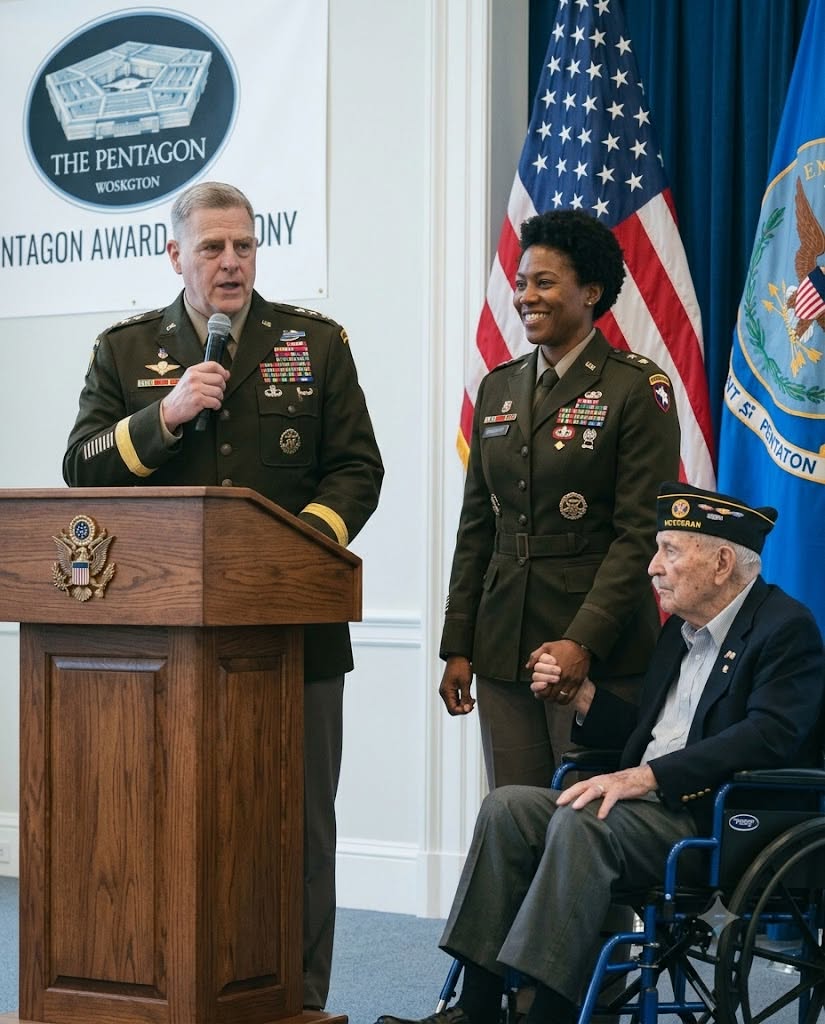
My name is Staff Sergeant Maya Parker.
My grandfather was turning ninety, and our family had organized a grand military tribute for him just outside Washington, D.C.
He had served during the Korean War, and I had always been incredibly proud of him.
My family, however, had never been particularly proud of me.

My older brother, Daniel, was a successful corporate executive. My father never stopped talking about his promotions. My younger sister had married into a wealthy family.
And then there was me.
I had chosen the Army.
To my father, that meant I was the daughter who had “settled.”
The moment I stepped out of the SUV in my dress uniform, Daniel looked me up and down.
“You actually wore that?”
I glanced at my uniform.
“Yes.”
His wife, Ashley, looked at the ribbons on my chest.
“Isn’t all that a little dramatic for a family event?”
I smiled politely.
“It’s a military ceremony.”
Daniel laughed.
“That doesn’t mean you need to turn it into your ceremony.”
I said nothing.
Then my father found me inside the ballroom.
“Maya, we need to talk.”
“About what?”
He lowered his voice.
“There are senators, CEOs, generals, and some very important donors here today.”
“I noticed.”
“We don’t need you drawing attention.”
I stared at him.
“Because I’m wearing my uniform?”
He sighed.
“Compared with what Daniel has accomplished, being a career soldier isn’t exactly impressive anymore.”
My mother was standing nearby.
She heard every word.
But she said nothing.
Somehow, her silence hurt more than anything my father had said.
I walked outside before I could say something I would regret.
Then my phone rang.
“Staff Sergeant Parker?”
“Yes?”
“The Pentagon delegation has arrived.”
I looked back through the glass doors.
My family had absolutely no idea what was about to happen.
Months earlier, I had been notified that I would receive a major military commendation for my leadership during an overseas rescue operation.
The presentation had been kept completely quiet.
At my request, it had been added to my grandfather’s ceremony because I wanted his ninety years—and his service—to remain the focus of the day.
So I walked back into the ballroom.
Daniel was still laughing with a group of executives.
My father was busy greeting important guests.
Nobody asked where I had gone.
Nobody even seemed to notice.
So I quietly took my seat.
About an hour later, the lights suddenly dimmed.
A four-star general walked onto the stage.
He began by speaking about my grandfather.
His courage.
His service.
His generation.
Then he stopped.
He looked across the ballroom.
“Ladies and gentlemen, today we are honoring not one hero—but two.”
My father’s head slowly turned toward me.
Daniel’s smile disappeared.
And the general looked directly at my section.
The general held my gaze for a moment.
Then he smiled.
“Staff Sergeant Maya Parker, please come forward.”
For a second, I didn’t move.
Daniel looked at me as if he couldn’t understand what he was hearing.
My father stared at the stage.
My mother finally covered her mouth with one hand.
I stood.
The ballroom fell completely silent as I walked toward the stage.
The general extended his hand.
“Your grandfather served his country with honor during the Korean War.”
He turned toward my grandfather.
“Today, we honor his service and the legacy he passed on to the next generation.”

My grandfather’s eyes filled with tears.
Then the general looked back at me.
“During an overseas rescue operation, Staff Sergeant Parker assumed command after her unit lost communication with its commanding officer.”
A screen behind him lit up.
It displayed photographs from my deployment.
I heard someone whisper behind me.
“That’s Maya?”
The general continued.
“Under extremely difficult conditions, she coordinated the evacuation of injured personnel and helped bring every member of her team home safely.”
The room remained silent.
Then he held up a small presentation box.
“For exceptional leadership and courage, the United States Army is proud to present Staff Sergeant Maya Parker with the Distinguished Service Commendation.”
Applause erupted.
I felt my eyes burn.
But I wasn’t looking at the audience.
I was looking at my grandfather.
He was crying openly now.
I walked over to him first.
He reached for my hand.
“I knew,” he whispered.
I smiled.
“You knew?”
He nodded.
“Your father didn’t tell me. But I always knew what kind of soldier you were.”
That was the moment I finally understood why the ceremony had been arranged this way.
It wasn’t meant to embarrass my family.
It wasn’t even meant to prove them wrong.
It was meant to remind me that someone had always seen me.
The general stepped back toward the microphone.
“There is one more thing.”
The applause stopped.
He looked toward my grandfather.
“Your granddaughter requested that today’s ceremony remain focused on you.”
My grandfather looked at me.
“She specifically asked that her commendation not be announced until after your tribute.”
A murmur moved through the ballroom.
The general smiled.
“She did not want to take anything away from your ninety years of service.”
My grandfather squeezed my hand.
“You never did,” he said.
Then he turned toward the audience.
“My granddaughter never settled.”
His voice was quiet, but every person in the ballroom heard him.
“She chose something difficult.”
He looked at me.
“And she became exactly the kind of person I hoped she would become.”
My father lowered his eyes.
Daniel wasn’t smiling anymore.
After the ceremony, people began approaching me.
The same executives who had barely acknowledged me earlier now wanted to shake my hand.
One of the senators congratulated me.
Several officers asked about my deployment.
Daniel stood several feet away, watching.
Eventually, he walked over.
“Maya.”
I turned.
He looked uncomfortable.
“I was wrong.”
I said nothing.
He glanced at my medals.
“I shouldn’t have mocked them.”
I nodded.
Then my father approached.
For a moment, neither of us spoke.

Finally, he said,
“I didn’t understand what you had accomplished.”
I looked at him.
“No. You didn’t.”
He swallowed.
“I was proud of Daniel because I understood his success.”
I waited.
“But I didn’t understand yours.”
I didn’t need an apology.
I didn’t need him to suddenly become the perfect father.
I simply said,
“You don’t have to understand it.”
He looked surprised.
“Just don’t call it settling.”
He nodded slowly.
“I won’t.”
Across the ballroom, my grandfather raised his glass.
Everyone turned toward him.
He smiled.
“To ninety years,” he said.
Then he looked directly at me.
“And to the next generation.”
The room erupted in applause.
I stood beside him in my uniform, my medals catching the light.
For years, my family had measured success by corner offices, promotions, money, and titles.
That night, none of those things mattered.
Because my grandfather had spent his life serving his country.
And I had spent mine following the example he gave me.
I hadn’t settled.
I had chosen.
And for the first time, my family finally understood the difference.