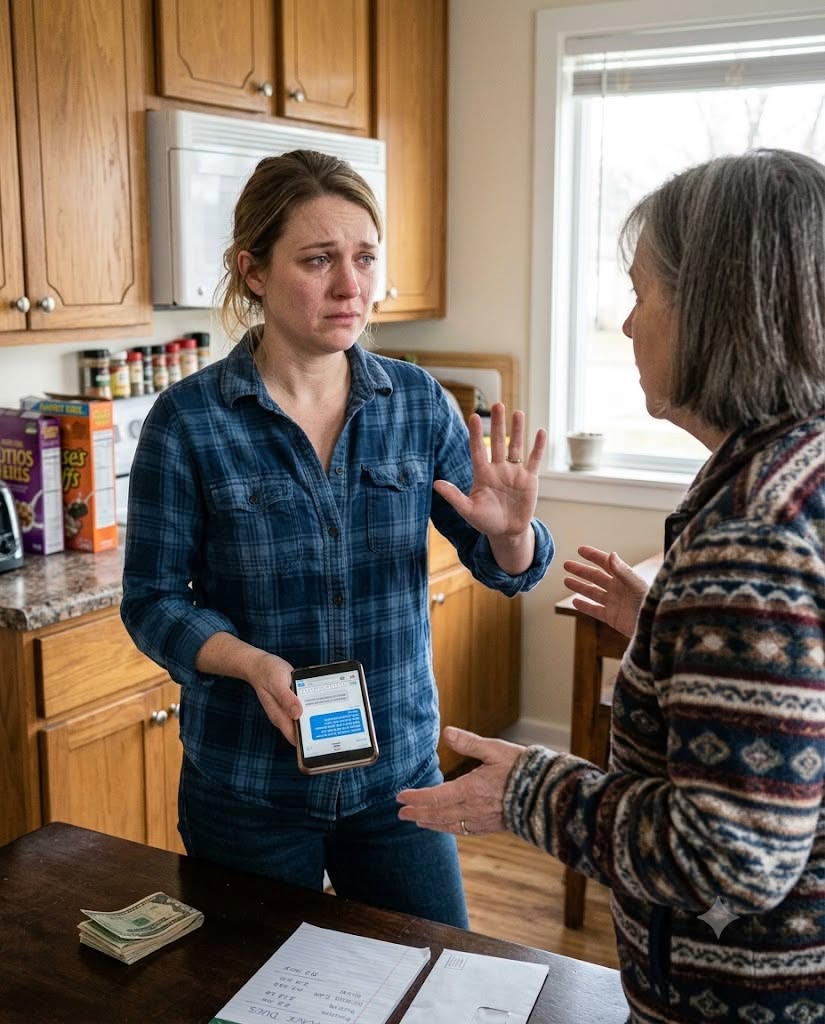
The first time I told my mother no, she went completely silent.
Three seconds passed.
Then she laughed.

Not a nervous laugh. Not the kind of laugh someone gives when they don’t know how to respond.
It was cold. Cruel. Almost delighted—as if I had just told her the funniest joke she’d heard all year.
“Emily,” she said slowly, “you’re not serious.”
“I am.”
It was Thursday night, exactly 8:00 p.m.
Just like every month for the past ten years, my mother had called.
“The mortgage is overdue,” she ordered. “Pay it tonight.”
I closed my laptop and leaned back in my chair.
“And send Jenna twelve thousand dollars,” she continued. “Her housewarming is Saturday, and she still needs furniture.”
For a moment, I said nothing.
On my computer screen was the biggest professional opportunity of my life—a contract worth more money than my parents had earned in twenty years.
And for the first time, I wanted to use my money for myself.
So I took a breath.
“No.”
Silence.
“What did you say?”
“I said no.”
Her voice changed instantly.
“You’ve gotten arrogant.”
I almost laughed.
For ten years, I had paid that mortgage.
When Dad’s business collapsed, I covered the payments.
When Jenna leased a new car, I paid the deposit.
When she went to graduate school, I helped with her tuition.
When she got married, I paid for the venue.
And when Mom decided the kitchen needed renovating, she called it “protecting the value of the family property.”
Every emergency somehow became my emergency.
Every bill somehow became my responsibility.
And every time I received a raise, they celebrated for about five minutes before figuring out how much more they could ask me for.
I was thirty-four years old.
I lived in a modest apartment because almost half of my income disappeared into that house.
Yet somehow, I was still the selfish one.
“Family comes first,” Mom snapped.
“No,” I said quietly. “Respect comes first.”
That was when she exploded.
“You ungrateful little ingrate! After everything we’ve done for you?”
I looked at the framed professional license hanging above my desk.
“You’ve always been the responsible one,” she continued. “Jenna has a future. You don’t have children. You don’t have a husband. What else are you going to do with your money?”
That question hurt more than she could have known.
Because she wasn’t really asking what I wanted.
She was telling me that my life existed to finance theirs.
“You’ve had your answer,” I said.
“No, Emily. You don’t get to suddenly rewrite how this family works.”
Then she hung up.
Ten minutes later, Jenna texted me.
Mom says you’re having some kind of breakdown. Send the money and stop embarrassing yourself.
Then Dad called.
“Just pay it, Em. You know how your mother gets.”
Something inside me finally went quiet.
I didn’t argue.
I didn’t cry.
Instead, I opened a folder I had been avoiding for six months.
Mortgage statements.
Bank transfers.
Property records.
Tax documents.
And then I found one document I had almost forgotten existed.
My grandfather’s trust agreement.
I read it once.
Then again.
Then a third time.
My hands started shaking.
The house wasn’t my parents’ property.
Grandpa had placed it into a trust.
And when I turned thirty, I had automatically become the successor trustee.
That had happened four years ago.
For four years, I had possessed legal authority over the house.
And for four years, I had deliberately done nothing.
Because they were my parents.
Because I believed family meant forgiveness.
Because I kept telling myself that eventually, they would appreciate everything I had sacrificed for them.
I called the attorney who had handled Grandpa’s estate.
“Mr. Hale?”
“Yes?”
“I need to enforce the occupancy agreement.”
There was a long pause.
“Emily, are you certain?”
I looked at Jenna’s message again.
Know your place.
“Yes,” I whispered.
“I’m certain.”
Mr. Hale exhaled slowly.
“Then we need to move quickly.”
“Why?”
Another pause.
“Because your mother has already taken steps to refinance the property.”
My stomach dropped.
“What?”
“She doesn’t have the authority.”
“Then how did she—”
“That’s what we’re going to find out tomorrow morning.”
I stared at the folder in front of me.
Suddenly, this wasn’t about twelve thousand dollars.
It wasn’t even about the mortgage.
Someone had tried to use a house they didn’t own as collateral.

By 8:30 the next morning, I was sitting across from Mr. Hale in his oak-paneled office.
A stack of certified county filings lay spread across the desk between us.
When he opened the local branch manager’s preliminary packet, the pieces finally came together.
And the truth made my stomach turn.
Two weeks earlier, my mother had walked into a private lending firm with a forged power of attorney bearing my name.
She had attempted to take out a $220,000 cash-out equity loan against the house.
And she had told the loan officer exactly what the money was for.
Jenna’s new luxury colonial.
Suddenly, the $12,000 she had demanded for furniture made sense.
She wasn’t simply asking me for another handout.
She had tried to steal nearly a quarter of a million dollars in equity from a house she didn’t own—and put my legal name and credit on the line to pay for it.
The loan was scheduled for final funding at 10:00 that very morning.
“If this had closed,” Mr. Hale said grimly, “you would have been trapped in years of litigation just to clear your credit. Your mother committed outright bank fraud.”
“Stop it,” I said.
My voice was cold.
Steady.
“Cancel the loan, notify their fraud division, and trigger the revocation clause in the trust.”
Mr. Hale studied me carefully.
“Emily, if I execute the trust’s revocation clause, their occupancy permit ends immediately. They’ll have thirty days to vacate, or the sheriff will remove them.”
I looked at my reflection in the dark glass of the office window.
Ten years of working eighty-hour weeks.
Ten years of scrimping.
Ten years of driving a battered sedan and denying myself vacations while they mocked my single life and treated me like an ATM.
I had spent a decade sacrificing for people who believed they were entitled to everything I earned.
“Serve them,” I said.
“Today.”
At 11:15 that morning, Mom, Dad, and Jenna were gathered around the granite dining table in my grandfather’s house.
They were sipping coffee and flipping through high-end furniture catalogs for Jenna’s living room.
Mom had already called me three times that morning.
Each voicemail was more venomous than the last.
If I didn’t wire the $12,000 by noon, she threatened to disown me.
Instead of a wire confirmation, their doorbell rang.
It wasn’t a furniture delivery.
A process server stood on the porch with a county sheriff’s deputy.
When my mother opened the door, expecting a courier, she was handed an official cease-and-desist from the lender’s anti-fraud unit, an emergency freeze notice covering all pending transactions, and a formal Thirty-Day Notice to Vacate the premises.
Ten minutes later, my phone lit up.
Not once.
Not twice.
It rang over and over like an alarm.
I finally answered and put it on speaker.
“Emily! What is this madness?!” my mother shrieked.
Her voice was frantic.
“There are police at our door! They gave us papers saying we have to leave our own home! Did you do this?”
“It isn’t your home, Mother,” I said calmly.
“It never was.”
The line went silent for a second.
“Grandpa left the property to the trust, and I am the sole trustee. Did you really think you could forge my signature on a $220,000 loan and I wouldn’t find out?”
A dead, suffocating silence fell over the phone.
Then Dad’s trembling voice came through.
“Emily… what did you do?”
For the first time, I heard something completely different in my mother’s voice.
The cruelty was gone.
The arrogance was gone.
All that remained was fear.
“Emily, listen to me,” she whispered. “We can talk about this. We’re your family! You wouldn’t throw your own parents onto the street! You wouldn’t ruin Jenna’s life!”
I closed my eyes.
“You told me last night to know my place,” I said quietly.
“My place isn’t your scapegoat.
It isn’t your personal bank.
My place is the sole owner and trustee of this estate.”
She said nothing.
“The fraud department offered to hand this over to the district attorney unless the application was voluntarily withdrawn and the property was vacated without incident.”
I paused.
“You have twenty-nine days left.”
“Start packing.”
Then I hung up.
And I blocked every single one of their numbers.
Over the next month, they tried everything.
They reached out through cousins.
Aunts.
Family friends.
They told everyone a carefully edited version of the story—a cruel daughter throwing her aging parents out of their home.
But Mr. Hale sent one collective letter detailing the certified forged documents and the decade of bank transfer receipts proving that I had paid every single dime.
The family went silent.
No one offered to take my parents in.
No one volunteered to pay Jenna’s bills.
And, for the first time, my family had to face the consequences of the choices they had made without me.

By the end of the month, the house was empty.
I didn’t move into it.
There were too many ghosts of their entitlement echoing through those hallways.
Instead, I put the house on the market.
It sold for top dollar in a booming market.
I took the proceeds, combined them with the money from my new career contract, and bought myself a breathtaking penthouse loft overlooking the harbor.
A few weeks after closing, I sat on my sun-drenched balcony with a glass of crisp wine in my hand.
The water stretched quietly beyond me.
No phone calls.
No demands.
No bills from Mom.
No emergencies that somehow belonged to me.
For the first time in ten years, the end of the month arrived.
And for the first time in my life, I didn’t feel afraid of it.
I was finally free.