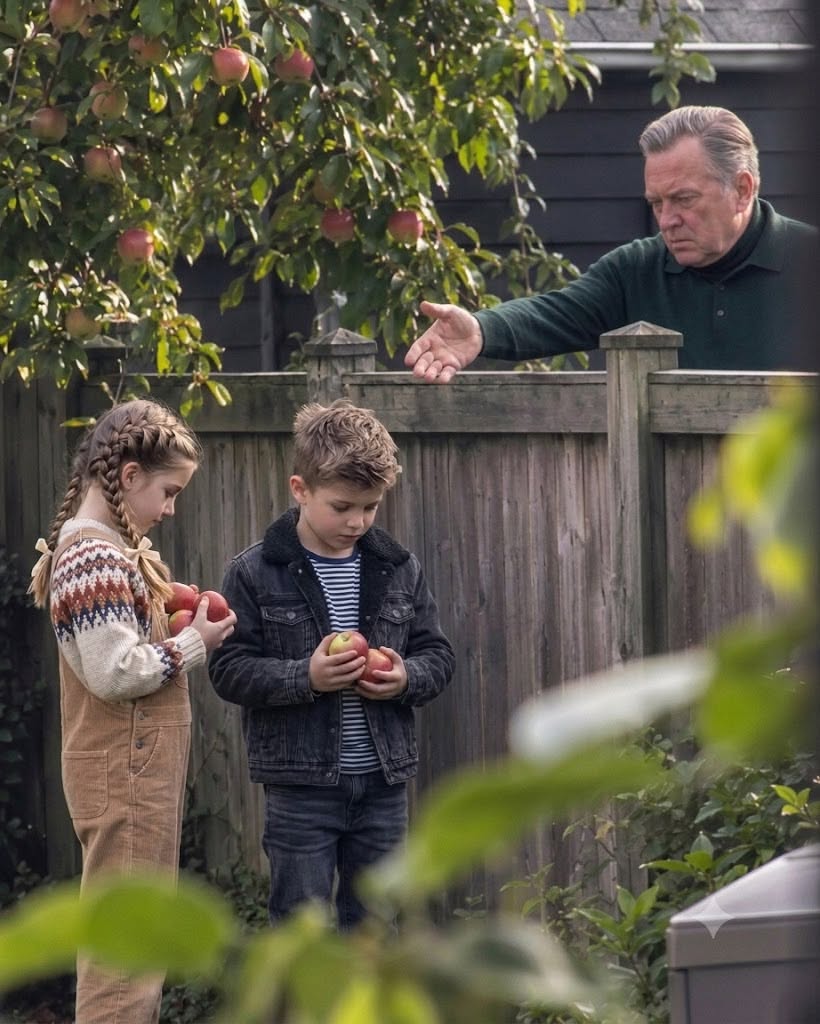
It took me four trips across the yard to realize what my six-year-old was doing.
Her arms were packed with apples.
But she wasn’t bringing them into the house.
She was taking them to the fence.
To Dale.

The apple tree belonged to him. But about a third of its branches stretched over our property, which meant that every August, his apples ended up scattered across our grass, buried in our flower bed, underneath the swing set, and all over the driveway.
I’d been raking them up for nine years.
Two years ago, one rotten apple had fallen against our shed and ruined the paint. The stain was still there.
That Sunday, after lunch, Maya and Leo went outside and started collecting the windfall apples, dropping them into an old bucket.
No one had told them to do it.
There were so many apples that you could barely walk across the yard without stepping on one.
Then Dale appeared on his side of the fence.
“Those are mine. Bring them here.”
Leo looked confused.
“What?”
“All of them. Every single one that fell from my tree. Bring them to the fence.”
“But they fell on our side.”
“Doesn’t matter where they land. It’s my tree.”
So they did exactly what he said.
My children walked around their own backyard, picking apples from the flower bed, pulling them out from beneath the swing set, and carrying them over in their little arms.
Dale took each load from them and dropped the apples into a large bag.
Maya could only carry three at a time.
That’s why she had to make four trips.
And every time she came back, she glanced toward the deck and looked at me.
I said Dale’s name.
He didn’t even turn around.
When the last apple was collected, he pulled the bag shut.
Then he finally looked up and saw me standing there.
“Nice. Raising thieves young, are we?”
Maya burst into tears.
Leo didn’t.
Somehow, that was worse.
He just stood there in the middle of the yard, his hands covered in dirt, staring at the ground while his ears slowly turned red.
I took two pictures through the deck railing and immediately sent them to my husband, Rob, at work.
I wrote one sentence:
He stood at the fence and made them hand over every apple in our yard.
Forty seconds later, my phone rang.
“You’re not going over there.”
“Rob, he just called our children thieves.”
“I know. And if you go over there, the entire street is going to see two adults screaming at each other. Then somehow, we’ll become the problem.”
He paused.
“I’ve got a better idea.”
“What idea?”
“I think I know how to teach the old man a lesson. And nobody has to say one rude word to anybody.”
There was another brief silence.
Then he said,
“Save those photos on your phone. Don’t delete them. And send every single one to my personal email.”
Rob called me back and told me to send every photo to his personal email.
Then he said something that made me even more confused.
“Sarah, don’t rake up the apples this year. Don’t pick up a single one. Just leave them there.”
I thought I’d heard him wrong.
“What?”
“Don’t pick them up.”
“Why?”
“Trust me.”
That was not exactly what a husband should say if he wanted his wife to calm down.
I asked what he was planning, but Rob only said he was going to find out exactly where the property line was and what we were legally allowed to do about the branches hanging over our yard.
That afternoon, Rob came home early.
He didn’t go over to Dale’s house. He didn’t argue or yell across the fence. He simply walked around our yard, taking pictures of the low branches stretching over our property, the apples scattered through our flower beds, beneath the swing set, across the lawn, and even the damaged spot on our shed where a rotten apple had fallen.
Dale appeared about ten minutes later.
“Taking up photography now?”
Rob remained calm.
“Just documenting the condition of our yard.”
Dale immediately repeated himself.
“Those apples are mine.”
“We know. You made that very clear to the kids.”
Dale shrugged.
“They took something that didn’t belong to them.”
“They were playing with apples that fell into our yard.”
“From my tree.”
Rob simply nodded.
“Right.”
That evening, Rob showed me what he had found.
He had contacted the town’s land-management office, a tree expert, and even a real-estate attorney.
Tree and property-line rules can vary depending on the area, and we couldn’t simply cut Dale’s tree without considering the legal and safety issues. But we could address branches extending over our property in the proper way, especially if they were creating an ongoing nuisance or safety concern.
More importantly, documenting everything would help.
“So all these apples are evidence?” I asked.
“Exactly.”
I looked at our apple-covered yard.
“You really want to leave them there?”
“All of them.”
“Do you have any idea how bad the yard is going to smell?”
Rob looked completely serious.
“Justice sometimes smells complicated.”
I had to laugh.
But for Maya and Leo, there was nothing funny about it.
The next morning, Maya sat on the front step holding a little toy bucket.
She didn’t want to go near the fence anymore.
I asked her why.
She pointed toward the apple tree.
“I don’t want him to think I’m stealing.”
My heart tightened.
I sat down beside her.
“You weren’t stealing anything.”
“But he said…”
“Dale was wrong.”
Maya looked up at me.
“Can grown-ups be wrong?”
I almost laughed.
“All the time.”
She thought about that for a moment.
“Even you?”
“Especially me.”
She finally gave me a small smile.
Leo pretended he didn’t care. But when an apple fell beneath the swing set while he was playing, he immediately jumped down and moved away from it.
Rob saw what happened.
“This is still your yard,” he told the kids.
I knew that.
But watching them become afraid to touch apples in their own backyard made me angry.
That was when Rob said,
“Then we don’t have to be polite anymore.”
For the next eleven days, we didn’t pick up a single apple.
Whatever fell stayed exactly where it landed.

Every morning, I took pictures.
At first, there were five.
Then nine.
Then fourteen.
By the second week, the yard didn’t look funny anymore.
Some apples had started rotting. Others had split open. Wasps and bees were beginning to gather around them.
Rob kept documenting everything.
Then he sent Dale a letter.
It wasn’t angry.
In fact, it was so polite that it almost made me angry.
Rob explained that Dale’s branches were continuously dropping large amounts of fruit onto our property, including around the children’s play area and the driveway.
He also reminded Dale that Dale himself had insisted every apple from the tree belonged to him.
Then came the sentence that made me read the letter twice:
If you believe all of those apples are your property, please make arrangements to collect your property each evening, or contact us to discuss professional trimming of the branches extending across the property line.
Dale received the letter two days later.
He immediately came over.
He stood at the fence and shouted,
“Rob!”
Rob was grilling burgers. He calmly flipped one over.
“What?”
“What the hell was that letter?”
“Was there something in it you didn’t understand?”
“You’re threatening my tree.”
“I didn’t threaten anything.”
“You said you’d cut the branches!”
“I said we should discuss professional trimming.”
Dale’s voice rose.
“If you touch that tree, I’ll sue you.”
Rob nodded.
“Okay.”
Dale stared at him.
“Okay?”
“If that’s what you want.”
“That’s not what I said.”
“Then don’t.”
“Then you pick up the apples.”
Rob smiled.
“Why should I clean up your property?”
I had to turn away so Dale wouldn’t see me trying not to laugh.
He stormed off.
But he still didn’t pick up the apples.
Another week passed.
The smell got worse.
So did the number of wasps.
Then Rob called a tree specialist named Martin to inspect the tree.
Dale showed up before Martin had even finished his inspection.
“What are you doing?”
Martin calmly answered,
“Assessing the tree.”
“Who hired you?”
“I did,” Rob said.
Martin spent nearly an hour examining the tree.
Then he pointed out a large branch extending directly over the swing set.
There was an old crack near the branch junction.
It wasn’t an immediate emergency, but Martin said it needed attention.
Especially because the weight of the apples, combined with strong winds, could put additional stress on the branch.
Dale immediately objected.
“That branch is perfectly fine.”
Martin looked at him.
“When was the last time the tree was professionally inspected?”
Dale didn’t answer.
Eventually, Martin determined that nearly one-third of the tree’s canopy extended over our property.
Dale was especially concerned about that.
“If you cut those branches, I’ll lose part of my apple production.”
Martin replied,
“Proper pruning won’t damage the tree.”
Dale turned toward Rob.
“This is because of the kids.”
Rob looked directly at him.
“No. This is because you made our children afraid to touch anything in their own yard.”
Dale laughed.
“Oh, come on.”
Rob kept his voice calm.
“Don’t turn this into us overreacting.”
“It was just a few apples.”
“Then why did you make a six-year-old carry them back to you four times?”
Dale had no answer.
Rob continued.
“You wanted every apple because it’s your tree. Fine. But if you want all the benefits, you also have to deal with the problems that tree creates for us.”
Dale still threatened to call a lawyer.
Rob simply said,
“Go ahead.”
And he actually did.
Three days later, we received a letter from Dale’s attorney.
Rob immediately forwarded it to our lawyer.
Eventually, after our lawyer sent back the photographs, the tree specialist’s report, the property-line documents, and a proposal to resolve the situation without excessive pruning, Dale finally became willing to negotiate.
One Saturday morning, he came over and knocked on our door for the first time.
“I don’t want the tree destroyed.”
“No one is trying to destroy the tree.”
“You know what I mean.”
Rob nodded.
“Then let’s work something out.”
Dale looked at me.
“What do you want?”
I almost said that I wanted an apology.

But then I changed my mind.
“I want my children to be left alone.”
Dale frowned.
“They shouldn’t be taking my fruit.”
I felt my anger rising, but Rob spoke first.
“Here’s the agreement.”
He raised one finger.
“Any fruit that naturally falls into our yard, we’ll deal with it ourselves. But you don’t call my children thieves. You don’t order them to collect apples for you. And you don’t stand at the fence telling them what they can and can’t do in their own yard.”
Dale said nothing.
Rob raised a second finger.
“In return, we’ll only trim the parts the specialist says need to be addressed for safety and reasonable clearance. We’re not going to cut away every branch that happens to cross the property line just because we can.”
Dale still wouldn’t agree.
So we proceeded with the pruning exactly as the specialist recommended.
The crew arrived Thursday morning.
Dale stood on his porch watching every cut.
When a large branch covered in apples came down, he shouted,
“That was one of the best branches!”
Martin calmly replied,
“And also one of the branches with structural problems.”
Dale stared at it.
“I’ve been picking apples from that branch for twenty years.”
Martin simply said,
“Then you’ve had a very long run.”
By noon, the tree looked completely different.
But it was still healthy.
Still green.
The only difference was that the canopy no longer covered nearly half of our yard.
Most importantly, there were no longer any branches hanging over the children’s swing set.
After that, Dale barely spoke to us for an entire month.
I didn’t mind.
The apples almost disappeared from our yard too.
One day, Maya spotted a small apple lying near the fence.
She froze.
Then she looked at me.
“Am I allowed to touch it?”
That question hurt more than any argument we’d had.
I knelt beside her.
“That’s our yard.”
“But is it his?”
I looked at the apple.
“It’s just an apple.”
Maya waited.
I said,
“Dale doesn’t get to tell you what to do in our yard anymore.”
She picked up the apple.
Leo ran over.
“Can we smash it?”
“No.”
“Why?”
“Because Mom said so.”
Maya laughed.
“Grown-ups can be wrong.”
I laughed too.
Then the two of them brought me four perfectly good apples.
“Can we make apple pie?”
So we did.
It wasn’t very good.
There was too much cinnamon.
The crust collapsed.
But Leo still ate two pieces.
That afternoon, Dale ran into Rob while Rob was taking the trash out.
They talked for about two minutes.
When Rob came back inside, I asked,
“What did he say?”
“He apologized.”
I looked surprised.
“Apologized for what?”
“Not exactly with those words.”
“Then it wasn’t really an apology.”
Rob shrugged.
“He said he shouldn’t have dragged the kids into it.”
I sighed.
“They’re six and seven. What did a fifty-eight-year-old man think would happen when he called them thieves?”
Rob kissed my forehead.
“He understands now.”
The following season, the apple tree produced just as much fruit as ever.
But most of it fell on Dale’s side.
Only a few apples landed in our yard.
Nobody ran to the fence.
Nobody demanded anything.
And my children stopped looking around nervously whenever they played near the tree.
That was what mattered most.
Because this had never really been about apples.
It was about an adult believing that because something belonged to him, he had the right to make two children feel like intruders in their own home.
Rob hadn’t really wanted revenge.
He didn’t damage the tree.
He didn’t ruin it.
He didn’t throw rotten apples onto Dale’s porch.
He simply stopped quietly cleaning up a problem our family had been dealing with for years.
Dale had insisted that every single apple belonged to him.
And Rob simply made him understand that if he wanted to claim every benefit of that tree, he also had to take responsibility for the problems that came with it.
And above all, he had no right to make two children carry the burden of an adult argument.