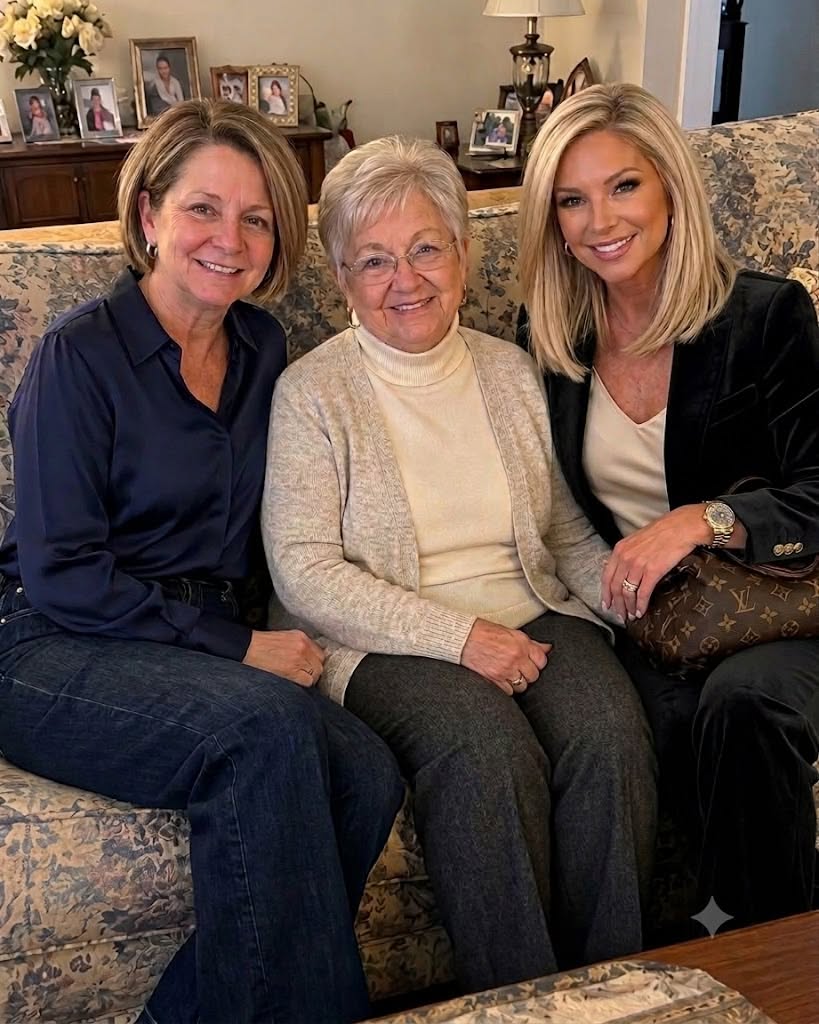
My sister Melissa showed up to Mom’s 70th birthday carrying a designer handbag that probably cost more than my monthly car payment.
She had always been the successful one in the family. She lived in a huge house, took expensive vacations, and was married to a man who owned three dental clinics.
So naturally, I assumed she would go all out for Mom’s birthday.
I was wrong.

Melissa reached into her purse, pulled out a twenty-dollar bill, slipped it into Mom’s birthday card, and handed it over with a laugh.
“At her age, she doesn’t need much.”
Mom forced a polite smile.
“Thank you, sweetheart.”
But I noticed what happened next.
Mom quickly folded the card, tucked it beneath her plate, and tried to move on as if nothing had happened.
It wasn’t really about the twenty dollars.
What made me angry was everything Mom had done for Melissa over the years.
She had babysat Melissa’s children for free. She cooked meals whenever Melissa worked late. And when Melissa and her husband bought their first house, Mom had even taken money from her own retirement savings to help them.
After all that, twenty dollars?
And then that comment.
“At her age, she doesn’t need much.”
I was furious.
I almost confronted Melissa right there at the table.
But then I remembered something.
A wooden box in Mom’s bedroom.
A few months earlier, while we were cleaning out her closet, Mom had shown it to me. Inside were little pieces of our childhood that she had carefully saved for decades—report cards, drawings, hospital bracelets, old photographs, and countless tiny notes we had written as children.
There were also two small notebooks.
And suddenly, I had an idea.
“Mom,” I said, “I’m sorry. I forgot your real present at home. Can we open gifts again tomorrow?”
Melissa laughed.
“You’re seriously making her wait another day?”
I said nothing.
The next afternoon, everyone came back to Mom’s house for leftover birthday cake.
This time, I placed a large, carefully wrapped box in front of Mom.
Melissa leaned back in her chair, looking amused.
Mom slowly tore away the wrapping paper.
Inside was a scrapbook I had made using copies of everything she had saved over the years—photographs, Mother’s Day cards, childhood drawings, and little notes my siblings and I had written when we were young.
Mom covered her mouth.
Her eyes filled with tears.
Then she reached the final page.
And suddenly, her smile vanished.
I hadn’t added anything strange.
There was only one thing on that page—a photocopy of a single entry from one of those old notebooks.
Melissa suddenly shot to her feet.
“Where did you get that?”
I looked at her.
“From Mom’s box. Why?”
She grabbed the scrapbook before Mom could respond and began flipping frantically through the pages.
Then she stopped.
Her eyes locked onto one handwritten date.
Mom’s face instantly went pale.
Without saying a word, she pushed back her chair and walked into her bedroom.
A few seconds later, she returned holding a small brass key.
Melissa jumped to her feet.
“Mom, no.”
Mom didn’t answer.
She walked straight to the old locked drawer at the bottom of the cabinet and knelt down.
Melissa suddenly lunged across the room.
“Don’t open that!”
Mom slid the key into the lock.
Click.
The sound was so small that it should have meant nothing.
But the entire room immediately fell silent.
Melissa was still standing beside me, her face completely pale.
I looked at her.
“What’s going on?”
She didn’t answer.
Mom slowly pulled the drawer open.
There was no jewelry or cash inside.
Only several folders, a few old envelopes, and a faded bankbook.
Mom took out one of the folders and placed it on the bed.
“Here.”
I opened it.
The first page was a bank transfer from fourteen years ago.
I looked at the amount and froze.
“$35,000?”
Melissa lowered her eyes to the floor.
I turned to Mom.
“Was this the money you gave her for the house?”
Mom nodded.
I knew Mom had helped Melissa and her husband with the down payment on their first home.
But I had never known the exact amount.
Until I saw the date in the corner of the document.
It matched a date written in one of the old notebooks.
I turned the page.
Three years later, there was another date written beside another amount.
“What’s this?”
Melissa spoke before Mom could answer.
“That was the date I planned to pay her back.”
I looked at her.
“You borrowed the money from Mom?”
“Not exactly.”
“There’s a repayment date written right here.”
Melissa crossed her arms.
“We were struggling at the time.”
I kept going through the folder.
$18,000.
Another year.
Another repayment date.
Then $12,500.
After that, $27,000.
I looked at Mom’s notebook.
Every single amount was there.
Every transfer.
Every date.
Every time Mom had given Melissa money.
The numbers I had once dismissed as random notes suddenly meant something completely different.
I sat on the edge of the bed and started adding them up.
“There’s no need to do that,” Melissa said.
I kept calculating.
There was money transferred around the time Melissa’s second child was born.
Another payment came just before her husband opened his second dental clinic.
I remembered that period.
Melissa had told us how much pressure they were under while expanding the business.
I also remembered Mom suddenly saying that her twelve-year-old car still ran perfectly and that there was no reason to replace it.
Another transfer appeared during the same year Mom canceled a vacation with her friends because she said the trip was “too expensive.”
I looked at Mom.
“How much did you give her?”
Mom was silent for a few seconds.
“I suppose I’d have to add it all up.”
“I already did.”

I looked at the calculator on my phone.
Then I checked it again.
And a third time.
$137,500.
No one said a word.
I turned to Melissa.
“You owe Mom $137,500?”
“No.”
I almost laughed because I couldn’t believe what I was hearing.
“No?”
“It’s not like that.”
“All of these documents have repayment dates.”
Melissa whispered, “Mom never asked me to pay her back.”
“That’s convenient.”
“It’s the truth.”
I turned to Mom.
“Is that true?”
Mom nodded.
“Yes.”
That answer stunned me.
“Then why did you write all of this down?”
Mom picked up the notebook.
“Because I needed to remember how much Melissa had received.”
“For what?”
Mom looked at me for a long moment.
“For you.”
I didn’t understand.
Mom opened the notebook to another page.
My name was written there.
There was almost nothing underneath it.
“What are you talking about?”
“Melissa needed help earlier than you did. You didn’t need it. But that doesn’t mean one daughter should eventually receive more than the other.”
I stared at her.
“But you never made her pay you back.”
“No.”
“Why?”
Mom looked at me as if the answer were obvious.
“Because by then, I didn’t need her to.”
She closed the folder.
“I have two daughters. Whatever I leave behind will eventually belong to both of you. Melissa simply received part of her share earlier.”
I looked at the notebook.
All this time, I had thought Mom was letting Melissa take advantage of her.
But Mom had been quietly keeping track of everything.
Not to punish Melissa.
But to make sure the two of us were treated fairly.
“You planned this from the beginning?”
Mom nodded.
I shook my head.
“I don’t need $137,500.”
“I know.”
“I’m not angry because of the money.”
“I know that too.”
I looked at Melissa.
“Did you know about this?”
Melissa didn’t answer.
“Melissa.”
She lowered her head.
“Yes.”
“You knew?”
“Mom told me.”
“So you knew Mom had given you more than a hundred thousand dollars. You knew it was part of the inheritance she was setting aside for you. And yesterday you gave her $20 and said she didn’t need much at her age?”
Melissa closed her eyes.
“Amanda, this isn’t about the $20.”
“Exactly.”
I looked at her.
“It isn’t about the $20.”
Mom stood up.
“That’s enough.”
I turned to her.
“No, Mom.”
“You’re done.”
“I just—”
“You’re angry on my behalf.”
I fell silent.
Mom looked at me.
“But I wasn’t deceived.”
Then she turned to Melissa.
“Melissa didn’t steal my money.”
Melissa lowered her head.
“Mom willingly helped me.”
I still couldn’t completely calm down.
“Then why did you hide the birthday card under your plate?”
Mom froze.
Melissa looked at her.
“Mom?”
Mom didn’t answer.
She simply gathered the papers from the bed.
I softened my voice.
“Mom, the $20 isn’t the issue. But what she said…”
Mom sighed.
“‘At my age, I don’t need much.’ Right?”
Melissa immediately spoke.
“I was only joking.”
“I know.”
“I didn’t mean to insult you.”
“I know.”
Melissa looked at her.
“Then why were you hurt?”
Mom was quiet for a long time.
Then she said,
“Because I’m seventy years old, Melissa.”
No one spoke.
“I’m not dead.”
Her voice was calm, but it made the entire room go silent.
“I still like beautiful things. I still want to travel. There are still places I want to see. There are still things that make me happy.”
Melissa’s eyes began to fill with tears.
“I spent too many years telling both of you not to worry about me.”
Mom gave a sad little smile.
“Maybe I did that too well.”
Melissa sat down.
“I never thought you weren’t worth it.”
“I know.”
“Then…”
“You knew I would never ask for anything.”
Mom paused.
“But yesterday, for a moment, I felt as though I didn’t deserve anything.”
Melissa began to cry.
She picked up the scrapbook.
One of the pages showed an old birthday card she had made for Mom when she was seven years old.
The handwriting was crooked.

There was a picture of Mom with purple hair because that was the only color Melissa had used.
Melissa laughed through her tears.
“You still kept this?”
“Of course.”
She turned another page.
A paper flower.
A picture of the two sisters wearing matching pajamas.
A tiny note I had written to apologize for breaking Mom’s lamp and blaming the cat.
None of those things were worth much money.
But Mom had kept every one of them for decades.
Melissa stared at the scrapbook.
Then she looked at the $20 still tucked inside her birthday card.
“I understand now.”
Mom sat beside her.
“You really understand?”
Melissa nodded.
“I don’t want Mom keeping those things because I’m afraid Amanda will think everything I have came from you.”
I shook my head.
“I don’t think that.”
Melissa looked down.
“Every time Mom helped me, I told myself it was temporary. Then things got better, and Mom never asked me to pay her back.”
She paused.
“After a while… I stopped thinking about what she had sacrificed.”
Mom took her hand.
Melissa cried harder.
“I got used to Mom giving.”
Mom gave her a sad smile.
“Maybe that was partly my fault too.”
“No.”
Melissa shook her head.
“That was my fault.”
She looked around the room.
At the old furniture.
The curtains that had been repaired instead of replaced.
The cabinet Mom always insisted was still perfectly usable.
“I kept hearing Mom say she didn’t need anything, and eventually I believed she really didn’t need anything.”
Mom squeezed her hand.
“I’m sorry.”
“Not because I gave you $20.”
Melissa’s voice broke.
“I’m sorry because I started thinking that since you never asked for anything, you didn’t need anything from me either.”
Mom pulled her into a hug.
I looked away because my own eyes were burning.
After a while, Melissa looked at the scrapbook again.
Near the beginning was a photograph of Mom when she was young, standing beside a lake with her shoes in one hand and her pants rolled up to her knees.
“Where was this?”
“Lake Briar.”
“You’ve told us about that place.”
“Yeah.”
“You haven’t been back since we were kids, have you?”
“No.”
Melissa looked at Mom.
“Do you still want to go?”
Mom looked up.
“What?”
“Lake Briar. Do you still want to go there?”
A slow smile spread across Mom’s face.
“Of course.”
Melissa nodded.
“Then let’s go.”
Mom laughed.
“All three of us?”
Melissa looked at me.
“If Amanda can survive a whole weekend with me.”
I raised an eyebrow.
“I’ll think about it.”
For the first time in two days, the three of us laughed together.
Before we left, I watched Mom put the folders back into the drawer.
She locked it and slipped the little brass key into her pocket.
“You still keep records of everything?”
“Of course.”
I hugged Mom.
For years, I had thought Mom lived simply because she didn’t want anything.
Melissa had thought the same thing.
But we had been wrong.
Mom still wanted plenty of things.
She still wanted to visit places she had never seen, to be remembered on her birthday, to feel cared for, and sometimes to receive a gift simply because someone thought she deserved one.
She had just spent so many years putting the needs of her two daughters before her own.
And maybe what we needed to ask her from now on wasn’t, “What do you need?”
It was:
“What do you want?”
Because at seventy, Mom didn’t need less.
Maybe, after everything she had given us, it was finally time for her two daughters to learn how to give her a little more—not with money, but with the same care she had given us all our lives.