For two years, every weekday morning, I drove my ten-year-old daughter, Emma, and her classmate, Sophie, to school.
Sophie and her mother, Vanessa, lived just four houses down from us. Vanessa usually left early for Pilates, so picking Sophie up had simply become part of my daily routine. I never asked her for gas money, even when fuel prices kept climbing. If Sophie had soccer practice after school, I waited for her. If she forgot her lunch at home, I turned the car around and went back for it.
Vanessa was always grateful.
“You’re a lifesaver,” she would tell me.

Then she bought a brand-new white SUV with beautiful cream-colored leather seats.
Suddenly, that car was all she talked about.
The following week, I woke up to heavy rain pounding against the windows. When I tried to start my old Honda, nothing happened.
The battery was completely dead.
School started in twenty-five minutes.
Since Vanessa lived only four houses away, I called her immediately.
“Could Emma ride with you just this once?” I asked. “I’ll have the car fixed today.”
There was a long pause.
“Fine,” she finally said. “Have her ready.”
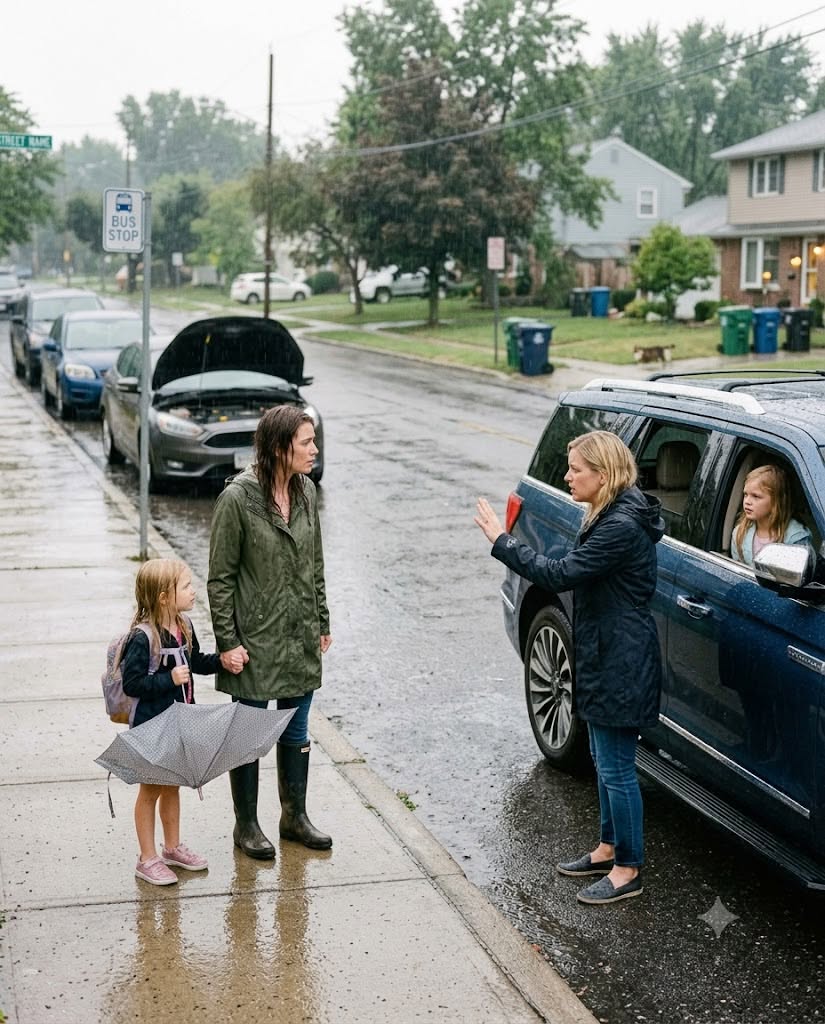
Emma put on her raincoat and stood outside under an umbrella, waiting by the curb.
When Vanessa’s SUV finally pulled up, the rain was coming down so hard that the wind was blowing it almost sideways. Emma’s jeans were wet below the knees, and one of her sneakers had already splashed through a puddle.
Vanessa rolled down the passenger window.
Her eyes immediately went to Emma’s shoes.
“Oh. No.”
I frowned. “What?”
She pointed toward the spotless interior of her new SUV.
“I just got this car. Look at her. She’s soaked.”
“Vanessa, it’s raining. She can sit on a towel.”
Vanessa actually laughed.
“Sorry, but I’m not having muddy water all over my new seats.”
Emma had heard every word.
Her face turned bright red.
“Mom, it’s okay,” she whispered.
I could hardly believe what I was hearing.
For two entire years, I had driven Vanessa’s daughter to school hundreds of times without asking for a single dollar. Rain, snow, cold mornings—I never made an issue of it.
And now Vanessa couldn’t even give my daughter a five-mile ride because her shoes were wet.
“I didn’t spend this much on a car just to have someone else’s kid ruin it,” she said.
Then she drove away.
Emma stood beside me in the pouring rain, desperately trying not to cry.
I ordered a rideshare, even though the cost was money I really couldn’t afford, and watched as Emma finally left for school twenty minutes late.
That evening, Vanessa texted me cheerfully.
She wanted to know if I could start driving Sophie again once my Honda was repaired.
I didn’t reply.
The next morning, before seven o’clock, someone started pounding violently on my front door.
I opened it.
Vanessa stood on my porch, completely soaked. Her face was pale, furious, and almost unrecognizable.
She pointed frantically behind her.
“What the hell have you done?!”
I stared at her in confusion.
“What are you talking about?”
Then I looked past her.
Her precious new white SUV was sitting in the driveway.
And the moment I saw what was surrounding it, I realized something.
Karma hadn’t even waited twenty-four hours.
Vanessa stood there, completely soaked, pointing toward the street as if I had somehow caused the entire scene waiting outside.
“What the hell have you done?” she demanded.
I stepped onto the porch and looked past her.
Then I froze.
There were children everywhere.
Around fifteen of them stood near Vanessa’s spotless white SUV, bundled in raincoats and holding umbrellas. Several parents stood behind them. Some of the kids were carrying handmade cardboard signs that were already beginning to sag under the rain.
One sign read:
“EMMA CAN RIDE WITH US.”
Another said:
“IT WAS JUST RAIN!”
And someone had written:
“SEATS CAN DRY.”
Vanessa’s face turned red.
“You did this,” she said.
“I didn’t,” I replied.
She pointed toward the crowd. “Then who did?”
Before I could answer, Emma stepped onto the porch behind me.
She stared at the crowd in shock.
“Mom?”
I turned around.
“What happened at school yesterday?” I asked her.
Emma hesitated.
“People asked why I was late,” she said quietly. “I told them our car broke down.”

She looked at Vanessa.
“And I told them Mrs. Vanessa wouldn’t let me ride because my shoes were wet.”
A boy near the mailbox immediately shouted, “They weren’t even that muddy!”
A few kids laughed nervously.
Vanessa looked horrified.
“This is ridiculous,” she snapped. “This has been blown completely out of proportion.”
Then another child spoke.
“Your mom drives Sophie every day,” he said to Emma. “She should have let you ride with them.”
Emma shook her head.
“Sophie didn’t do anything.”
That silenced everyone.
Then Sophie slowly stepped forward.
Her eyes were red, and she was clutching the strap of her backpack.
“Mom,” she said, “I told you Emma could sit on my jacket.”
Vanessa stared at her.
“Sophie, not now.”
“But you wouldn’t let her.”
“I said not now.”
Sophie looked down.
Emma walked over and took her hand.
“It’s okay,” she whispered.
Watching the two girls stand there together made something inside me ache.
None of this was Sophie’s fault.
She hadn’t asked her mother to refuse Emma a ride. She hadn’t asked to be driven by me for two years. She was just a ten-year-old girl caught between adults.
I looked at the crowd.
“I appreciate that you all wanted to stand up for Emma,” I said, “but nobody is going to gang up on Vanessa, and nobody is going to blame Sophie.”
The signs slowly lowered.
One of the parents, Rachel, stepped forward.
“My boys rode with you for nineteen school days when I broke my ankle,” she said to Vanessa. “You know how many times Sarah checked whether their shoes were clean?”
Vanessa said nothing.
“Zero,” Rachel answered herself.
Another father, Greg, nodded.
“You helped us whenever we needed it. Nobody ever had to beg you.”
I shook my head.
“You don’t owe me anything.”
Rachel smiled.
“Maybe not. But helping people shouldn’t be a one-way street.”
Vanessa folded her arms.
“So now I’m the villain because I didn’t want mud on my seats?”
I looked directly at her.
“You didn’t just protect your seats. You left my ten-year-old standing in the rain because her shoes were wet.”
Vanessa’s expression hardened.
“I have every right to care about my car.”
“You do.”
“And I have every right to decide who rides in it.”
“You do.”
She seemed almost relieved that I had agreed.
Then I finished my sentence.
“And I have every right to stop driving your daughter every morning.”
Her expression changed.
“What?”
“You heard me.”
She stared at me.
“But I have Pilates at seven.”
“You’ll have to figure something out.”
“Tuesdays I go straight to work.”
“You’ll figure something out.”
“Thursdays I have a client call.”
I almost smiled.

For a moment, I caught myself doing exactly what I’d done for two years—mentally rearranging my schedule to make her life easier.
Then I stopped.
“That’s exactly the problem,” I said quietly. “For two years, I did you a favor. Somewhere along the way, you stopped seeing it as a favor and started seeing it as something you were entitled to.”
Vanessa’s jaw tightened.
“So you’re punishing Sophie because you’re angry with me?”
“No.”
I looked at Sophie.
“Sophie isn’t being punished. You’re simply going to start driving your own daughter to school.”
Sophie looked at Emma.
“Are you mad at me?”
Emma immediately shook her head.
“No. Of course not.”
She squeezed Sophie’s hand.
“I’m mad about what happened. Not at you.”
Sophie smiled faintly.
Vanessa didn’t.
She turned away and glanced toward my driveway.
“What happened to your car, anyway?”
“The battery died. It might be the alternator too.”
Before I could say anything else, Greg walked over.
“I know a mechanic.”
Rachel raised her hand.
“I’ll cover the battery.”
I immediately shook my head.
“No. You don’t have to do that.”
Rachel laughed.
“Yes, we do.”
“I can’t let you guys pay for my car.”
She looked at me seriously.
“You helped us when we needed it. Let us help you now.”
Another parent stepped forward.
“I can give you a ride to work until it’s fixed.”
Greg nodded.
“And I’ll call my mechanic.”
I stood there in the rain, suddenly unable to find the right words.
Then I remembered something Emma had asked me months earlier.
“Why doesn’t someone help you?”
Back then, I’d laughed and told her I didn’t need help.
Standing there with half the neighborhood offering me exactly that, I realized how wrong I’d been.
Maybe accepting help didn’t make me weak.
Maybe it simply meant I finally understood that kindness wasn’t supposed to be a one-way road.
Two days later, my old Honda was back in my driveway.
The battery had been replaced, the alternator repaired, and the car started on the first try.
Vanessa never asked me to drive Sophie again.
And honestly, I never expected her to.
Sophie still waved whenever she saw us.
Sometimes Emma and Sophie walked to school together when the weather was nice. Other mornings, one of the other parents gave them a ride.
As for Vanessa, she still had her beautiful white SUV.
Her cream leather seats were still spotless.
But now, whenever it rained, she had to get her own daughter into that spotless car.
And I learned something I wish I’d understood years earlier:
Being generous doesn’t mean you have to keep giving until people forget it was ever a gift.
Sometimes the kindest thing you can do—for yourself and for your child—is finally say no.