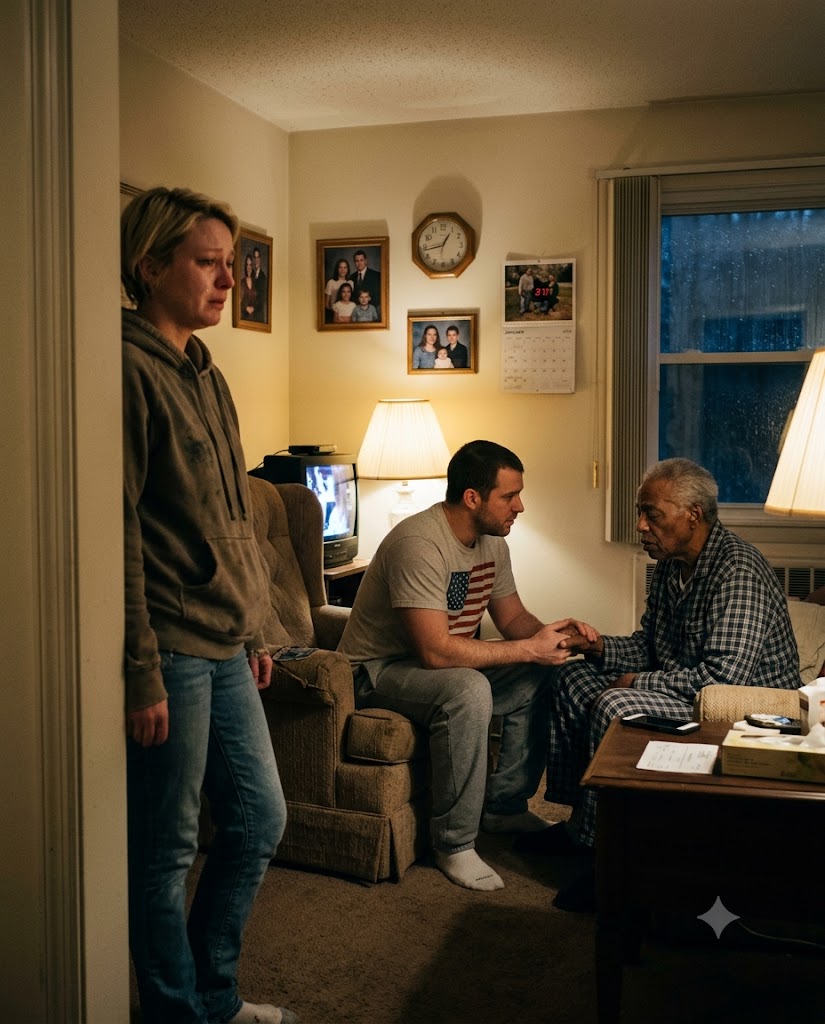
I used to dread 3 AM.
It became the hour that slowly stole my husband from our bed, night after night.
Every time the phone rang in the darkness, I would wake instantly. The sound seemed unnaturally loud in the quiet bedroom. Before the second vibration, my husband would already reach for it.
“It’s Mom,” he would whisper.

Then he would sit up, swing his legs over the edge of the bed, and answer.
At first, I tried to understand.
His mother lived alone, and I knew she was getting older. If she needed help, of course he should go. I never wanted to be the wife who complained about something like that.
But then one night became several.
Several became weeks.
And eventually, months.
“What is it this time?” I finally asked one night, unable to hide the frustration in my voice.
My husband paused before answering.
“She says there’s a leak. I’ll be back soon.”
I stared at him.
“A leak?”
He nodded.
It was always something.
A leak.
A strange noise.
A headache.
A broken lock.
A problem with the heating.
Somehow, every crisis happened at exactly the same hour.
Three in the morning.
And every time, my husband went.
I began lying awake after he left, staring at the ceiling while resentment slowly replaced concern.
I started wondering whether his mother was taking advantage of him.
Maybe she simply didn’t want to be alone. Maybe she had learned that calling her son at 3 AM guaranteed he would come running.
And the worst part was that I felt like I was losing my husband to it.
“She just wants attention,” I said one evening.
My husband looked at me.
“You don’t see it,” I continued. “But I do. Every time we finally settle into a routine, she calls and you leave.”
He didn’t argue.
He simply looked exhausted.
Somehow, that silence made me even more frustrated.
I wanted him to tell me I was wrong.
Instead, he just lowered his eyes.
Then, a few nights later, the phone rang again.
3 AM.
The familiar sound cut through the darkness.
My husband reached for it.
“It’s Mom.”
Before he could get out of bed, I sat up.
“I’m coming with you.”
He turned toward me, surprised.
“You don’t have to.”
“I know.”
I reached for my coat.
“But I want to.”
The drive to his mother’s apartment was almost completely silent.
The streets were empty. Streetlights passed over the windshield one after another, casting pale flashes across his face.
I couldn’t explain what I was feeling.
Part of me was still irritated.
Another part was curious.
And beneath both was a strange feeling I couldn’t name.
When we finally arrived, everything looked completely normal.
There were no emergency vehicles.
No flashing lights.
No water pouring from the building.
No sign of anything being wrong.
My husband walked toward the door.
Before he could knock, it opened.
His mother was standing there.
And that was the first thing that confused me.
She looked perfectly fine.
She wasn’t panicked.
She wasn’t crying.
She wasn’t even particularly worried.
She simply stepped aside.
“Come in,” she said quietly.
I followed my husband inside.
My eyes immediately searched the room for evidence of the latest emergency.
Nothing.
The apartment was neat.
The kitchen was dry.
There were no broken locks or damaged pipes.
Nothing looked remotely urgent.
Then I heard something.
A faint sound.
Uneven breathing.
I stopped.
My husband had already started walking toward the hallway.
I followed.
The breathing grew louder with every step.
Then I reached the bedroom doorway.
And froze.
There was an elderly man lying beneath a blanket.
I had never seen him before.
He looked impossibly fragile.
His chest rose and fell with effort. His hands trembled slightly against the blanket. A thin oxygen tube rested beneath his nose, connected to a small machine beside the bed.
The quiet hum of the machine filled the room.
And beside him sat my husband.
He was gently adjusting the blanket around the man’s shoulders.
“Easy,” he whispered. “You’re okay. We’re here.”
The elderly man’s breathing gradually became steadier.
I stood there, unable to speak.
Then my mother-in-law came up behind me.
“That’s Mr. Edmond,” she whispered.
I looked at her.
“He’s eighty-four. He lives down the hall.”
She paused.
“He has no children.”
I looked back at the old man.
“No one?” I asked quietly.

She shook her head.
“Two months ago, I found him collapsed in the hallway. He had been alone for hours.”
My stomach tightened.
“Since then, the nights have been the hardest.”
She looked toward my husband.
“Especially around three.”
I felt something shift inside me.
“His pain gets worse at that time,” she continued. “But it isn’t only the pain.”
Her voice became softer.
“It’s the fear.”
She explained that Mr. Edmond hated asking for help. He had told them repeatedly that he didn’t want to become a burden. He was proud, independent, and deeply embarrassed by how much he now needed others.
“He begged us not to tell anyone,” she said.
I swallowed.
“So you called my husband?”
She nodded.
“He comes because Mr. Edmond feels safer when he hears another voice.”
I looked at my husband again.
Suddenly, every 3 AM departure looked different.
Every hurried explanation.
Every tired expression.
Every night I had assumed he was being pulled away from me.
He hadn’t been abandoning me.
He had been helping someone who had no one else.
And his mother hadn’t been stealing my husband’s time.
She had been quietly caring for a lonely old man who was terrified of facing the darkest hours of the night alone.
All the anger I had carried for months began to dissolve.
I felt ashamed of every assumption I had made.
Without saying anything, I walked toward the bed.
Mr. Edmond’s hand rested weakly on top of the blanket.
I reached out and gently took it.
His skin was cool and fragile.
For a moment, he didn’t react.
Then his fingers moved slightly against mine.
My husband looked up.
Surprise crossed his face.
Then it softened into something else.
Relief.
I sat down beside the bed.
I didn’t know Mr. Edmond.
I didn’t know how many nights he had spent alone.
But that night, he didn’t have to be alone.
The three of us stayed beside him.
We waited until his breathing became calmer.
Until the tension left his face.
Until the room no longer felt filled with fear.
Instead, there was peace.
After a while, my mother-in-law stood quietly in the doorway.
I looked at her.
For the first time, I didn’t see a demanding mother who constantly needed her son.
I saw a woman who had been carrying a quiet kindness for months.
She had been waking up in the middle of the night, answering calls, helping an elderly stranger breathe through his pain, and asking for nothing in return.
Not recognition.
Not praise.
Just because someone needed her.
And suddenly, I understood something.
Sometimes we become angry because we don’t know the whole story.
We fill in the silence with our own fears, our own assumptions, and our own hurt.
That night, I realized how wrong I had been.
We didn’t rush home.
We stayed a little longer.
And when we finally stepped outside, the streets were still dark and quiet.
But somehow, the world felt different.
Softer.
Quieter.
More honest.
I no longer dreaded 3 AM.
Because I finally understood what had been happening at that hour.
Sometimes love doesn’t look like grand gestures or beautiful words.
Sometimes it looks like getting out of a warm bed in the middle of the night.
Sometimes it looks like holding the hand of a frightened old man who has no one else.
And sometimes, the greatest acts of kindness happen at 3 AM—
when almost everyone else is asleep,
and no one is watching.