My name is Gabriel Torres. I’m thirty years old, and I make my living driving freight trucks across the country. The job keeps me away from home for days at a time, but every mile I travel has always been for one reason — to give my daughter, Sofia, the life she deserves.
After my first wife, Elena, passed away, Sofia became the center of my world. She was only a little girl when we lost her mother, and I promised myself that no matter how difficult life became, she would never have to feel alone.

When I married Patricia, I believed I was giving my daughter another person to love and protect her. I thought our family was finally whole again.
I was wrong.
And I didn’t discover the truth until I returned home three days earlier than anyone expected.
It was nearly eleven o’clock at night when I pulled into the driveway of our house in San Antonio. I was exhausted from the long drive, my shoulders ached, and all I wanted was a hot shower and a few hours of sleep before surprising Sofia with breakfast the following morning.
Patricia had told me she was taking her mother, sister, and niece, Bianca, on a vacation to Miami. They planned to return on Sunday.
I was glad Sofia would have some quiet time at home. At least, that was what I had assumed.
As I walked through the front door, the house was unusually quiet. I set down my travel bag and headed toward the kitchen, expecting to find everything dark and empty.
Then I heard the sound of water running.
It came from the laundry room.
I pushed open the door, and what I saw made me stop in my tracks.
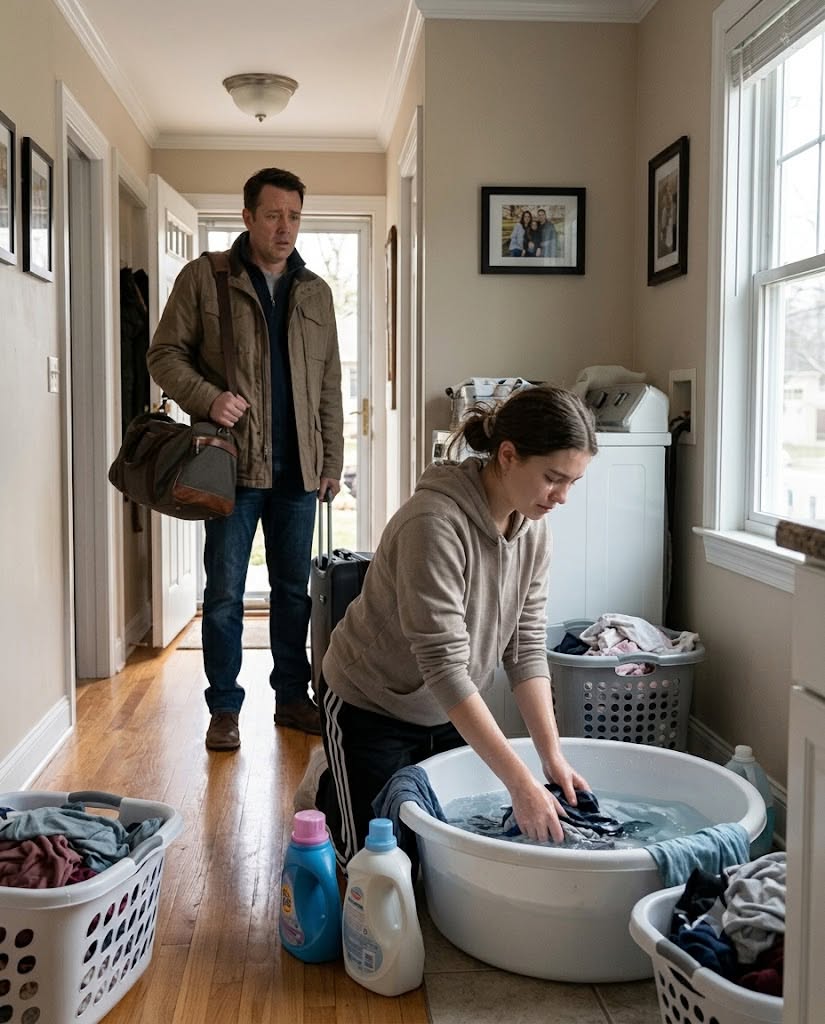
My sixteen-year-old daughter was standing in front of a plastic basin, her hands submerged in freezing water. A pile of clothes sat beside her, and she was scrubbing each garment by hand, her shoulders hunched against the cold.
Behind her, the washing machine was running.
It was filled with clothes that clearly belonged to Patricia and her family.
For a moment, I couldn’t make sense of what I was seeing.
“Sofia?”
She spun around so quickly that water splashed onto the floor.
“Dad!” Her face went pale. “You’re home?”
I stared at the basin, then at the washing machine.
“Why are you washing your clothes by hand when the machine is right there?”
She immediately lowered her eyes.
“Patricia said I’m not allowed to use it for my clothes. She says I waste too much water and electricity.”
I felt something tighten in my chest.
“Where is Patricia?”
“She went to Miami with Grandma, Aunt Rachel, and Bianca. They left yesterday.”
“And they left you here alone?”
Sofia hesitated before answering.
“They said I had to finish cleaning the house and washing everything before they came back on Sunday.”
I looked at the clock. It was almost eleven at night.
My daughter had been standing in freezing water, washing clothes that weren’t even hers, while the rest of the family enjoyed a vacation.
I wanted to shout. I wanted to call Patricia immediately and demand an explanation. But one look at Sofia’s frightened expression made me stop.
She wasn’t looking at me the way a child looks at her father when she’s been caught doing something wrong.
She was looking at me as though she was afraid I might punish her.
That frightened me more than anything else.
“Sofia, sweetheart, roll up your sleeves for me.”
Her eyes widened.
“Why?”
“Please. I just want to see your arms.”
Slowly, she pushed the sleeves of her oversized sweatshirt toward her elbows.
My stomach dropped.
Faint bruises covered her forearms. There were scratches near her wrists and darker marks that looked as though they had been there for days. Some were fading, but others were unmistakably fresh.
I had seen injuries like those before. Years on the road had taught me that people could hide pain behind a smile, but nothing could have prepared me for seeing those marks on my own child.
“What happened to you?” I asked, struggling to keep my voice steady.
“Nothing, Dad. I’m fine.”
“Sofia, look at me.”
She kept her eyes on the floor.
“Did someone hurt you?”
For several seconds, she said nothing.
Then she whispered, “Please don’t be mad.”
Those five words cut deeper than any explanation could have.
I took out my phone and carefully photographed the visible injuries, making sure to document what I could see without hurting her. I didn’t want to frighten her, and I didn’t want important evidence to disappear before I understood what had happened.
“I’m not mad at you,” I told her. “Not now. Not ever for telling me the truth.”
She nodded, but she still looked unconvinced.
“Go take a warm shower,” I said gently. “I’ll finish the laundry.”
“Are you sure?”
“Yes, sweetheart. You don’t have to do any more tonight.”
She stood there for a moment, as though she was waiting for me to change my mind. Then she slowly walked out of the room.
I remained beside the basin, staring at the clothes soaked in cold water.
For sixteen years, I had believed I was protecting my daughter by working hard. I had driven through storms, slept in truck stops, and spent countless nights away from home because I wanted her to have financial security.
Meanwhile, something terrible might have been happening beneath my own roof.
And I hadn’t noticed.
At five the next morning, I was already in the kitchen.
I couldn’t sleep. Every time I closed my eyes, I saw those bruises on Sofia’s arms.
I decided to make oatmeal pancakes, the kind her mother used to prepare on Sunday mornings. Elena had always said that a warm breakfast could make even the hardest day feel a little easier.
I had barely finished setting the table when Sofia appeared in the doorway.
Her hair was still damp, and she wore a clean sweatshirt with the sleeves pulled down over her hands.
She looked at the pancakes, then at me.
“Dad?”
“Good morning, sweetheart. Come sit down.”
She didn’t move.
“Am I allowed to eat?”
For a moment, I couldn’t breathe.
“What do you mean, are you allowed?”
She glanced toward the hallway.
“Patricia says I have to finish my chores before breakfast. And sometimes she says I don’t deserve to eat if I haven’t done enough.”
I pulled out a chair for her.
“You don’t have to earn breakfast in your own home. Sit down.”
She approached the table cautiously and took a small bite.
Then another.
As she ate, I noticed how quickly she glanced toward the hallway whenever the house made a noise. It was as though she expected someone to appear and take the plate away.
I sat across from her.
“Sofia, I need you to tell me what’s been happening while I’m away. You won’t get in trouble for anything you tell me. I promise.”
Her fingers tightened around her fork.
“Patricia says you’re always tired when you come home. She says you don’t need more problems. She tells me not to bother you with things that happen here.”
“What things?”
She stared at her plate.
“Sometimes she doesn’t let me eat dinner if she thinks I haven’t cleaned properly. Sometimes she makes me stay awake until everything is finished, even when I have school the next morning.”
My hands curled beneath the table.
“And the bruises?”
Sofia swallowed hard.
“Bianca does it sometimes. She hits me when she’s angry. She says nobody will believe me because she’s Patricia’s niece, and I’m just the girl who complains about everything.”
“Does Patricia know?”
“She says I provoke Bianca. She tells me I should be grateful they let me live here.”
I felt sick.
Bianca was sixteen, the same age as Sofia. She had been staying with us for almost a year after some difficulties in her own family. I had agreed because I thought giving her a stable home was the right thing to do.
I had never imagined that my own daughter might be paying the price for my generosity.
“What about your phone?” I asked. “Why haven’t you called me?”

Sofia’s eyes filled with tears.
“Patricia keeps it sometimes. She says I spend too much time on it. When the school calls, she answers and pretends to be me. She tells them everything is fine.”
I stared at her, stunned.
“She pretends to be you?”
Sofia nodded.
“She says if I tell you anything, you’ll blame me for ruining your marriage. She says you’ll send me away because you’ll always choose your wife over me.”
I pushed my chair back and knelt beside her.
“Listen to me very carefully. You are my daughter. You are not a burden, and you are not responsible for keeping my marriage together. No one has the right to hurt you, frighten you, or make you believe you don’t belong in this family.”
Her tears finally spilled over.
“I wanted to tell you, Dad. I really did.”
“I know, sweetheart.”
“But I was scared you wouldn’t believe me.”
That was the moment I understood how badly I had failed her. Not because I had intentionally hurt her, but because I had allowed someone else to convince her that her own father would turn against her.
I held her while she cried, promising that she wouldn’t have to face this alone anymore.
But there was still something she hadn’t told me.
Something that seemed to frighten her even more than the bruises.
After Sofia calmed down, I asked her about the school calls again.
She told me that Patricia had been doing it for months. She had also described an incident that made my blood run cold.
On Sofia’s birthday, I had sent money home for a small celebration. I remembered calling Patricia that evening while I was parked at a truck stop several states away.
She had told me Sofia was tired and had gone to bed early.
I had believed her.
Now Sofia told me what had really happened.
Patricia had used the decorations and money I sent to throw a birthday party for Bianca instead. The cake, balloons, gifts, and food had all been intended for Sofia, but Patricia had turned the occasion into a celebration for her niece.
“And where were you?” I asked, although I was already afraid of the answer.
“In the backyard.”
She wiped her cheeks.
“I could see everyone through the window. They were singing to Bianca. Patricia said I wasn’t allowed to come inside until I finished cleaning.”
I closed my eyes.
I remembered that phone call. I remembered wishing Sofia a happy birthday and telling Patricia to give her an extra hug for me.
I had been speaking to a woman who knew exactly where my daughter was, what she was doing, and how alone she felt.
And she had lied to me without hesitation.
“Why didn’t you call me from a neighbor’s phone?” I asked quietly.
“I thought you wouldn’t believe me. Patricia always said she had proof that I was a liar. She said she could make everyone think I was the problem.”
I took a slow breath.
“Did she ever threaten you with anything else?”
Sofia went completely still.
Her expression changed so suddenly that I leaned forward.
“What is it?”
She looked toward the staircase, then back at me.
“Dad, there’s something Patricia keeps hidden in your bedroom.”
I felt a chill run down my spine.
“My bedroom? Where?”
“In the closet. Behind some boxes. She told me never to touch it.”
“What is it, sweetheart?”
Sofia’s voice dropped to barely more than a whisper.
“It’s why she told me never to tell you anything.”
For a few seconds, neither of us moved.
Then I stood up.
“Stay here with me. We’re going to look at it together.”
I didn’t want Sofia to face another frightening moment alone, so I asked her to remain in the hallway while I opened the closet.
Behind several storage boxes, I found a small locked document case I had never seen before.
It wasn’t one of mine.
I brought it into the bedroom and examined it carefully. There were no signs that it belonged to me, and I couldn’t understand why Patricia would hide something like that in my personal space.
I didn’t force it open. Instead, I photographed the case and contacted a lawyer I trusted, explaining that I had discovered something suspicious while documenting a possible case of abuse in my home. I also asked what steps I should take to preserve the evidence properly.
When I returned to the hallway, Sofia was trembling.
“Are you going to send me away?” she asked.
I looked at her in disbelief.
“No. Why would you think that?”
“Because Patricia said you would.”
I took her hands.
“Nothing she says about your place in this family changes the truth. You are my daughter. You belong with me, and I will protect you.”
That morning, I contacted Sofia’s school and arranged to speak privately with the appropriate staff about the calls Patricia had been answering. I also sought guidance from the authorities on how to report the injuries and the treatment Sofia described. I wanted the situation investigated properly, and I wanted my daughter safe while it happened.
The lawyer helped me understand how to preserve the records and photographs, and how to handle the hidden case without compromising any evidence.
Inside were documents that made the situation even more disturbing.
There were copies of financial records, correspondence, and paperwork connected to an account I had set up years earlier for Sofia’s future. I had intended that money to help pay for her education and give her a secure start in adult life.
Several documents suggested that Patricia had been trying to gain control over those funds without my knowledge.
There were also messages and notes that raised serious questions about what she had been telling others about Sofia, including the suggestion that my daughter was unstable and unable to manage her own affairs.
I sat at the kitchen table, reading through the information with the lawyer on the phone, and felt the last of my excuses disappear.
This wasn’t simply a cruel stepmother who had lost her temper.
Someone had been systematically isolating my daughter, undermining her confidence, and making her believe she had no one to turn to. At the same time, there were troubling signs that my family’s finances might have been involved.
I didn’t yet know the full extent of what Patricia had done. I wasn’t going to make accusations I couldn’t prove. But I knew I could no longer pretend this was a misunderstanding that would disappear if I confronted her angrily enough.
I needed to protect Sofia first.
Patricia called that afternoon.
Her voice was bright and casual, as though nothing unusual had happened.
“Gabriel! How’s your trip? Everything okay at home?”
I looked across the room at Sofia, who was sitting on the couch wrapped in a blanket.
“I’m home,” I replied.
Silence.

“You’re home? I thought you weren’t coming back until Sunday.”
“I finished early.”
“Oh. Well, that’s nice. Is Sofia behaving herself?”
I could hardly believe what I was hearing.
“Why don’t you ask her yourself?”
Another pause.
“She’s there?”
“She is.”
Patricia began talking quickly, explaining that she had left Sofia a few chores to complete and that everything was perfectly normal. She claimed the bruises were probably from an accident and insisted that Sofia had always been dramatic.
I didn’t argue with her.
I told her that we would discuss everything when she returned, and that I expected her to cooperate with the investigation.
Her tone changed immediately.
“What investigation?”
I ended the call after making it clear that I would not discuss the details over the phone.
Within minutes, messages began arriving. Patricia accused me of overreacting, claimed Sofia had manipulated me, and insisted that I was destroying our marriage over a few scratches.
But she never asked if Sofia was all right.
Not once.
That told me more than any excuse could.
Over the next several days, I worked with the lawyer and the appropriate authorities to document what had happened. Sofia spoke with trained professionals in a setting where she could explain things without fear of being punished. Her school helped clarify the calls it had received, and we began piecing together a timeline of events.
I made sure Sofia had a safe place to stay and that she could contact me whenever she needed to. For the first time in months, she slept without worrying that someone would wake her in the middle of the night to demand more chores.
The change wasn’t immediate. She still apologized for little things. She still asked permission before taking food from the refrigerator. Sometimes, when I raised my voice to call her from another room, she flinched before realizing it was only me.
Each time, my heart broke a little more.
So I stopped telling her that she had nothing to fear and started showing her.
I made breakfast every morning. I helped her reconnect with the school counselor. I listened when she wanted to talk, and I didn’t pressure her when she needed silence.
Slowly, she began to believe that home could be a place where she was safe.
Patricia returned from Miami expecting everything to be exactly as she had left it.
Instead, she found me waiting in the living room with the lawyer’s guidance already in motion and the documented concerns ready to be addressed.
She tried to turn the conversation against Sofia. She claimed I had misunderstood everything, that Bianca was only joking when she hit her, and that the restrictions were necessary because Sofia had become lazy and disrespectful.
I asked one question.
“Why did you make my daughter afraid to eat breakfast in her own home?”
Patricia opened her mouth, but no answer came.
“Why did you let me believe Sofia was sleeping on her birthday when she was outside watching you celebrate Bianca with the money I sent for her?”
She looked away.
“And why were you hiding documents connected to Sofia’s account in my bedroom?”
For the first time since I had known her, Patricia had nothing convincing to say.
She accused me of choosing Sofia over her.
I looked at the woman I had married and realized that she had misunderstood the most important thing about me from the beginning.
This had never been a competition.
Sofia wasn’t someone I could choose or reject depending on who made my life easier. She was my child. Protecting her wasn’t a betrayal of my marriage. It was my responsibility as her father.
I made it clear that Patricia would not be allowed to return to a situation where she could intimidate Sofia, and I followed the legal advice I had received about separating our living arrangements and addressing the financial concerns.
The investigation continued. I didn’t need to shout or threaten revenge. The photographs, records, school information, and Sofia’s account of what she had endured were far more important than any angry speech I could make.
As for Bianca, I insisted that her role be examined fairly as well. She was a teenager, but her age did not make Sofia’s injuries or suffering acceptable. The adults responsible for the household had a duty to ensure both girls were safe, and I would not allow anyone to dismiss what happened as harmless teasing.
The truth would be dealt with through the proper process.
And whatever the outcome, Sofia would no longer be left to face it alone.
A few weeks later, I woke early on a Sunday morning and went downstairs to make pancakes.
This time, Sofia followed me into the kitchen without hesitation.
She sat at the table, pulled a plate toward herself, and reached for a pancake before looking up at me.
Then she stopped.
“Dad?”
“What’s wrong, sweetheart?”
She smiled a little.
“Nothing. I just wanted to say thank you.”
I set the spatula down.
“For what?”
“For believing me.”
I walked over and hugged her.
“I should have noticed sooner,” I whispered. “I’m sorry I didn’t.”
She held on to me for a long moment.
“You came home,” she said. “That’s what matters.”
I wished I could take away every night she had spent frightened and alone. I wished I could erase the memory of her hands submerged in freezing water while she washed clothes for people who were supposed to care for her.
But I couldn’t change what had already happened.
What I could do was make sure the future was different.
That Sunday, Sofia ate as much as she wanted. We spent the afternoon going through old photographs of her mother, laughing at stories Elena had told us years ago. For the first time in a long while, Sofia talked about her birthday without lowering her eyes.
Before bed, she asked if she could keep her phone beside her.
“Of course,” I said.
“And if I need you while you’re away driving?”
“You call me. Any time. If I can’t answer immediately, I’ll call you back as soon as I safely can. And we’ll make sure you always have another trusted adult you can reach, too.”
She nodded, satisfied.
After she went upstairs, I remained in the kitchen, looking at the empty plate she had left behind.
For years, I had thought being a good father meant working harder, earning more, and making sure the bills were paid.
Now I understood something far more important.
A child should never have to wonder whether she is allowed to eat, whether she deserves kindness, or whether her own father will believe her when she says she’s hurting.
I couldn’t undo the days I had been away.
But I could make sure my daughter never again had to face that kind of fear in silence.
And this time, when I promised to protect her, I intended to prove it every single day.