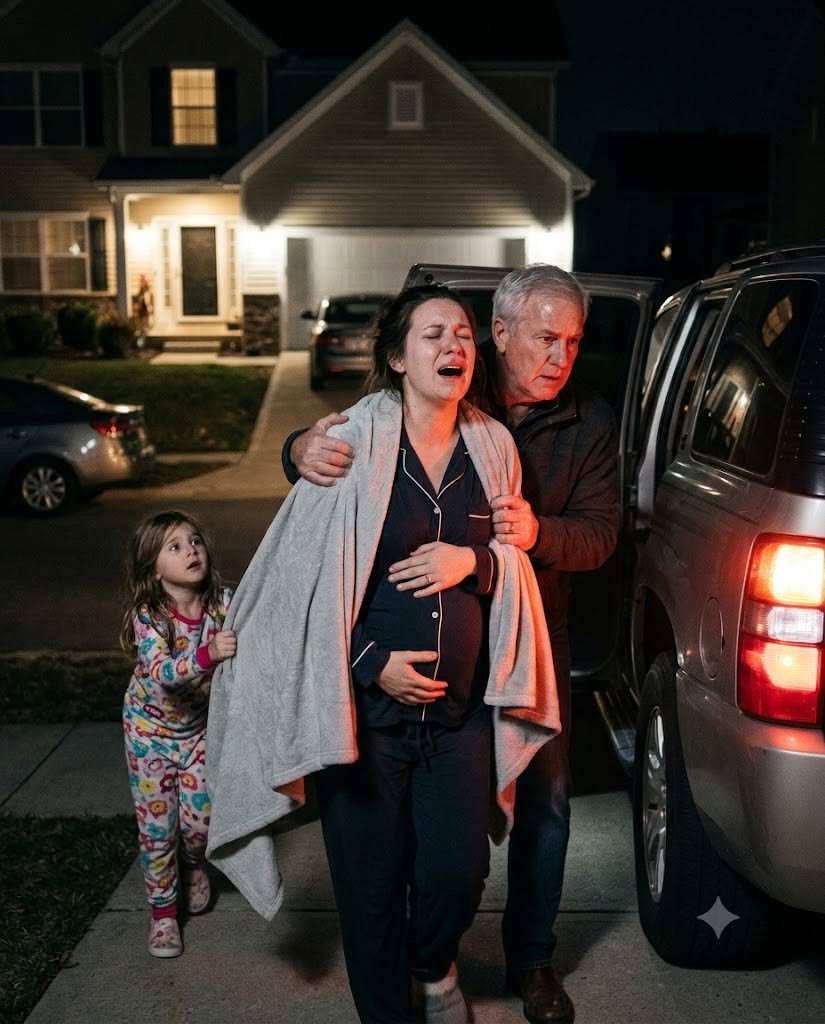
PART 1 — The Cruiser Waiting in the Dark
My phone began vibrating at 12:47 a.m.
Half asleep, I reached across the nightstand and answered without even looking at the screen.
“Papa?”
My six-year-old granddaughter was crying so hard that I could barely understand her.
“Lydia? Sweetheart, what’s wrong?”
“Mommy… Mommy says the baby is coming!”
I sat straight up in bed.
My daughter, Cassidy, wasn’t due for another six weeks. Something was terribly wrong.
I threw off the covers and reached for my jeans.
“Where’s your daddy, sweetheart?”

For a moment, all I heard was Lydia’s ragged breathing. Then she whispered something that made the blood drain from my face.
“Daddy hurt Mommy’s tummy. Then he got in his truck and drove away.”
I was on my feet before she finished speaking.
“Is Mommy awake?”
“Yes. There’s blood on the kitchen floor.”
My stomach twisted.
“Have you called 911?”
“I did. They said an ambulance is coming.”
“You did exactly the right thing, Lydia. Listen to me carefully. Stay near Mommy, but don’t try to move her. I’m coming right now.”
I ended the call and grabbed my keys.
My name is Harry Kane. I’d spent twenty-eight years working drilling sites and oil fields across Montana and Wyoming. Those years had taught me how to handle emergencies, how to keep a clear head when everyone else was panicking, and how precious the first few minutes could be.
But nothing in those years had prepared me for the thought of my pregnant daughter lying injured on her kitchen floor while her six-year-old little girl watched helplessly.
The drive to Cassidy’s house outside Bozeman took twenty-two minutes.
It felt like twenty-two hours.
When I pulled into her driveway, an ambulance was already there. Paramedics rushed in and out of the house, their voices clipped and urgent beneath the flashing red lights.
Then they wheeled my daughter through the front door on a stretcher.
Her face was gray beneath the porch light. An oxygen mask covered her mouth, and her eyes fluttered as though she were struggling to stay conscious.
“Dad…”
I rushed to her side and took her hand.
“I’m here, sweetheart. I’ve got you.”
One of the paramedics explained that Cassidy had suffered severe abdominal trauma. They were concerned about placental separation and signs that the baby was in distress.
They couldn’t afford to waste another minute.
As the ambulance doors closed, I saw Lydia sitting on the living-room couch in her princess pajamas. She was clutching a stuffed elephant so tightly that her little fingers had gone pale.
There were stains on her hands from trying to help her mother.
I knelt and pulled her into my arms.
“Is Mommy going to die?” she whispered.
For the first time in decades, I struggled to find the right words.
“No, sweetheart. The doctors are going to help her. We’re going to stay strong for Mommy and the baby.”
I followed the ambulance to the hospital, with Lydia beside me.
The moment we arrived, the medical team rushed Cassidy straight into surgery for an emergency delivery. A physician later explained that her injuries were consistent with repeated blunt-force trauma, not the kind of damage doctors would expect from an ordinary fall.
My daughter was fighting for her life.
And somewhere out there, the man who had hurt her was free to walk away.
The baby boy was delivered prematurely at thirty-four weeks and taken directly to the neonatal intensive-care unit. Cassidy had lost a dangerous amount of blood, but the doctors managed to stabilize her.
I stood outside the operating room, staring at the closed doors, praying that I wouldn’t lose my daughter or my grandson before sunrise.
Then a deputy arrived.
His name was Brock Timmons.
I knew exactly who he was.
Timmons drank with Cassidy’s husband, Trent Huxley, at a bar near the highway. I’d seen them together more than once. At the time, I’d considered it nothing more than a casual friendship.
Now, looking at the deputy standing in the hospital corridor with his little notebook, I began to wonder whether that friendship meant something far more troubling.
He glanced at me.
“I understand there was a family disagreement.”
I stared at him, certain I’d misheard.
“My pregnant daughter was just taken into emergency surgery.”
“We still need to hear both sides of the story.”
“Her six-year-old daughter witnessed what happened.”
Timmons looked toward Lydia, who was sitting beside a hospital social worker.
“Children can misunderstand adult arguments.”
Something inside me went cold.
My daughter had suffered serious injuries. My granddaughter had called 911 in a panic. My grandson had been born weeks early because of what had happened.
And this deputy was already talking as though it were nothing more than a domestic squabble.
Before I could respond, the hospital social worker stepped between us.
She made it clear that Lydia would not be questioned casually in a hallway. Any interview would need to take place in a protected setting with a trained child interviewer, and her account would be properly documented.
Timmons didn’t look pleased.
He scribbled something in his notebook, closed it, and walked away.
I watched him disappear down the corridor.
I had spent most of my life believing that a badge meant someone had a duty to protect the vulnerable. That night, for the first time, I wondered whether the person wearing it might be more interested in protecting a friend.
By sunrise, Cassidy was awake.
She looked exhausted, pale beneath the hospital blankets, with tubes and monitors surrounding her bed. I moved to her side and gently brushed a strand of hair from her forehead.
“The baby?” she whispered.
“A little boy,” I told her. “He’s in the NICU. He’s small, but the doctors say he’s stable.”
Tears slipped down her cheeks.
“Can I see him?”
“As soon as the doctors say it’s safe.”
She closed her eyes for a moment, gathering what little strength she had.
Then she opened them again.
“I want Trent gone.”
I took her hand.
“He won’t come near you or Lydia.”
“Dad, you don’t understand.” Her voice trembled. “He has friends here.”
“Who?”
She looked toward the door, as though she were afraid someone might be listening.
“Brock. Deputy Timmons. Trent always said Brock could make complaints disappear.”
I felt my grip tighten around her hand.
“Has Trent done this before?”
Cassidy didn’t answer immediately. Her eyes filled with tears, and the silence between us told me more than any denial could have.
I wanted to storm out of that hospital and find Trent myself. I wanted to demand answers, to make him look me in the eye and explain how he could hurt the woman carrying his child.
But anger wouldn’t protect Cassidy. It wouldn’t protect Lydia. And it certainly wouldn’t help the fragile little boy fighting to survive in the NICU.
I needed something stronger than anger.
I needed evidence.
Before leaving the hospital, I contacted a family-law attorney and a domestic-violence advocate. They helped Cassidy begin the process of requesting an emergency protective order covering herself, Lydia, and the newborn.
The hospital preserved photographs of her injuries, the surgical records, and her statement. The 911 center preserved Lydia’s call. A trained child-forensic interviewer arranged to speak with Lydia in a safe environment so she wouldn’t have to recount the terrifying night over and over to different strangers.

Every detail mattered.
I wasn’t going to let anyone dismiss what had happened simply because Trent had friends in the right places.
The first major break came that afternoon.
Cassidy’s neighbor, Mrs. Cardenas, arrived at the hospital carrying a flash drive. Her doorbell camera faced the street outside Cassidy’s home, and she had checked the footage after seeing the ambulance arrive during the night.
She handed the drive to our attorney.
“I thought you should see this,” she said quietly.
We gathered in a private room and played the recording.
At 12:31 a.m., Trent’s black pickup came racing out of Cassidy’s driveway.
He didn’t stop to check on his wife. He didn’t wait for help to arrive. He simply sped away into the darkness.
The footage supported Lydia’s account that her father had left after the incident.
But that wasn’t the part that made my heart pound.
As the truck disappeared down the road, another vehicle came into view beneath the streetlamp.
A sheriff’s cruiser.
It had been parked about fifty yards from Cassidy’s house, its headlights off.
The cruiser remained there as the minutes passed. Then, just as the ambulance approached, it pulled away and followed Trent’s truck in the opposite direction.
The vehicle number was visible for several seconds beneath the streetlight.
It belonged to Deputy Brock Timmons.
Nobody in the room spoke.
I replayed the footage, hoping there might be another explanation. Perhaps the deputy had been responding to an unrelated call. Perhaps the timing was a coincidence.
But why had he been sitting in the dark outside my daughter’s home? And why had he driven away in the same direction as Trent instead of stopping when an ambulance arrived?
We didn’t make accusations we couldn’t yet prove. We preserved the original recording and sent it directly to the county prosecutor and the Montana Department of Justice.
By that afternoon, a state investigator named Maria Santos had arrived to examine the case.
Timmons claimed he had been conducting an unrelated patrol and hadn’t seen Trent leave.
Then the phone records came in.
Trent had called Timmons four times during the hour before Cassidy was injured.
Another call began just three minutes after Trent drove away.
The investigator didn’t immediately tell us what those calls contained. She didn’t need to. Their timing raised questions that could no longer be brushed aside.
The next morning, Santos asked us to meet in a private hospital conference room.
She arrived carrying three sealed folders and placed them on the table.
“Mr. Kane,” she said, “your daughter’s case may be connected to something larger.”
She opened the first folder.
Inside was an earlier complaint involving Trent.
The second contained another.
The third held a report from a woman who had accused him of assault two years before.
All three complaints had been closed by Deputy Timmons.
No documented interviews. No photographs. No meaningful follow-up.
Then Santos opened a fourth folder.
Inside was the earlier victim’s written statement. At the bottom of the page, someone had written a short note:
Victim withdrew complaint.
I read the sentence twice.
“Did she really withdraw it?” I asked.
Santos looked directly at me.
“No.”
The woman had never withdrawn her complaint.
For a moment, the room seemed to tilt around me.
This wasn’t simply about a deputy who might have looked the other way for a friend. If the records were accurate, someone had been using his position to make allegations against Trent disappear.
And Cassidy might not have been the first woman left to suffer the consequences.
Santos closed the folder.
“We’re going to find out exactly what happened to those complaints.”
I nodded, but my mind had already moved to my daughter, my granddaughter, and the little boy lying in an incubator.
Trent had counted on Cassidy being too frightened to speak. Timmons had counted on the authority of his badge being enough to discourage questions.
They had both underestimated how far I would go to protect my family.
And they had made one mistake that could change everything.
They had left a trail.
PART 2 — The Woman Who Never Withdrew Her Complaint
Two days later, Cassidy was finally strong enough to sit up without help.
Her first request was to see her son.
A nurse wheeled her carefully into the NICU, where the tiny boy lay inside an incubator, surrounded by monitors that measured every fragile heartbeat.
Cassidy pressed her fingertips against the clear wall.
“I’m your mommy,” she whispered. “I’m right here.”
I stood behind her, struggling to hold myself together.
For all the fear and anger consuming me, that moment reminded me what we were fighting for. Not revenge. Not the satisfaction of seeing Trent punished.
We were fighting for a future in which Cassidy could raise her children without being afraid of the man who had hurt her.
The following afternoon, Investigator Santos called.
She had located the woman whose complaint had supposedly been withdrawn.
Her name was Rebecca Miller.
Rebecca agreed to meet us with her attorney present. She was cautious, and I couldn’t blame her. Two years earlier, she’d trusted the system to protect her. Instead, her complaint had vanished, and Trent had continued living as though nothing had happened.
When Santos showed her the document claiming she’d withdrawn the allegation, Rebecca stared at it in disbelief.
“I never signed this,” she said.
She took a breath, then added, “I never even knew it had been closed.”
Santos asked whether Rebecca still had any records from the original complaint.
Rebecca nodded.

She had kept text messages, photographs of her injuries, and a copy of an email she’d sent to the sheriff’s office asking for an update. The email had received no meaningful response.
She had preserved everything because she’d never understood why no one had followed up.
Those records gave investigators another path to examine Timmons’s handling of the case.
As the investigation widened, more questions emerged. Santos began reviewing how other complaints involving Trent had been processed, whether evidence had been omitted, and whether anyone else had interfered with the reports.
Timmons was removed from any involvement in Cassidy’s case while the state examined his conduct.
Trent, meanwhile, began telling people that Cassidy had exaggerated what happened and that I was trying to destroy his life.
Then the messages started arriving.
Some came from numbers I didn’t recognize. Others came from people who had once called Cassidy a friend.
They urged her to reconsider her statement, to think about the children, and to keep the matter private.
One message warned that a public investigation would make life difficult for everyone.
I showed the messages to Santos and our attorney.
Cassidy read them from her hospital bed, her face growing paler with every line.
“They still expect me to protect him,” she whispered.
I sat beside her.
“You don’t owe him your silence.”
For years, Cassidy had tried to keep the peace. She had explained away Trent’s temper, made excuses for his behavior, and convinced herself that perhaps things would improve if she were more careful.
Now she was beginning to understand that no amount of carefulness could make an abusive person safe.
She had not caused what happened to her.
And she was not responsible for protecting him from the consequences.
The next major development came when investigators obtained additional footage from a business along the road Trent had taken that night.
The video showed his truck passing shortly after leaving Cassidy’s home. A short time later, the sheriff’s cruiser appeared on the same road.
The footage alone couldn’t establish what had been said between the two men, but it helped investigators reconstruct their movements and compare them with the phone records.
Santos also learned that Timmons had failed to document his contact with Trent in the way investigators would ordinarily expect.
The pieces were beginning to fit together.
But the case still needed careful work. Santos warned us that suspicious timing and incomplete records were not, by themselves, proof of every allegation. Investigators needed to establish what Timmons had known, what he had done, and whether he had deliberately interfered with the investigation.
I appreciated her honesty.
I didn’t want shortcuts. I wanted a case strong enough to survive every denial Trent and Timmons could offer.
A week after Cassidy was admitted, our attorney called with an update.
The court had granted temporary protective measures to help keep Trent away from Cassidy and the children while the legal process continued.
Trent was also facing a formal investigation into the assault allegations. The authorities were reviewing the medical evidence, witness accounts, preserved recordings, and the circumstances surrounding his departure.
Timmons’s conduct was being investigated separately.
For the first time, Trent could no longer rely on his friendship with a local deputy to make the problem disappear.
But he wasn’t ready to surrender.
Through his attorney, he denied deliberately injuring Cassidy. He claimed the incident had been misunderstood and insisted that the timing of his calls with Timmons proved nothing.
Then he made a mistake.
He contacted Cassidy despite being told to communicate through the proper legal channels.
His message began with an apology.
For one brief moment, Cassidy wondered whether he might finally understand what he had done.
Then she read the rest.
He wanted her to change her statement.
He wanted her to tell investigators that the injury had been an accident and that Lydia had misunderstood what she saw.
He promised that if she cooperated, he would make sure the family could move on.
Cassidy’s hands trembled as she read the message.
I expected her to cry. Instead, she took a long breath, forwarded the message to our attorney, and placed her phone on the table.
“He’s still trying to control the story,” she said.
“Yes,” I answered. “But he doesn’t get to write your version of the truth.”
The message was preserved and passed to the investigators. They would determine what significance it had in the case.
Meanwhile, Cassidy’s little boy began making progress in the NICU.
Each day brought another small victory. He needed less assistance, his feeding improved, and the nurses grew more optimistic.
Cassidy spent as much time beside his incubator as her recovery allowed. Lydia visited when the medical team said it was appropriate, bringing drawings of their new baby brother.
She drew him with a blue blanket and a smiling sun above his head.
When I asked what she wanted to name the picture, she said, “Our family is safe now.”
I swallowed hard.
We weren’t completely safe yet. There were still legal proceedings ahead, and the investigation had not reached its final conclusions.
But for the first time since that terrible phone call, I could see something other than fear in my granddaughter’s face.
I could see hope.
PART 3 — The Evidence They Couldn’t Erase
Several weeks later, Investigator Santos asked us to come to her office.
The investigation had uncovered discrepancies between Timmons’s official account and the evidence collected from the night Cassidy was injured.
The phone records, the cruiser footage, and the history of earlier complaints had prompted investigators to examine his actions far more closely than before.
They had also spoken with Rebecca Miller and reviewed the records she had kept.
Santos explained that the findings had been referred to the appropriate authorities for further action. Timmons would not be allowed to investigate or influence Cassidy’s case.
The department was also reviewing his earlier handling of complaints involving Trent.
I looked at the documents on the table and thought about all the people who might have been spared years of fear if someone had taken those earlier reports seriously.
“What happens now?” I asked.
“Now we follow the evidence,” Santos replied. “And we make sure the people responsible are held accountable through the proper process.”
It wasn’t the dramatic answer I might once have wanted. There was no single announcement that could undo everything.
But it was the answer I trusted.
Over the following weeks, the legal process moved forward. Cassidy continued cooperating with investigators, and the evidence collected from the hospital, the 911 call, the security footage, and the witnesses helped establish a clearer account of the night.
Trent’s denials no longer stood alone. They had to be considered alongside the medical findings and the records of his movements.
The investigation into Timmons also advanced, with authorities examining whether he had improperly interfered with prior complaints and whether his actions that night had compromised the response to Cassidy’s emergency.
There were no instant resolutions. Every allegation had to be tested, every piece of evidence documented, and every legal step completed.
But the case was no longer being handled by the man whose conduct was under scrutiny.
That mattered.
Cassidy eventually left the hospital with her newborn son. He was still small, but he had grown stronger, and the day the doctors finally cleared him to go home was one of the happiest days of my life.
I carried his car seat to the truck while Cassidy held Lydia’s hand.
Before we left, Lydia looked up at me.
“Papa, are we going to our house now?”
I knelt beside her.
“We’re going somewhere safe, sweetheart.”
She considered that for a moment, then nodded.
At home, we built a new routine around the baby’s feeding schedule, Cassidy’s recovery, and Lydia’s need to feel secure again. Some nights were difficult. Sudden noises startled her, and she occasionally woke from nightmares.
We didn’t tell her to forget what she’d seen. We reassured her that she had done the right thing by calling 911, and we made sure she had support from people trained to help children who had experienced frightening events.
Cassidy also began rebuilding her life, one decision at a time.
She worked with her attorney on the separation and custody issues, followed the protective measures in place, and kept all communication with Trent documented. She no longer felt obligated to answer every accusation or explain herself to people who had already decided to take his side.
She had two children depending on her.
That was where her energy belonged.
As for me, I returned to the oil fields only when I was certain Cassidy had the support she needed. I had spent decades solving practical problems in dangerous places, but this was a different kind of fight. It demanded patience, restraint, and the willingness to let the evidence speak.
Eventually, the state investigation into Timmons’s conduct resulted in formal action, and the earlier complaints he had handled were reviewed. The authorities also pursued the allegations against Trent through the appropriate legal process.
I won’t pretend that a few documents and a security camera repaired everything. They didn’t.
But they changed the balance of power.
For years, Trent had counted on Cassidy being afraid to speak. Timmons had counted on his position making people reluctant to challenge him.
Neither had expected a six-year-old girl to call for help, a grandfather to preserve the evidence, and a neighbor’s security camera to record a truck leaving in the middle of the night.
The camera hadn’t saved Cassidy by itself. The medical team had fought to save her life. Lydia had called 911. The neighbor had preserved the footage. The state investigator had followed the evidence. And Cassidy had found the courage to tell the truth.
Every one of those choices mattered.
Months later, I stood by the window as Cassidy held her son near the living-room couch. Lydia sat beside her, carefully showing her baby brother a picture she’d drawn at school.
There was no guarantee that the road ahead would be easy. Legal proceedings could take time, and healing rarely followed a straight line.
But my daughter was alive. My grandson was growing stronger. And my granddaughter no longer had to carry the terrible memory of that night alone.
I thought back to the phone call that had awakened me at 12:47 a.m.
“Papa? Daddy hurt Mommy.”
Those words had changed our lives.
They had also reminded me of something I should never have forgotten: the truth doesn’t become less true because someone powerful wants it buried.
Sometimes, it begins with a frightened child’s voice.
Sometimes, it survives because one person refuses to look away.
And sometimes, all it takes to begin exposing a carefully protected lie is a security camera quietly recording in the dark.