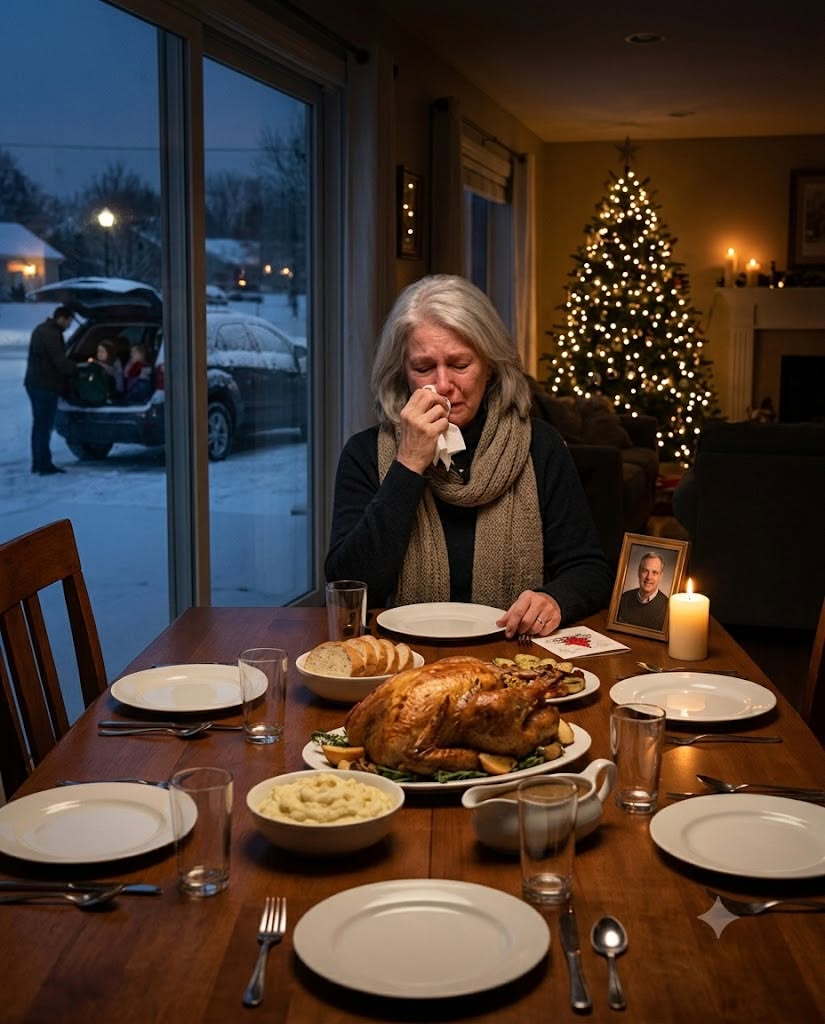
At 4:10 on Christmas afternoon, a courier handed me a manila envelope while the ham I had prepared for my son sat untouched behind me, growing cold.
“Mrs. Bennett?”
“Yes?”
He checked his phone, handed me the envelope, and hurried back toward his van without another word.
My daughter-in-law’s handwriting stretched across the front.
Inside was a single card.
Helen,
Sorry for the late change. We’re doing Christmas at Mom’s this year. It just worked out better for everyone. Hope you understand.
Merry Christmas,
Megan and Ryan
I read the final sentence twice.
Better for everyone.

Three places were set at my dining-room table. Three water glasses. Three linen napkins. Three slices of pecan pie, the kind Ryan had loved since he was eight years old.
The candles had burned nearly halfway down.
My husband, Daniel, had been dead for nine months. This was my first Christmas without him, and our only son had known for three weeks that I was counting on him to come.
I was sixty-seven years old. I had survived Daniel’s cancer, the hospital bills, the funeral home, the Social Security forms, the insurance calls, and the unbearable administrative cruelty of changing forty-six years of “Daniel and Helen Bennett” into simply “Helen Bennett.”
I could survive a canceled Christmas dinner.
What hurt was the way Ryan had chosen not to tell me himself.
He hadn’t called. Megan hadn’t texted. They had paid a stranger to deliver the news after dinner was supposed to begin.
My phone buzzed while I was still standing beside the door.
For one hopeful second, I thought Ryan was calling to explain.
Instead, it was a photograph Megan had posted online.
She and Ryan stood behind her parents’ dining table in Fox Chapel, surrounded by twenty people wearing matching holiday sweaters. Ryan had one arm around Megan’s shoulders, and both of them were smiling.
The caption read:
Christmas exactly where we needed to be. ❤️
I looked from the photograph to my own dining table.
Then I turned off my phone.
I had spent two days preparing that meal. Not because Ryan had demanded it, but because I needed something familiar to hold on to.
Daniel had always carved the ham. He had always stolen a roll before dinner and denied it with butter still on his fingers. He had always told me to wear my red dress with the pearl buttons because, according to him, it made me look “like Christmas morning.”
I had worn it that afternoon.
At four thirty, I sat alone and cut myself a piece of ham.
The glaze was perfect.
I could barely swallow.
I packed the food into plastic containers, putting away the ham, mashed potatoes, green beans, and rolls. I left the pie on the counter because putting it away felt too much like admitting that no one was coming.
Then I blew out the candles.
Daniel used to say I had a dangerous talent for explaining away other people’s behavior.
He had never meant it as a compliment.
When Ryan forgot my birthday, I said he was busy. When Megan stopped inviting us to Sunday dinners, I told myself newlyweds needed space. When they borrowed twelve thousand dollars for a kitchen renovation and took three years to repay half of it, I insisted young couples had expenses.
When Ryan began leaving our house ten minutes after Megan glanced at her watch, I pretended not to notice.
Daniel noticed everything.
“You don’t have to turn every disappointment into something reasonable,” he told me once.
“I’m keeping the peace.”
“No,” he replied. “You’re doing all the work required for other people to avoid consequences.”
I had been angry with him for saying it.
Mostly because he was right.
After Daniel died in March, Ryan visited frequently during the first month. He carried boxes, changed the furnace filters, and helped me close one of his father’s old business accounts.
Then the visits became phone calls.
The phone calls became text messages.
By autumn, most conversations began with some variation of the same questions.
“Have you decided what you’re doing with the house?”
“Did Dad leave the brokerage account in both names?”
“You should let me help organize everything before it becomes overwhelming.”
I told myself he was concerned about me.
Daniel would have rolled his eyes.
That Christmas night, Ryan still hadn’t called.
I changed out of my red dress and hung it carefully in the closet. Before closing the door, I touched one of the pearl buttons.
Daniel had fastened that same button for me before our fortieth-anniversary dinner. His hands had already begun shaking from his medication.
“Still worth the trouble,” he had murmured.
I closed the closet and went to bed.
I didn’t sleep much.
At six the next morning, I made coffee and carried it into the backyard, wearing Daniel’s old gray cardigan over my pajamas.
A hard frost covered the lawn. At the edge of the garden stood the bird feeder Daniel had built twenty years earlier. It leaned slightly to the left because he had measured one post incorrectly and refused to fix it.
“Birds don’t own levels,” he used to say.
I smiled at the memory and brushed frost from the feeder’s wooden roof.
That’s when I noticed the envelope.
It had been wedged behind one of the support beams.
My first name was written across the front.
Helen.
I recognized the handwriting before I even touched it.
Daniel.
For several seconds, I simply stood there, staring at his familiar letters.
Then I pulled the envelope free.
Inside was a single line.
Desk. Bottom drawer. Feel underneath.
I left my coffee outside and hurried into the house.
Daniel’s oak desk still occupied the small study off the kitchen. I had barely opened it since his funeral. His reading glasses lay beside an old yellow legal pad, and a mechanical pencil rested exactly where he always left it.
I pulled open the bottom drawer.
Tax files. Insurance policies. Old instruction manuals.
Nothing unusual.
Then I ran my fingers along the underside of the drawer.
Tape.
I pulled, and a second envelope came loose. A small brass key was clipped to the front.
The note inside read:
If Ryan ever makes you feel like a guest in your own life, use this.
You already own what the key opens.
You just don’t know it yet.
I sank into Daniel’s chair.
Beneath the note was a photocopy of a recorded deed.
The property was in the Laurel Highlands, a little over an hour east of Pittsburgh. I had never seen the address before.
The grantee listed on the document was:
Helen Marie Bennett.
My name.
I checked the recording stamp.
Three years earlier.
“What did you do, Daniel?” I whispered.
The empty room offered no answer.
By nine o’clock, I had packed an overnight bag and climbed into my car.
The drive east took me through bare hills and narrow roads edged with old snow. Eventually, the GPS directed me onto a gravel lane outside Ligonier.
At the end stood a cedar cabin with dark green shutters and a stone chimney.
It wasn’t a mansion or some extravagant investment property.
It was a house Daniel would have loved.
I walked onto the porch and slid the brass key into the lock.
It turned easily.

The house was cold, with the furnace set low, but familiarity greeted me the moment I stepped inside.
Daniel’s brown leather reading chair sat beside the fireplace. A quilt my mother had made was folded across the sofa. Our old kitchen table—the one Ryan had done his homework on—stood beneath a window.
Photographs lined the mantel.
Ryan at five, asleep on his father’s chest.
The three of us at Ocean City.
My parents on their wedding day.
Daniel and me standing beside our first used Buick.
I touched the back of his chair.
Then I cried.
Not because of the cabin.
Because Daniel had taken pieces of our life and built a place for me without ever telling me it existed.
On the kitchen counter sat another envelope.
Helen,
This was supposed to be your retirement place someday. I wanted to surprise you.
Then things with Ryan began worrying me, so I changed the plan.
If you’re here because you’ve been shut out, stay long enough to remember something.
Being wanted is not the same as being useful.
Love,
D.
I read it twice.
Then my phone rang.
The number was unfamiliar, and I nearly ignored it.
Something made me answer.
“Hello?”
“Mrs. Bennett? My name is Allison Pierce. I was Daniel’s estate attorney.”
I sat down.
Daniel had told me our regular lawyer was handling everything. I had never heard Allison’s name.
“I’m sorry to call the day after Christmas,” she continued. “Daniel gave me very specific instructions about when to contact you.”
My fingers tightened around his letter.
“What instructions?”
“If family circumstances changed in a way that made you question your financial security, I was to ask whether you had found the brass key.”
I stared at it on the counter.
“Yes.”
There was a brief silence.
“Then we need to meet.”
Allison’s office was in a converted brick building near downtown Pittsburgh.
She was in her early sixties, with silver-framed glasses and a calm, deliberate way of speaking. I placed Daniel’s key on her desk.
She looked at it and nodded.
“So he followed through.”
“With what?”
She opened a locked drawer and removed a thick white envelope.
“Protecting you from the one person he believed you would have the hardest time protecting yourself from.”
I already knew the answer.
I asked anyway.
“Ryan?”
Allison nodded.
Then she slid a photocopy of a check across the desk.
Eighteen thousand five hundred dollars.
My name was signed at the bottom.
I had never seen it before.
I stared at the signature. It looked close enough to mine to fool someone who didn’t know me, but the final stroke was wrong. I had always looped the last letter in my surname. Whoever had signed this check had forgotten.
“That isn’t my signature,” I said.
“I know.”
“Where did this come from?”
Allison folded her hands.
“Your son.”
For a moment, I couldn’t breathe.
She explained that the check had been drawn against an account connected to the assets Daniel had carefully arranged for my benefit. Ryan had submitted it during the weeks after his father’s death, claiming I had authorized the payment.
The bank had flagged the signature for verification.
When Allison contacted me through the information Daniel had left in her files, she discovered that I knew nothing about the transaction.
“Did he actually get the money?” I asked.
“No. The bank stopped the payment before the funds were released.”
I closed my eyes.
Relief came first, followed immediately by a deeper, more painful feeling.
My son hadn’t merely forgotten me on Christmas.
He had attempted to take money from me without my permission.
“Why would he do this?”
Allison didn’t rush to answer.
“Daniel became concerned about Ryan’s financial behavior long before he died. He asked me to review several matters privately. He wanted to ensure that your home, your savings, and the cabin could not be transferred or accessed without your authorization.”
She opened the white envelope and laid several documents on the desk.
The cabin was legally mine. Daniel had purchased it through a separate arrangement and recorded the deed in my name. He had also established safeguards around certain assets so that no one could gain control simply by claiming to be acting on my behalf.
“He didn’t tell me any of this,” I whispered.
“He wanted to surprise you with the cabin,” Allison said. “But as his illness progressed, he became worried that you might feel pressured into signing documents or giving Ryan control of your finances.”
I thought about every conversation I’d had with my son since Daniel’s death.
The questions about the house.
The requests to organize my accounts.
The way he’d begun treating my grief like evidence that I couldn’t manage my own life.
“Did Daniel know Ryan would forge my signature?”
“No,” Allison answered. “He didn’t know what Ryan might do. He simply wanted you to remain in control of your own affairs.”
She pushed another document toward me.
It was a letter Daniel had written to her several months before he died.
Helen will always look for the good in Ryan. I understand that. She’s his mother.
But she must never be made to believe that loving her son requires surrendering her independence.
I read those words through tears.
Daniel had known me better than anyone.
Even after death, he had found a way to reach me when I needed him most.
“What happens now?” I asked.
“That depends on what you want to do. We can preserve the evidence and pursue the appropriate legal steps. You can also establish new safeguards so no one can access your accounts without your direct approval.”
I looked at the forged check again.

For years, I had convinced myself that keeping the peace was the same as being a good mother.
Now I understood how much that belief had cost me.
“Do whatever is necessary to protect me,” I said. “And I want to speak to my son.”
Allison nodded.
“I’ll arrange for the bank records and the relevant documents to be preserved. You should not sign anything Ryan brings you or agree to any financial requests without independent advice.”
I thanked her and returned to my car.
Before starting the engine, I called Ryan.
He answered on the fourth ring.
“Mom? Everything okay?”
His voice was casual, as though nothing had happened.
“I need you to come to the house tomorrow.”
“Tomorrow? Why?”
“We need to talk about Dad’s estate.”
There was a pause.
“Sure. Is something wrong with the paperwork?”
“Yes,” I said. “There is.”
Ryan arrived the following afternoon with a box of pastries from a bakery near his house.
He kissed my cheek, set the box on the counter, and looked around the kitchen.
“Mom, you look tired. Have you been sleeping?”
I didn’t answer.
He pulled out a chair and sat down.
“So, what’s going on with the estate?”
I placed the photocopy of the check in front of him.
His expression changed almost imperceptibly.
“What is this?”
“An $18,500 check with my name on it.”
He glanced at the paper, then back at me.
“I don’t know.”
“Your name appears in the bank records connected to the transaction.”
He leaned back.
“Maybe Dad set something up. He had a lot of accounts. You know how complicated everything was.”
“Daniel didn’t sign this. I didn’t sign it, either.”
Ryan rubbed his forehead.
“Mom, I was trying to help you. You were overwhelmed after Dad died. I thought there might be money available to cover some expenses.”
“Then why didn’t you ask me?”
He looked away.
“I didn’t think you’d understand.”
The words struck harder than I expected.
“You didn’t think I’d understand you taking money from an account in my name?”
“I wasn’t stealing from you.”
“Then why did you use a signature that wasn’t mine?”
His jaw tightened.
For the first time, he had no immediate answer.
Finally, he said, “I needed the money.”
“For what?”
“Things have been difficult.”
“That doesn’t explain why you forged my signature.”
He stood and began pacing.
“Megan’s parents have helped us a lot. We have bills, the house, and other expenses. I thought I’d replace the money before anyone noticed.”
I looked at him, searching for the little boy who used to run into the kitchen after school and tell me every detail of his day.
I remembered how Daniel used to lift him onto his shoulders at Christmas so he could place the star on the tree.
I wanted those memories to mean that my son couldn’t have done what the evidence suggested.
But memories weren’t proof of innocence.
“You left me alone on Christmas,” I said quietly. “You couldn’t even call me yourself. And now I discover that you’ve been trying to access my money without asking.”
“Mom, Christmas has nothing to do with this.”
“It has everything to do with how you’ve been treating me.”
He sighed.
“I knew you’d make this emotional.”
I stared at him.
“No, Ryan. You made it personal when you decided that my money was yours to take and my feelings were something you could dismiss.”
He looked toward the door.
“What do you want me to do?”
“Tell the truth. Return anything you took from me. And understand that you will never again have access to my finances without my permission.”
He scoffed.
“So now you’re treating me like a criminal?”
“I am treating you like an adult who must take responsibility for his decisions.”
For a moment, neither of us spoke.
Then Ryan said, “Dad would never have wanted you to turn against me.”
I felt something inside me settle.
“Your father spent his final months making sure I would be safe, Ryan. He didn’t do that because he wanted me to turn against you. He did it because he knew I might find it difficult to protect myself from someone I love.”
Ryan’s face reddened.
“You think Dad trusted me so little?”
“I think he wanted me to have choices. And I intend to honor that.”
He left without taking the pastries.
I watched his car disappear down the street, then closed the door and locked it.
My hands were shaking, but for the first time in years, I didn’t feel compelled to call him back and make everything comfortable again.
Over the following weeks, Allison helped me secure my accounts and document what had happened. The bank completed its review, and the attempted payment was never released. Ryan was required to cooperate with the inquiry and address the matter through the proper channels.
I didn’t pretend the consequences were easy.
He sent angry messages. Megan accused me of humiliating him. A few relatives suggested that I should forgive everything because he was my only child.
I listened, but I didn’t change my decision.
Love did not require me to ignore dishonesty.
Eventually, Ryan sent me a message asking if we could talk again.
I agreed to meet him at a café, not at my house.
He arrived alone.
For a long time, he stared at his coffee before speaking.
“I know I handled things badly.”
“Badly is one way to describe it.”
He winced.
“I was scared. After Dad died, everything felt different. The expenses kept coming, and I thought there would be more money available than there was.”
“Then you should have spoken to me.”
“I know.”
I waited.
He finally looked up.
“I’m sorry I left you alone on Christmas.”
It wasn’t the apology I had once imagined receiving, but it was the first time he had acknowledged the hurt without blaming the circumstances.
“I needed you that day,” I told him. “I wasn’t asking you to fix my life. I just wanted my son to sit at the table with me.”
His eyes filled with tears.
“I should have come.”
“Yes,” I said. “You should have.”
We didn’t hug. We didn’t pretend everything had been repaired by a few words.
I told him that if we were going to rebuild our relationship, it would have to begin with honesty, respect, and time.
He agreed.
I couldn’t know whether he would keep his promises. I could only decide what I would accept going forward.
And that was enough for now.
By February, I had begun spending more time at the cabin.
I raised the thermostat, stocked the pantry, and brought Daniel’s favorite books to the shelves beside his chair. I hung the red Christmas dress in the bedroom closet, where the morning sunlight touched its pearl buttons.
One afternoon, I found a small notebook tucked inside the desk.
On the first page, Daniel had written a list of things he wanted us to do when we retired.
Walk the trails.
Learn to make bread.
Watch the sunrise without checking the time.
Invite friends for dinner.
Take the long road home.
At the bottom, he had added one final sentence.
Make sure Helen remembers that her life belongs to her.
I sat in his chair and held the notebook against my chest.
For months, I had thought my first Christmas without Daniel was the beginning of a life in which I would always be the person left behind.
But he had left me more than a cabin, a brass key, and protection from a financial betrayal.
He had left me a reminder that I was still allowed to choose what happened next.
The following Christmas, I cooked dinner at the cabin.
I set the table for one, then paused and added a second place—not because I was waiting for someone to prove I mattered, but because I wanted to leave room for the possibility of a better future.
Ryan called that afternoon.
“Mom, can I come over?”
I looked through the window at the snow settling over the trees.
“Not today,” I told him gently. “But we can arrange another day.”
He was quiet for a moment.
“Okay. Merry Christmas, Mom.”
“Merry Christmas, Ryan.”
After we hung up, I carried my plate to Daniel’s old chair and sat beside the fire.
The cabin was warm. The food smelled wonderful. Outside, birds gathered around the feeder Daniel had built years ago.
I no longer needed to wait by the window for someone else to decide whether I deserved to be remembered.
My husband had spent his final years trying to teach me something I