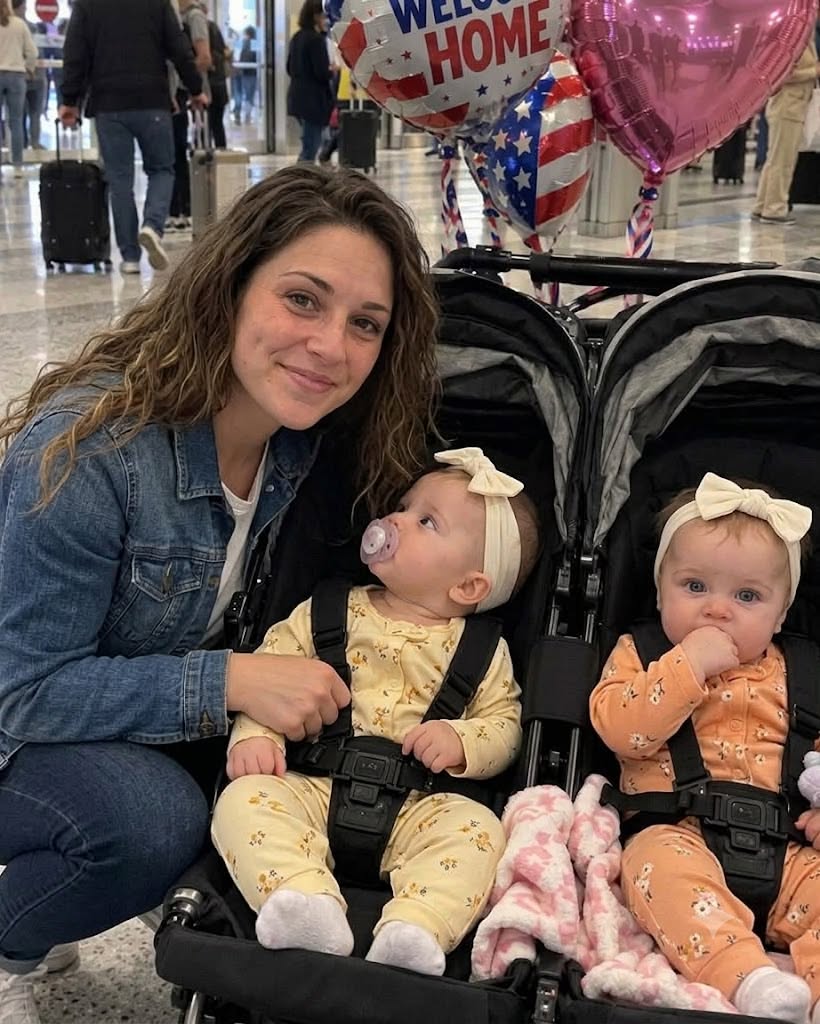
My husband has never held our daughters.
They were born in March while he was away on deployment. He’s only seen them through a laptop screen, with the sound constantly cutting out. He’s told me the hardest part isn’t the heat or the long hours—it’s knowing they’ll recognize his voice before they ever recognize his face.
He was supposed to come home Tuesday.

About nine hours earlier, he called from the airport overseas. He was waiting at the gate, ready to board.
“I miss you so much. I can’t wait to meet my little girls.” He laughed. “Though apparently, they’re not so little anymore.”
Then he apologized again, just as he had a hundred times before. “I’m so sorry I wasn’t there.”
I told him to stop apologizing. All that mattered was that he was coming home. His three girls were waiting for him.
He sent me a video of himself boarding the plane. I’ve watched it more times than I’d like to admit.
I barely slept Monday night. I dressed the twins in the outfits his mother had sent, the ones that read DADDY’S HOME. Three balloons were tied to their stroller.
I tracked his flight the entire way, watching the little plane move across the map on my phone.
Then the screen displayed LANDED.
Passengers began pouring through the arrivals gate. A woman beside me screamed and ran toward a young man in uniform. The whole hall erupted in applause.
Then someone tapped my shoulder and called my name.
I turned around, but it wasn’t him.
It was a soldier in dress uniform, carrying no bag.
“Sorry,” I said. “I think you’ve got the wrong person.”
“You’re here for Jeremy?”
“Yes. He’s my husband.”
“He’s not coming.”
I actually laughed. I’d been tracking his flight all night. He’d even sent me a video of himself boarding.
“Ma’am, he was never on that flight. You need to go home immediately.”
“What did you just say?”
I turned and looked at him properly.
I looked at him properly, searching his face for an explanation that would make any of this make sense.
“Please tell me my husband is alive,” I whispered.
The soldier’s expression softened.
“Jeremy is alive. My name is Daniel. We served together, and he asked me to find you.”
“Then why isn’t he here?”
Daniel glanced at the twins. Their matching pink outfits and tiny balloons seemed to make the words he needed to say even harder.
“Your husband was injured six weeks ago. He’s been receiving medical treatment, and things haven’t gone the way he hoped.”
My grip tightened around the stroller.
“What kind of injury?”
“His back and legs were affected. He’s using a wheelchair right now.”
For a moment, I couldn’t speak.
I remembered all our video calls. Jeremy always sat propped against pillows, framing the camera so I could only see him from the chest up. Whenever I asked him to show me around his room, he changed the subject or made a joke.
I’d thought he was simply tired.
Now I understood there had been something he was desperately trying to hide.
“He told me he was coming home today,” I said.
“He planned to. He boarded his first flight, just like he showed you in that video. But when he reached the connecting airport, his condition worsened. The medical team took him to a hospital before he could board the next plane.”
“Why didn’t he call me?”
Daniel looked down.
“At first, there was an emergency. Afterward, he was ashamed. He thought he would be able to recover before coming home, and he didn’t want you to see him like this.”
I stared at him, struggling to understand how my husband could believe I would rather have him missing than injured.
“Where is he now?”
“He’s being transferred to a rehabilitation facility nearby. The doctors have approved the journey, and he should arrive this evening.”
“Then take me there.”
“Jeremy asked me to bring you home instead.”
I almost laughed again, but there was nothing funny about it.
“I came here believing my husband was finally coming home to meet his daughters. When you touched my shoulder, I thought he was dead. And now you’re telling me he doesn’t even want to see me?”
“That’s not what he wants,” Daniel said quietly. “He’s frightened. I think he believes he’s protecting you.”
“He’s not protecting me. He’s leaving me alone with questions I can’t answer.”
Daniel lowered his head.
“You’re right. I’m sorry I didn’t tell you he was alive first.”

I looked at my daughters. One had begun crying, and the other soon followed. I bent over the stroller, trying to soothe them with hands that wouldn’t stop shaking.
Their father was alive.
That was the only fact I could hold on to.
I refused to go home.
Instead, Daniel took us to the rehabilitation facility and helped me settle into a family room while we waited for Jeremy’s medical transport.
The hours dragged on. I fed the girls, changed their diapers, and watched them sleep. Every few minutes, I checked my phone, hoping Jeremy would call.
He didn’t.
I kept remembering the night our daughters were born. I’d been exhausted and frightened, holding two tiny babies while a phone rested beside my pillow. When Jeremy finally saw their faces on a video call, he’d cried so hard he could barely speak.
He had promised that missing their birth wouldn’t mean missing every other first.
I’d believed him.
By evening, Daniel returned and told me Jeremy had arrived.
We walked down a quiet hallway to his room. Before opening the door, Daniel paused.
“He’s scared,” he warned me.
“So am I.”
I heard Jeremy’s voice from inside.
“I told you not to bring her. I just needed another week.”
Another week.
After nine months apart, he still thought he needed to hide from me.
I pushed the door open.
Jeremy sat on the edge of a hospital bed. He looked thinner, and the shadows beneath his eyes made him seem older. A wheelchair stood beside him.
When he saw me, he froze.
Then his gaze shifted to the stroller.
Our daughters were sleeping peacefully, their little fists curled beside their faces.
Jeremy covered his mouth.
“They’re real,” he whispered. “They’re really here.”
He reached toward them, but then looked down at his legs and pulled his hand back.
That small movement broke my heart more than anything Daniel had told me.
“Jeremy,” I said.
“I’m sorry.”
I had heard those words so many times that I couldn’t bear to hear them again.
“Please stop apologizing. I don’t need another apology. I need my husband.”
His eyes filled with tears.
“I wanted to walk through those doors and pick them both up. I wanted to hold them without needing someone to help me. I thought I’d be better by now.”
“You don’t have to be better to be their father.”
He shook his head.
“You don’t understand. I promised myself I’d never become my father.”
Jeremy rarely talked about his father. I knew there had been an accident when Jeremy was seven, leaving his father dependent on a wheelchair. Afterward, his father had withdrawn from the family, and Jeremy had grown up believing he no longer wanted to be part of his son’s life.
“I remember taking him a wooden airplane we’d been building together,” Jeremy told me. “I wanted us to finish it. He told me to go away.”
He tried again the following week, then the week after that. Eventually, he stopped knocking on his father’s door.
“I thought he didn’t want me anymore,” Jeremy whispered. “And now I can’t even walk across a room to hold my own children.”
I sat beside him and took his hand.
“Your father hurt you by shutting you out. But now you’re doing the same thing to us.”
His face crumpled.
“I know.”
I wrapped my arms around him. He buried his face against my shoulder, holding me as tightly as he could.
For the first time in nine months, I felt his arms around me.
I didn’t pretend everything was suddenly fine. His secrecy had hurt me, and we would have to talk about it. But he was here, alive, and I wasn’t going to let fear keep us apart any longer.
A nurse helped Jeremy settle safely into his wheelchair. Then, with my assistance, he held one of our daughters against his chest.
He stared at her tiny face as though he were afraid the moment might disappear.
“I’ve been waiting for you,” he whispered.

She began to cry.
Jeremy panicked, but I encouraged him to sing the silly little song he’d sung during our video calls. He started softly, his voice trembling.
Gradually, our daughter settled against him.
“She knows my voice,” he whispered in amazement.
“Of course she does.”
When her sister woke, he laughed through his tears.
“That’s my other girl?”
“That’s your other girl.”
For the first time, he held both daughters close, one after the other, learning their expressions and the little sounds they made.
But our family still had one painful mystery to unravel.
The next morning, I called Jeremy’s mother and asked about his father. When I mentioned the wooden airplane, she fell silent.
Then she told me something Jeremy had never known.
His father had finished building that airplane after Jeremy stopped visiting his room. He had kept it carefully wrapped away with Jeremy’s childhood belongings.
“He asked about Jeremy every Saturday,” his mother explained through tears. “He thought his son no longer wanted him. He was ashamed of needing help and didn’t know how to reach out.”
I found the airplane among Jeremy’s belongings. Its wings were smooth, its wooden tail carefully polished. When I turned it over, I discovered a message carved underneath.
FOR JEREMY. ALWAYS DAD.
That afternoon, I brought it to the rehabilitation center.
Jeremy stared at the airplane in disbelief. When I told him his father had finished it and had continued asking about him, his hands began to tremble.
“He thought I didn’t want him,” he whispered.
“And you thought he didn’t want you,” I replied.
He pressed the airplane against his chest and cried.
For years, both father and son had lived with the same heartbreak, each believing the other had closed the door.
Jeremy looked at our daughters.
“I almost did the same thing to them.”
“Then don’t,” I told him.
Recovery wasn’t immediate. There were difficult appointments, painful exercises, and days when Jeremy struggled to accept how much help he needed. But he stopped hiding from us. He learned to tell me when he was frightened instead of pretending everything was fine.
Eventually, he came home in his wheelchair.
We took the family photograph we’d imagined for months. Both girls rested in his arms, their matching outfits now a little too small. His wheelchair was visible, and the wooden airplane sat on the table beside him.
That night, one of our daughters woke crying.
Before I could get out of bed, Jeremy rolled over to her crib.
“I’m here, sweetheart,” he whispered, beginning to sing.
She quieted at the sound of his voice.
I watched from the doorway, remembering the airport, the three balloons, and the terrible moment when a soldier told me my husband wasn’t coming.
For nine months, Jeremy had feared our daughters would know his voice before they knew his face.
Now, his voice was the sound that comforted them.
And when they needed their father, he was finally there.