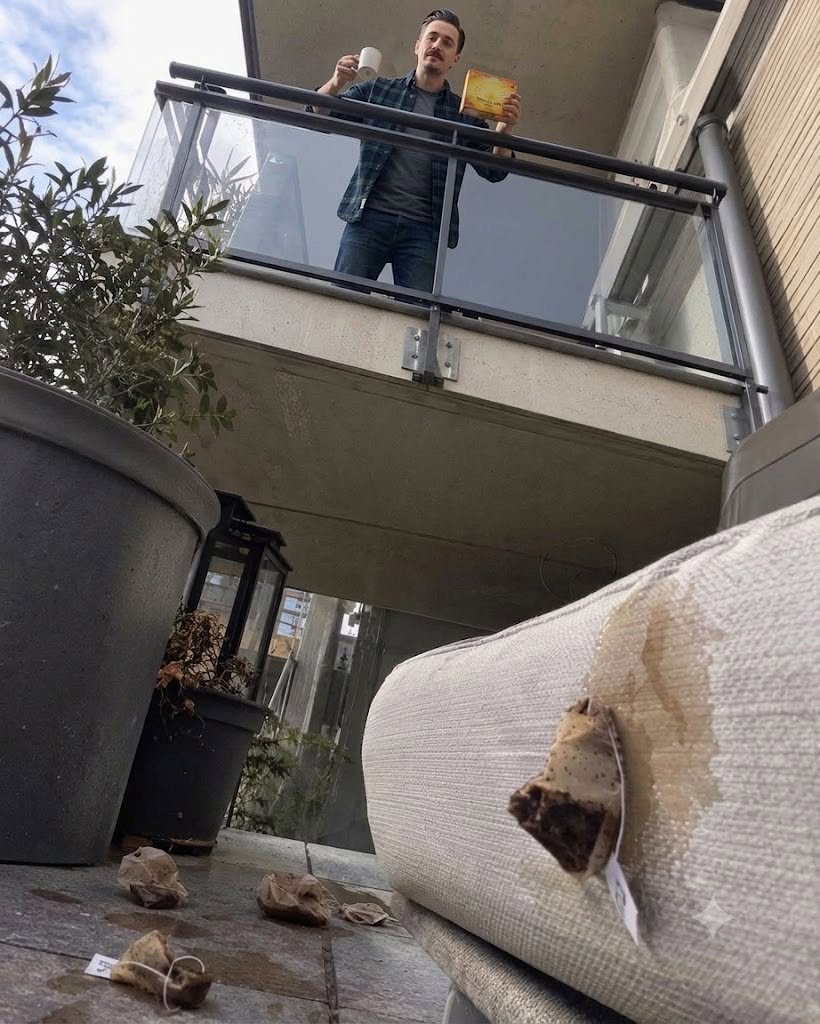
My upstairs neighbor threw his used tea bags over his balcony twice a day, and somehow, they always landed on mine.
Every morning around seven. Every evening around nine.
You could practically set a clock by it.
The first time, I assumed it was an accident.
I picked it up, threw it in the bin, and said nothing.
The following week, I found one sitting on a white bath towel I’d hung out to dry. It had left a brown stain right in the middle, about the size of a coffee cup.

That was when I went upstairs and knocked on 4B.
“Oh, no. Was that me?”
“It’s been about six of them now.”
“I’m so sorry. I’m half asleep in the morning. I just flick it over the rail without thinking.”
He actually seemed embarrassed.
He apologized, promised it wouldn’t happen again, and I went back downstairs wondering if I’d made too much of a fuss.
Then another one landed on my balcony the very next morning.
I still gave him three more weeks.
I’d lived in this building for eleven years, and I’d never been the woman who complained about every little thing.
Then one evening, a tea bag landed directly on the cushion of my chair. It sat there long enough to soak through the fabric.
That was it.
I went upstairs and knocked again.
“You’re still doing it.”
“It’s a tea bag.”
“It stains. I’ve already thrown out a towel, and now I’ve ruined a cushion cover.”
He leaned against his door frame and stared at me for a moment.
“You live underneath. That’s how buildings work.”
Then he laughed.
“You’re lucky it’s tea bags and not something else.”
“Excuse me?”
“I’m just saying. Be glad it’s tea.”
And with that, he shut the door.
I stood there on the landing for a full minute.
Eleven years in this building.
I’d watched people’s cats. I’d signed for his packages all last winter.
And suddenly, I understood exactly what he wanted.
He wanted me to lose my temper on the landing at nine at night so he could tell everyone about the woman downstairs who’d completely lost it over a tea bag.
So I gave him one last chance.
I decided that if nothing came over the railing the next morning, I’d let the whole thing go.
At 7:04, the tea bag came flying over.
It landed beside my plant pots, exactly where they always did.
I stood there in my robe, staring at it for a long time.
By the time I’d finished my coffee, I knew exactly what I was going to do.
It took me one afternoon.
The next morning, I was already sitting on my balcony before seven, coffee in hand, completely quiet in my chair.
I was waiting for him to come outside with his tea.
At 7:02 a.m., I heard his sliding door open.
Footsteps moved across the balcony above me.
Then came the faint scrape of a chair.
I took another sip of coffee and waited.
At 7:04 a.m., something dark appeared over the railing.
The tea bag dropped.
But this time, it didn’t land on my balcony.
It hit a clear plastic panel I’d installed above the part of my balcony where most of his tea bags usually fell.
Tap.
The bag slid down the angled surface and dropped neatly into a shallow tray underneath.
I smiled.
“Morning.”
For a few seconds, there was no response.
Then Greg’s head appeared over the railing.
He looked down at me.
Then he looked at the clear panel.
“What the hell is that?”
“My new tea-bag catcher.”
“What?”
I pointed at the tray.
“Works pretty well.”
He leaned farther over.
“You built that because of a tea bag?”
“No. I built it because of 43 of them.”
His expression changed.
“You’re counting them?”
“I started after our first conversation.”
“That’s insane.”
“Throwing garbage onto somebody else’s balcony twice a day is pretty strange too.”
“It’s tea.”
“Yes, Greg. We’ve established that.”
He disappeared from view.
A moment later, his balcony door slammed.
I finished my coffee in peace.
The panel wasn’t anything fancy. I’d bought a clear sheet, a lightweight frame, and a few brackets that didn’t require drilling into the exterior wall.
Before installing it, I’d checked the building rules.
Twice.
Everything stayed within my balcony space. Nothing extended above his floor, and nothing blocked anyone’s view.
If Greg stopped throwing things, the panel would have absolutely nothing to do.
That evening, I sat outside again.
At 9:06 p.m., his door opened.
I waited.
Nothing happened.
For one glorious second, I thought my ridiculous invention had worked.
Then a tea bag sailed past the edge of the panel and landed directly inside my largest plant pot.
I stared at it.
Then I looked up.
Greg’s balcony door slid shut.
That was when I stopped wondering whether the tea bags were accidents.
He had aimed.
I took out my phone and photographed the tea bag exactly where it had landed.
Then I took another picture showing the panel beside it.
The next morning, another tea bag landed beyond the opposite edge.
I took a photo.
That evening, one hit my glass balcony door.
Another photo.
By the following morning, I had four pictures showing tea bags in places they had never landed before.
Apparently, once I’d made it harder for Greg to drop his garbage straight down, he’d decided to improve his aim.
What he didn’t realize was that he was helping me.
Until then, he could always claim carelessness.
Now he was proving intent.
I created a folder on my phone and added every photograph I’d taken over the previous weeks.
The stained towel.
The ruined cushion cover.
The tea bags beside my plants.
The new ones thrown around the panel.
I added dates and approximate times.
Then I emailed myself a summary of both conversations I’d had with Greg while everything was still fresh in my memory.
I didn’t contact management yet.
I wanted to see what Greg did next.
I didn’t have to wait long.
Saturday morning, someone knocked on my door.
I opened it.
Greg stood there in sweatpants, his arms folded.
“Take that thing down.”
“Good morning to you too.”
“I’m serious.”
“So am I.”
He pointed toward my balcony.
“That plastic thing. Take it down.”
“Why?”
“It looks ridiculous.”
“From where?”
“What?”
“You can’t see it unless you’re leaning over my balcony.”
“People can see it from outside.”
“Then they’ll probably assume I’m having a problem with falling objects.”
His mouth tightened.
“You can’t just install things on the building.”
“I checked.”
“With who?”
“The building rules.”
“That’s not a person.”
“No, but they’re surprisingly informative.”
“You’re doing all this over tea bags.”
“No. I’m doing this because asking you nicely didn’t work.”
“I told you, I don’t think about it.”
“Interesting.”
“What?”
“You’ve suddenly gotten very good at throwing them around the panel for someone who doesn’t think about it.”

His face changed.
“Maybe that’s where they fall.”
“They never fell there before.”
He shrugged.
“Fine. I’ll just throw them farther.”
For a second, neither of us spoke.
Then a voice behind him said,
“That’s probably not going to help your argument.”
Greg turned.
Mrs. Alvarez from across the hall was standing beside her door with a reusable shopping bag over one shoulder.
She’d apparently come home at exactly the right moment.
Greg looked from her to me.
“I was joking.”
Mrs. Alvarez raised an eyebrow.
“It didn’t sound very funny.”
He turned back to me.
“Just take the stupid thing down.”
“No.”
His jaw tightened.
Then he walked upstairs.
Mrs. Alvarez waited until his footsteps disappeared.
“Does he really throw tea bags down there every day?”
“Twice.”
“Every day?”
“Pretty much.”
She shook her head.
“Why?”
“I’ve been trying to figure that out for a month.”
She looked toward the stairs.
“Let me know if you need me to tell anyone what I just heard.”
That was the moment my little plan became much simpler.
“Actually,” I said, “I might.”
The following Wednesday, our building held a residents’ meeting.
Usually, I skipped them unless something important was being discussed.
That week, I arrived ten minutes early.
I had a folder.
Inside were printed photographs, copies of the replacement costs for the towel and cushion cover, and a written timeline.
I also brought one more thing.
A clear container.
Inside were the tea bags I’d collected from the tray and balcony over the previous days after allowing them to dry.
I wasn’t planning to dump them dramatically onto a table.
I wasn’t trying to turn myself into the star of a courtroom show.
I simply wanted one thing Greg had repeatedly dismissed as insignificant to become visible.
He arrived several minutes later.
His eyes found the container almost immediately.
“What is that?”
I smiled.
“You know what it is.”
“You kept them?”
“You kept giving them to me.”
Mrs. Alvarez covered a smile.
Greg sat down.
When it was my turn to speak, I kept it simple.
I explained that used tea bags had been coming from the balcony directly above mine twice a day for several weeks.
I explained that I’d spoken to Greg twice.
Then I showed the photographs.
The building manager, Mr. Lewis, studied the picture of my towel.
“That came from upstairs?”
“Yes.”
Greg leaned forward.
“It’s a tea bag.”
Mr. Lewis looked at him.
“It’s still your garbage.”
“Garbage is a little dramatic.”
“What would you call something you’ve finished using and thrown away?”
Greg didn’t answer.
I showed the cushion cover next.
Then the photographs taken after I installed the panel.
Mr. Lewis frowned.
“Why are these landing farther out?”
I looked at Greg.
He shifted in his chair.
“They fall where they fall.”
I slid another photograph across the table.
“For weeks, they landed almost directly below his railing. After I installed the panel, they started landing around both sides of it.”
“That’s ridiculous,” Greg said.
Mrs. Alvarez spoke from two seats away.
“I heard him tell her he’d throw them farther.”
Greg turned.
“I was joking.”
“You didn’t sound like you were joking,” she replied.
Mr. Lewis looked at him.
“Did you say that?”
Greg sighed.
“This whole thing has gotten completely out of proportion.”
“Did you say it?”
“Yes, but I was frustrated.”
Mr. Lewis sat back.
“Then this isn’t really about accidentally dropping something anymore.”
For the first time since I’d knocked on Greg’s door weeks earlier, he didn’t have an answer.
The building rules were straightforward.
Residents weren’t permitted to throw objects, liquids, cigarette butts, food waste, or anything else from balconies.
Mr. Lewis explained that it wasn’t merely about staining someone’s furniture.
Something thrown from an upper floor could hit a person below.
Greg tried once more.
“They’re wet tea bags, not bricks.”
Mr. Lewis nodded.
“And the rule doesn’t say residents may throw things as long as they’re soft.”
I almost smiled.
Greg didn’t.
He received a formal written warning.
He was also told that another documented incident could lead to further action under the building rules.
Then Mr. Lewis asked about my damaged things.
I showed him what replacing the towel and cushion cover had cost.
The amount wasn’t enormous.
That wasn’t the point.
Greg looked at the paper.
“You seriously want me to pay for that?”
“You ruined them.”
“The towel could’ve been washed.”
“I tried.”
“It’s a stain.”
“On my property.”
Mr. Lewis interrupted before we could go in circles.
“You’ll reimburse her.”
Greg leaned back.
He looked furious.
Then came the part I hadn’t expected.

Greg had recently requested permission to attach privacy screening around his balcony.
Mr. Lewis had apparently been reviewing the request.
He closed Greg’s paperwork.
“For now, I’m not approving additional balcony fixtures while there’s an active warning involving your use of that balcony.”
Greg stared at him.
“You’re denying it because of tea?”
“I’m postponing it because you’ve admitted deliberately throwing items from your balcony after another resident asked you to stop.”
That finally silenced him.
The meeting ended twenty minutes later.
I packed my photographs away.
Greg left before I did.
I thought that would be the end of it.
It wasn’t.
The following afternoon, he caught me near the mailboxes.
“You could’ve just asked me to stop.”
I genuinely thought I’d misheard him.
“I did.”
“You know what I mean.”
“No, actually, I don’t.”
“You didn’t have to involve management.”
“I asked you twice.”
“It was a tea bag.”
“And you were asked to stop throwing them.”
He glanced toward the lobby doors.
“You made me look like an idiot over tea.”
I shook my head.
“No. I showed them what you were doing. You handled the rest yourself.”
His face reddened.
“You’re enjoying this.”
“No.”
And I meant it.
I hadn’t enjoyed losing a towel.
I hadn’t enjoyed replacing a cushion cover.
I hadn’t enjoyed checking my chair before sitting down because I didn’t know what had been thrown onto it.
Mostly, I hadn’t enjoyed being told that because I lived underneath him, I should simply accept whatever came over his railing.
“I wanted you to stop,” I said. “That’s all.”
He looked away.
Then he walked upstairs without another word.
The next morning, I woke at 6:55 a.m.
I made coffee.
At 6:58, I carried it onto the balcony and sat down.
Seven o’clock.
Nothing.
7:02.
Still nothing.
At 7:04, I heard Greg’s balcony door slide open.
I waited.
Footsteps crossed above me.
I looked toward the clear panel.
Nothing fell.
A few seconds later, his door closed again.
I smiled into my coffee.
That evening, I went outside shortly before nine.
Again, I heard him above me.
Again, nothing came over the railing.
The next morning was the same.
After four days, I took the panel down.
My balcony looked normal again.
My plants were safe.
My new cushion cover stayed clean.
More importantly, I stopped looking up every time I heard his door open.
A week later, someone buzzed my apartment.
It was a delivery driver.
“I’ve got a package for 4B. No one’s answering. Do you mind taking it?”
For a second, habit almost made me say yes.
I’d signed for Greg’s packages throughout the previous winter.
Sometimes two or three a week.
Then I remembered his voice.
“You live underneath. That’s how buildings work.”
“Sorry,” I said. “He’ll have to collect it himself.”
“No problem.”
That evening, I met Greg in the hallway.
“They said you wouldn’t take my package.”
“That’s right.”
He frowned.
“You always used to.”
“I did.”
“So now you’re refusing my deliveries too?”
“I’m not refusing anything. Your deliveries aren’t my responsibility.”
He stared at me.
I unlocked my door.
Before stepping inside, I looked back at him.
“I used to do favors for a neighbor who respected my home.”
For once, Greg had absolutely nothing to say.
I went inside and closed the door.
The funny thing is, I never wanted a feud.
I still don’t.
If Greg asks me to hold the elevator, I’ll hold it.
If there’s a fire alarm, I’ll knock on his door like I’d knock on anyone else’s.
But I finally understood something I’d spent eleven years avoiding.
Being a good neighbor doesn’t mean accepting bad behavior just to keep things peaceful.
Sometimes keeping the peace only teaches another person that you’ll tolerate whatever they do.
Greg expected me to lose my temper.
Instead, I kept receipts.
I took photographs.
I learned the rules.
And I let his own behavior explain the rest.
The following Saturday, I sat outside with my coffee at 7:04 a.m.
Nothing came over the railing.
No wet tea bag.
No brown stain.
Just my plants, my chair, and a balcony that finally felt like mine again.